Performances
Relic presents lively Latin-American dances but it’s not opera, Doc
Imagine attending a performance billed as La Traviata and seeing, instead […]
The Sebastians open season with a buoyant concerto feast
Born in the Baroque and carried into the Classical era, the […]
Philharmonic enjoyably brushes up a colorful program for European tour
Next week, the New York Philharmonic, conductor Gustavo Dudamel, and some […]
From scenic folksong to Mendelssohn, Camerata Nordica impresses at Carnegie
It would be easy to underestimate the Camerata Nordica octet. Here […]
Horszowski Trio in synch with Village Trip’s New York state of mind
The Village Trip Festival, which opened last week, celebrates the artistic […]
Articles
Top Ten Performances of 2025
1. Mahler: Symphony No. 7. Gustavo Dudamel/New York Philharmonic Gustavo Dudamel […]
Critic’s Choice
Music of Prokofiev, Still, Ginastera, Blache. Sphinx Virtuosi. October 17. The […]

Concert review
Neuwirth’s remarkable score well served live by Parlando with “Die Stadt ohne Juden”
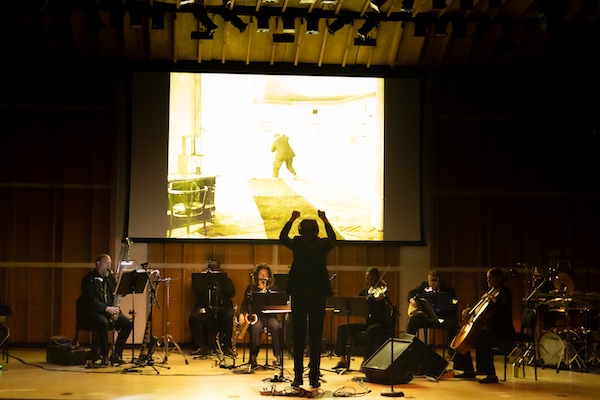
Musicians are, in a sense, archaeologists, often mining the past. Most generally follow well-trodden paths, but Ian Niederhoffer and Parlando tend to venture further afield.
The 1924 film Die Stadt ohne Juden (The City Without Jews) was first screened in New York in 1928 and has been shown here several times since. What set this screening apart was Parlando’s pairing of the film with Olga Neuwirth’s 2018 score, presented Sunday afternoon at Merkin Hall as the opening concert of the season.
Before it became a film, Die Stadt ohne Juden was a satirical novel by Hugo Bettauer, a bestseller considerably more successful than Hans Karl Breslauer’s filmic adaptation. Antisemitism was a highly charged political issue in post-World War I Vienna. Bettauer imagined the government expelling Vienna’s Jews, only to see the city’s economy and cultural life collapse. When they are eventually invited back, Vienna recognizes how deeply it had depended on the people it drove away.
Contemporary audiences could scarcely have imagined how horrifyingly prophetic the premise would prove. In the early 1920s, the Nazi Party was still a fringe movement, but its antisemitic propaganda and capacity for political violence were becoming increasingly apparent. Hitler’s failed Beer Hall Putsch in 1923 led to his imprisonment the following year.
By the time Breslauer made the film, Austria’s political climate had grown more volatile, with the Austrian Nazi movement increasingly assertive. He changed the setting from Vienna to the fictional city of Utopia and softened some of Bettauer’s sharper political material. Most notably, the film ends on a more conciliatory note. After the disastrous consequences of the expulsion, the Jews are welcomed back, but other scapegoats, including the international banking system, remain.
The fates of its creators further color a 21-century audience’s perception of the film. Bettauer would not live to see the horrors his novel anticipated. Less than a year after the film’s premiere, he was assassinated in Vienna by Otto Rothstock, a young National Socialist. Rothstock was convicted but released after being declared mentally unfit. He remained an unrepentant Nazi until his death in 1977.
Die Stadt ohne Juden was Breslauer’s last film. He joined the Nazi Party in 1940 and, after the war, lived in relative obscurity, dying in poverty in 1965.
Niederhoffer, for whom context is important, provided it in a brief introduction. After which, he let the film and music speak for themselves. They did so with undeniable power.
Neuwirth’s music is rarely heard in New York, at least by the standards of a composer of her stature. She was in the international spotlight earlier this year with the politically charged Monster’s Paradise, her new opera with Nobel laureate Elfriede Jelinek, which premiered in Hamburg and subsequently traveled to Zurich.
Die Stadt ohne Juden, however, has a particularly personal resonance for her. Its vision of a Vienna purged of Jews intersects with Neuwirth’s own family history: she comes from a Viennese family with Jewish roots, some of whose members concealed their identity during the Nazi era.
Neuwirth is a stylistic nomad, moving freely among contemporary classical music, jazz, popular culture, and the sounds of cinema. Her score is an unsettling collage of styles and sonorities. Although set for a small amplified ensemble of flute, clarinet, saxophone, trumpet, trombone, electric guitar, viola, cello, keyboard, and percussion, augmented by prerecorded segments and electronics, the listed instruments hardly convey the range of her sonic palette. It expanded exponentially through multiple clarinets and saxophones, 16 different keyboard sounds, and an eccentric assortment of sound-making objects, including Styrofoam blocks and a milk frother.
These resources produce a fractured sonic world in which Klezmer inflections, Viennese and Alpine references, cabaret, and folk music rub against ominous electronic drones and more abrasive contemporary sounds. There are also distorted paraphrases of Elgar’s “Pomp and Circumstance” March No. 1 and Strauss’s Also sprach Zarathustra.
The music cannot compete with the film’s most prescient scenes, in which Jews are forced from their homes, loaded onto trains, or seen marching out of Utopia. Instead, Neuwirth creates an atmosphere that allows the images to resonate without adding unnecessary weight. There is scant humor, but demagoguery prompts squawks, underscored by mocking quotations from Strauss’s Also sprach Zarathustra. Only in the romantic scenes between Jewish and Aryan couples does she lean into sentiment, and even there it comes with an edgy, triumphal bite.
Wearing headphones, Niederhoffer served as both conductor and sound engineer. His coordination was as exacting as his attention to the score’s acoustical details. The musicians performed with commitment and precision, with film and music creating an emotionally charged experience shot through with an uncanny sense of familiarity.
Parlando continues with “Cowboy Nations” 7:30 p.m. December 4 at Merkin Hall. parlandonyc.org
Calendar
October 6
Graphic Content Festival
Roberta Michel, flutist
Matt Mitchell, pianist […]
News
Critic’s Choice
Music of Morton Feldman and Earle BrownGraphic Content FestivalSeptember 11-November 21 […]
A complete Ring and Mahler cycle to highlight Carnegie Hall’s 2026-27 season
Carnegie Hall’s 2026-2027 schedule promises some of the most substantial and […]