New supporting cast helps Met’s “Butterfly” take wing
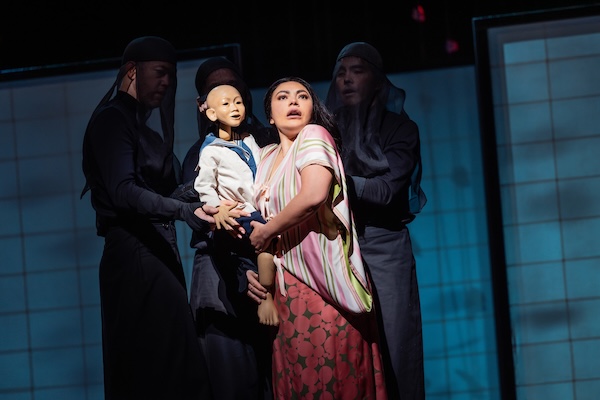
Apart from Wagner’s Tristan und Isolde, it is back-to-basics month at the Metropolitan Opera with a steady diet of Madama Butterfly and La Traviata, which suits many opera-goers just fine. And so it should, especially with the opportunity to experience Ailyn Pérez’s sensitively sung and superbly acted Cio-Cio-San, which launched the spring run of the Puccini favorite on Tuesday evening.
Now in its 20th season, Anthony Minghella’s 2006 production of Madama Butterfly still retains its beauty, freshness, and power. Brightly colored costumes compete with traditional Japanese aesthetics in a minimalist staging that suspends time. Employing a puppet to portray Trouble, Cio-Cio-San, and Pinkerton’s son, underscores that the boy will be a misfit regardless of whether he is raised in Japan or America. Few visual elements are as graceful as the airborne lanterns or origami doves drifting across the stage, nor as effective in conjuring tragedy as the streams of brilliant red cloth that spill from Cio-Cio-San in the final moments of the opera.
Pérez sang her first Met Butterfly in January and is reprising the role due to Sonya Yoncheva’s withdrawal from the run. Cio-Cio-San is one of Pérez’s finest, if not the best, achievements of her Met career to date. Her acting is as detailed and carefully etched as her singing. Neither became mannered nor distracting, because Pérez strives for authenticity and spontaneity at all times.
In the opening scenes, Pérez’s singing is clipped, almost infantile, but her voice blooms radiantly in the love duet with Pinkerton as they prepare to spend their first night together. “Un bel dì, vedremo” began as a soft, shimmering legato line, which gradually increased into a stream of molten sound, throbbing with a fierce, glorious intensity, as she expressed Butterfly’s certainty that Pinkerton will return.
Pérez rendered her benediction and hopes for happiness on Kate Pinkerton with nobility and warmth in one of the opera’s most profound scenes. While searing in its intensity, her final scene also contained moments of deep tenderness, as Butterfly bid farewell to her son, explaining she must die so he can live without the shame of her abandonment of him. The aria was as searing emotionally as it was moving in its tenderness.
Adam Smith made a praiseworthy house debut as B.F. Pinkerton, neither garnering nor eliciting sympathy as the callous U.S. Navy officer. Insensitivity came as naturally to Smith’s Pinkerton as did the lust which poured out of him as he anticipated his wedding night. Adam’s tenor, like Pérez’s voice, is essentially lyrical in nature, but easily lends itself to verismo roles. He has an impressive sound, which carries effortlessly into the house and imbues Puccini’s soaring lines with power and brilliance. Smith’s return as Rodolfo in La Bohème later in the season is something to look forward to.
Cio-Cio-San describes Sharpless as the kindest man on earth, and Quinn Kelsey embodied her appraisal. This was pure luxury casting, with the baritone’s deluxe voice enriching every scene, as did the compassion he lent to the put-upon U.S. Consul. Jennifer Johnson Cano’s Suzuki was dignified and subdued, which, combined with her compelling mezzo-soprano, lent unusual gravitas to the role. As lovely as she sounded when paired with Pérez in the Flower Duet, she was even more impressive in the Act III trio with Pinkerton and Sharpless.
Tony Stevenson’s Goro was appropriately sniveling and self-serving, whether revealing the mysteries of a Japanese home to Pinkerton or conniving to have Butterfly marry Prince Yamadori. That wasn’t in the cards, but Jeongcheol Cha’s Yamadori was an imposing, dignified man who engendered a modicum of sympathy. In the brief time she was on stage, Hannah Jones’ alluring dark voice and stoic presence effectively summoned Kate Pinkerton’s confusion and empathy over Butterfly’s plight.
Carlo Rizzi conducted a performance notable for its sensitivity and intimacy. At times, Pérez and Smith sang at the level of a mere whisper, enabled by luminous, soft sound Rizzi drew from the orchestra. He achieved a similar level of delicacy in the Humming Chorus, which emerged from offstage as a diaphanous cloud adding atmosphere as much as complexity to the soundscape. When passion was in order, Rizzi supported it with an unerring sense of balance, which was at the core of this fine performance.
Madama Butterfly runs through March 28. Aleksandra Kurzak will sing the title role on March 14, 18, 21, and 27. Matthew Polenzani will sing Pinkerton March 11, 14, 19, 23 and 28. Toni Marie Palmertree will sing Cio-Cio-San March 28. metopera.org
Leave a Comment