Lombardi brings vocal allure and touching drama to Mimi reprise in Met’s “Bohème”
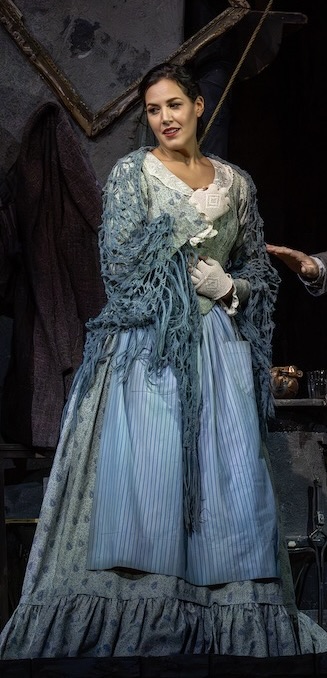
Federica Lombardi appeared earlier this season at the Metropolitan Opera in Così fan tutte bringing bobby-soxer zeal and exquisite vocalism to Fiordiligi. In 2023 she sang her first Mimi at the Met and Tuesday evening she returned in La Bohème, the third soprano to take on the role this season, in an equally compelling, heartbreaking performance.
Before she sings a note, it is clear that this Mimì is gravely ill. Violent coughs rattle her chest and convulse her body, growing more pronounced as the opera progresses. Lombardi’s face, too, charts the seamstress’s physical decline. The glow and softness of her features when she sings of her life and love upon first meeting Rodolfo give way to an angularity etched by illness as she relives those moments one final time.
The sheen and richness never leave Lombardi’s voice, although in the final scene it has darker emotional depth. What makes her Mimì so compelling, however, is not simply the beauty of her singing but her extraordinary command of the words. Italian is, of course, her native language, but she has a rare ability to make every word count, investing the text with exceptional clarity and expressiveness.
Tenor Atalla Ayan, an alumnus of the Met’s Lindemann Young Artist Development Program, had not appeared at the house since 2018. His voice has a complex, grainy texture, rich in color and singularly beautiful throughout its range. In this high-octane company of male Bohemians, Ayan’s Rodolfo provided the perfect counterweight, combining understated acting with impassioned singing.
Like Lombardi, he has an easy, conversational approach to Puccini’s vocal lines. Whether conveying unrestrained ardor or utter despair, Ayan sang impressively, bringing directness and sincerity to Rodolfo in an affecting performance.
Lucas Meachem’s Marcello was bold and loud in the first act, too much so at times. Clearly, he had not yet gotten over his rage at Musetta for ending their relationship. Kudos to conductor Marco Armiliato for maintaining balance in the Act IV duet asRodlogfo and Marcello lament their respective fates.
Meachem was explosive in the Café Momus scene, yet tender and compassionate toward Lombardi’s Mimì outside the tavern at the Barrière d’Enfer. In the final act, a different Marcello emerged, with Meachem singing with greater sensitivity, both dynamically and emotionally.
Alexandros Stavrakakis’s Colline and Nicola Alaimo’s Schaunard are large men, with equally robust voices. The camaraderie of the four male Bohemians was immediate, anchoring the performance the instant Stavrakakis and Alaimo stepped on stage. The former’s philosopher was cut from sunny cloth. His bass is unusually bright and beautiful for a Colline, making his farewell to his overcoat particularly touching. Alaimo was a flamboyant Schaunard with a flair for physical comedy, and a major voice which soared through the house when given the chance.
Heidi Stober’s soprano sounded huskier than usual, but there was nothing in her fiery Musetta to suggest she was under the weather Tuesday night. At Café Momus, she was a spitfire, every bit as high-octane as Meachem’s Marcello. Her verbal sparring with Meachem outside the tavern was equally pointed.
But before the fourth act, it was announced that, because of a cold, she could not continue. Anya Matanovič, who is scheduled to make her Met debut in April 2027 as Musetta, stepped into the breach. The transition was seamless, with Matanovič delivering an ardent house bow and making a strong vocal impression.
Donald Maxwell’s Benoit grows more decrepit with each passing season. He is a master of detail, which he deploys with greater subtlety as an equally baffled and bamboozled Alcindoro.
This was Armiliato’s 87th performance of La Bohème at the Met. His dedication to the score was as fresh and constant as ever. The camaraderie on stage owed much to his authority on the podium. The Met Orchestra, especially the violins, and the chorus were in top form.
The refurbished Zeffirelli production still draws gasps and applause from newcomers. The snowfall in Act III was particularly heavy on this evening, making the scene all the more wondrous.
La Bohème will run through December 10. Additional runs with different casts begin April 16, 2027. metopera.org
Leave a Comment