A weird and wonderful Baroque Halloween with The Sebastians
If one spends enough time around art of the Baroque era, one finds much that is saintly and spiritual, but also no end of things that are bizarre, whimsical, or downright chaotic. (Actually, the lives of the saints aren’t lacking in that department either, but that’s for another day.)
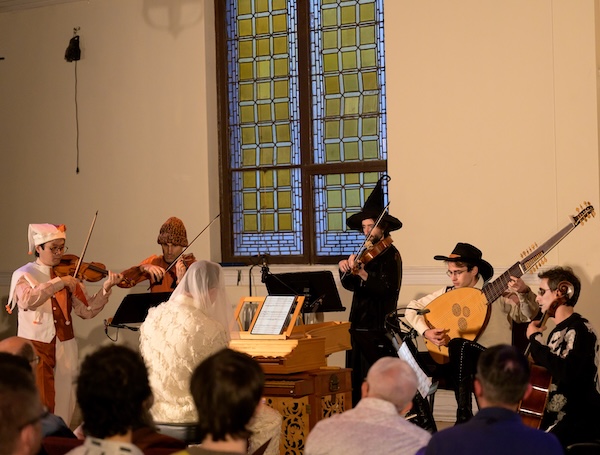
In Saturday afternoon’s concert at Manhattan’s Good Shepherd-Faith Presbyterian Church, the early-music group The Sebastians celebrated Halloween—the holiday where we literally make fun of death—by dressing up as a ghost, a witch, a jack-o’-lantern, etc. and taking a walk on the lighter side of the dark side of Baroque music, with the overall title “Bach from the Dead.”
The musical summons to the festivities was—had to be—the indelible opening bars of Bach’s Toccata and Fugue in D minor, BWV 565, arranged for portative organ, two violins and cello by the group’s leader and keyboardist Jeffrey Grossman. The highlight of this moment was its lowest point: skeleton-suited cellist Ezra Seltzer doing his best imitation of a 16-foot organ pipe blasting out a fortissimo low D.
This energetic performance with strings gave extra dimensions to the familiar fugue, as violinists Daniel Lee and Nicholas DiEugenio—in court-jester costume and jack-o’-lantern sweater respectively—made the rocking theme flex and fade in ways unknown to organs. However, arranger Grossman—costumed as a ghost in lace pajamas and a veil—saved the flashiest cadenzas for himself at the little organ.
The 1737 ballet Les élémens by Jean-Féry Rebel begins with an undanced prologue titled simply “Chaos.” On Saturday, unlike Haydn’s discreet “Representation of Chaos” that opens The Creation, Rebel’s movement dove right in with a cluster chord consisting of all the notes of the D minor scale at once. (Why is it always D minor?) The struggle of the four elements—earth, water, air, and fire—to emerge from the Biblical “without form and void” was audible in the violin shrieks and contortions that punctuated the movement’s grotesque gavotte.
What followed was not the rest of Rebel’s ballet but a segue into a charming piece by Telemann, the Ouverture Don Quixotte a 4, TWV 55:G10. Here the chaos was all in the mind of Cervantes’s romance-addled Spanish nobleman, riding off to adventures in knight-errantry.
Following the de rigeur stately French overture with vigorous allegro, five movements depicted a day in the life of the Don, from arising with a tender minuet to tilting at windmills in furious sixteenth notes to swooning for his ideal love Dulcinea. The suite closed, as suites did then, with fast dances, a heavy, rustic one for the Don’s valet Sancho Panza and a swirling one over a drone note incongruously titled “Le couché de Quixotte” (Quixote’s Bedtime). This was madness of the most benign sort, warmly rendered by The Sebastians.
For this occasion, composer Carson Cooman contributed Totentanz, Op. 1690 (really?), which received its world premiere Saturday. Updating the medieval genre, Cooman gave his “dance of death” a jig rhythm that slipped often into hemiola (three beats to a bar or two?), making the dead people wobble and limp to his sarcastic minor tune. Is it possible the twenty-first century is harder on the dead than the Middle Ages were?
“L’orage” (Storm) from Rameau’s comic opera Platée, for all its torrential scales and stutters of string tremolo, brought a kind of major-key, all-in-fun energy back to this Halloween celebration.
G minor darkness gathered again, however, in Giuseppe Tartini’s celebrated Violin Sonata in that key, dubbed “Devil’s Trill” for its last movement, supposedly dictated to the composer by the Devil in a dream. Violinist DiEugenio gave a muscular reading of this consistently minor-key music, operatic in the opening Larghetto, immoderately driven in the Allegro moderato, piercing in the brief Andante, and wild in the extensive finale, with its frequent tempo changes and eponymous double trills.
Vivaldi’s Four Seasons weren’t just climatic events but human ones. In the brief Adagio molto movement of the “Autumn” concerto, one heard the restless sleep of hard-working, hard-partying harvest workers in the dissonant notes sprinkled among the score’s long, drowsy chords.
Then the program leaped back 100 years (in a drunken dream, maybe?) to Dresden in 1627 and Carlo Farina’s Capriccio stravagante à 4, a carnival of special effects that began innocently enough with a medley of dance tunes in various meters, but then branched out into snap pizzicato, string-tapping col legno, and bow strokes that imitated all sorts of things from drums to cats meowing to little dogs yapping to big dogs woofing. The ensemble, which by this time had grown to include witch-costumed violist Kyle Miller and the rhinestone cowboy theorbo player Dani Zanuttini-Frank, played to a high standard of ensemble music-making through all the hijinks.
The concert closed with Vivaldi’s Sonata “La Folia,” Op. 1, No. 12, to the ancient tune that has inspired variations by Corelli, Rachmaninoff and many others. The very title means “madness,” and as Grossman wrote in the program, Vivaldi’s music “needs no story to sound unhinged.”
Indeed, Vivaldi’s own stravagante variations took off right away in a furious swirl of sixteenth notes for violins, then for cello, and just got hotter and more fantastic after that, only to close with one last joke, interpolated by organist Grossman: a faint echo of that Bach toccata.
Designer Stephanie Mae Fisher was credited with the players’ costumes, which provided just the right party atmosphere. She also had the foresight to decorate violinist Lee’s jester costume with balls, not bells.
The Sebastians will perform two Bach cantatas, Wachet auf, ruft uns die Stimme, BWV 140, and Ein feste Burg ist unser Gott, BWV 80, with one singer to a part, 5 p.m. Nov. 21 in the Sanctuary of Brick Presbyterian Church. sebastians.org
Leave a Comment