Relic presents lively Latin-American dances but it’s not opera, Doc
Imagine attending a performance billed as La Traviata and seeing, instead of an opera, a person reading passages from Piave’s libretto interspersed with waltzes, quadrilles and airs by various composers of the mid-nineteenth century, and not a note of Verdi till the very end.
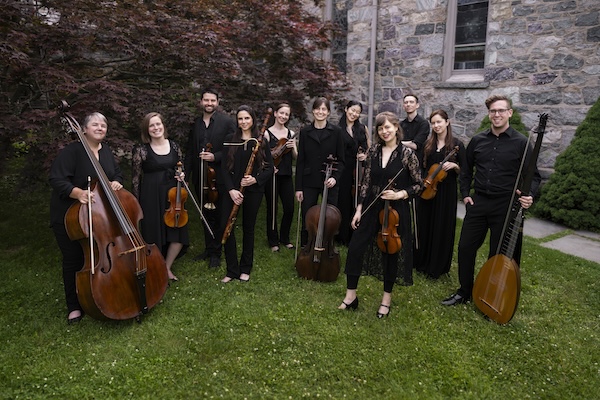
This is more or less what happened Sunday afternoon at Corpus Christi Church in Morningside Heights, as the Music Before 1800 series opened its season with the early-music ensemble Relic performing “The Blood of the Rose,” a concert program loosely based—and giving new meaning to that expression—on La Púrpura de la Rosa by Tomás de Torrejón y Velasco, the first opera ever performed in the Americas.
It would be interesting to actually hear Torrejón’s score, composed in Lima, Peru in 1701, performed by soloists and chorus and a fine band like Relic. And maybe Music Before 1800 will bring us that someday.
But on this afternoon, Relic was on a different track, using the opera’s plot as a framework for a concert of listenable Latin-American selections from that period, matched to the opera’s various moods.
And there was no shortage of moods to choose from. The love story of the goddess Venus and the mortal Adonis, complicated by the murderous jealousy of Mars, the god of war, attracted some of the leading literary lights of the 17th century. Shakespeare’s epic poem in 199 stanzas became literally his first bestseller.
The great Spanish poet Pedro Calderón de la Barca added to the story a mountain that split open to reveal the Cave of Disillusionment (with love, of course). That–along with the virginal Adonis rescuing the half-naked goddess from a fierce wild boar, and the couple’s escape to the Garden of Love, and the boar’s later bloody revenge, and the lovers’ apotheosis in the heavens and fields of flowers—seemed to cry out for an opera. Torrejón obliged, setting Calderón’s poem directly to music without adaptation by a librettist.
So at least listeners Sunday were treated to the Spanish poet’s own elegant lines and imagery (in English translation), as meaningfully declaimed by violinist Rebecca Nelson from the ensemble. An able fiddler with a dancing phrase or a sentimental swoon, Nelson didn’t pretend to act all the roles in the opera, although she did gruff up as the menacing god Mars and seemed to be channeling Vincent Price while Robert Warner’s organ groaned in the Cave of Disillusionment.
Nelson and her fellow fiddlers—Kako Boga, Aniela Eddy, Toma Iliev and Laura Lutzke—led the way most of the time, solo or in expressive combinations, although violist Kristen Linfante, cellist Cullen O’Neil and bassist Sue Yelanjian also made their presence felt.
Woodwind player Georgeanne Barker enhanced both ends of the sound spectrum with the piccolo-like sparkle of her soprano recorder in up-tempo numbers, golden-toned support on the bassoon, and a lyrical bassoon solo in Torrejón’s own dolorous music near the end.
Besides some atmospheric organ renderings, Robert Walker anchored the all-important basso continuo for most numbers at the harpsichord. Daniel Swenberg’s dulcet-toned theorbo actually led the way at times, and when he switched to guitar, the Spanish-Latin American temperature rose sharply.
Luke Rinderknecht’s percussion kept the metrically complex dance rhythms hopping, high-spirited but gauged just right: leaning in on the frame drum and tambourine, easy on the castanets.
Those fascinating rhythms had one wondering: It’s reported that the Spanish-born and -trained Torrejón took little notice of Latin-American or indigenous Peruvian music when composing his own works. On the other hand, for this program the Relic musicians looked far and wide for specifically New World music, both in published works and in the “cocides,” very old collections of tunes that didn’t specify authors or even instruments.
So, what exactly were we tapping our toes to on Sunday afternoon? Was it a Moorish beat from Iberia, or a swirling breeze from the Andes?
The ethos of Relic seemed to say, relax, just enjoy the story and the music. Sunday’s printed program listed the individual musicians’ affiliations with about every famous early-music ensemble you’ve ever heard of, but it was mum on the mission of Relic itself. So what do these people need another early-music ensemble for?
A look at the group’s website gave the answer: These musicians want to tour, as much as possible, as far as possible. They want to get early music out of the classroom, out of the Music Building, out of Morningside Heights, to where the people are. To where folks don’t ask so many questions, but want a good story and a tune. To where they don’t care if this is really the opera or something vaguely related to it, as long as the music is good.
Hey, it’s worth a try.
Music Before 1800 presents the Helicon Ensemble in “Children of Orpheus,” with works by Corelli and composers he influenced, including Handel, Geminiani, Dall’Abacca, Muffat and Jacquet de la Guerre. 5 p.m., Nov. 8 at Corpus Christi Church, Morningside Heights. mb1800.org
Leave a Comment