Dudamel leads the Philharmonic in a Mahler Fifth of depth and complex beauty
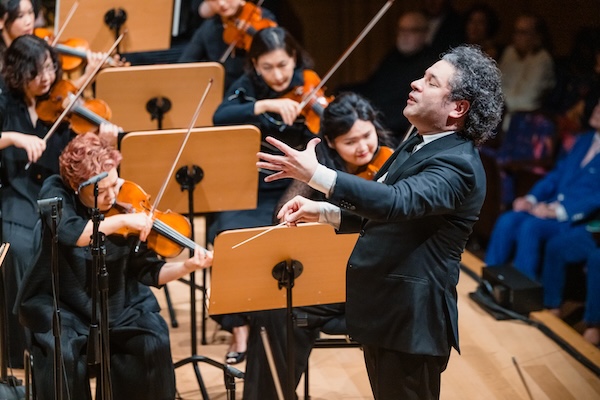
Toward the end of the 2024-25 season, Gustavo Dudamel led the New York Philharmonic in a tremendous, unforgettable performance of Gustav Mahler’s Symphony No. 7. Even more than the great music making, the concert hinted at the possibilities for when the then-podium guest began his tenure as music director this month.
That promise of great chemistry between musicians and conductor, of a natural, spontaneous feeling and deep understanding in music that is fundamental to the orchestra’s heritage, is now the reality. And it was in full view in David Geffen Hall Friday night with another Mahler masterpiece, the Symphony No. 5. Like the previous Mahler symphony, this was a tremendous performance in the moment, and an immensely meaningful and important reestablishment of the great historical legacy of this orchestra.
First, though, there was the opening half, and it was notable in itself for the world premiere of Tania León’s Imágines Mestizas. This was a tone poem focused on the inner landscape of León’s contemplation of where she fits in the complex mix of European classical, Afro-Cuban, and American music. It was a dreamy—yet not sleepy—stream-of-consciousness flow that started with a pastorale mood and a melody that comes out of a Yoruban prayer. Already, that showed León’s easy synthesis of traditions, because it sounded like it could also have been a response to the pastorale movement in Berlioz’s Symphonie fantastique.
From there, sounds bubbled and spread. There was a series of striking little fragments spilling over each other, a bluesy phrase in the strings, a compelling device where a languid string melody was layered on top of uneven, chattering winds, brass, and percussion.
This was stylish and evocative, but felt incomplete, especially with how it all petered out abruptly at the end, as if waking from the dream. Some combination of the composition and the performance, which felt competent but not totally clear and secure, put the music in an uncommitted space between juxtaposing separate episodes and developing an integrated through-line.
After intermission, Mahler’s Fifth was brilliant and enthralling. In a pre-season press conference, Dudamel, in response to questions, talked about the flexibility in the Philharmonic’s sound and also explained some of his thinking about Mahler. He spoke of the infinite detail in the scores, and how the music is full of Mahler’s mannerisms, and contrasted that with what he called the “flatness” of so much contemporary Mahler playing.
With that, he turned in a view of Mahler full of the gestures of sound and expression that make the surface so varied and compellingly uneven, and a clear panorama of the vast topology that binds everything together into the universe of a Mahler symphony.
This was dense with Mahlerian mannerisms. That doesn’t mean fussiness, or an interventionist emphasis on quirky details a conductor can put their brand on. Rather, Mahler’s mannerisms are things like fine modulations of tempo, the ability of instrumentalists to change their timbre and expression not just in the middle of a phase but in a single note, expressing everything with emotional weight. With that you have Mahler’s sound, which the orchestra learned from Mahler himself, and preserved and passed on through Bruno Walter and Leonard Bernstein.
No Philharmonic conductor since Bernstein has brought this music back to life like Dudamel has. Where Bernstein often pushed his own personality onto the music in later years, Dudamel Friday night held the form lightly and let it fill out its own shape through the playing, a superb balance between control of the form and giving trust over to the ensemble.
The opening funeral march was on the slow side, but totally reasonable, while the Adagietto was a quick nine minutes, also absolutely reasonable. The proportion between the faux climax toward the end of the first part, and then the grand one in the finale were ideal—and also thrilling with fantastic size and mass from the orchestra.
That was the extent of the obvious conducting. More subtle was how Dudamel kept his eye on each detail while letting this great orchestra play. That meant in stretches with three or more lines of polyphony, he didn’t emphasize one of them but all of them.
The musicianship was full of feeling of often stupendous purpose. There was a fantastic range of timbres in the strings, rich grumbles from the low brass, and David Cooper’s relaxed and exuberant horn solos in the third movement (played standing) produced as fine and true a Mahler sound as one has heard.
Dudamel’s Mahler presented beauty with discrete flaws and asymmetries inside it, snarls that were tender, and all the insoluble and unresolved contradictions in Mahler’s humanity and our own.
The program will be repeated 7:30 p.m. Saturday, 2 p.m. Sunday, and 7:30 p.m. Tuesday. nyphil.org.
Leave a Comment