Nelsons shows good and bad podium sides with Boston Symphony at Carnegie
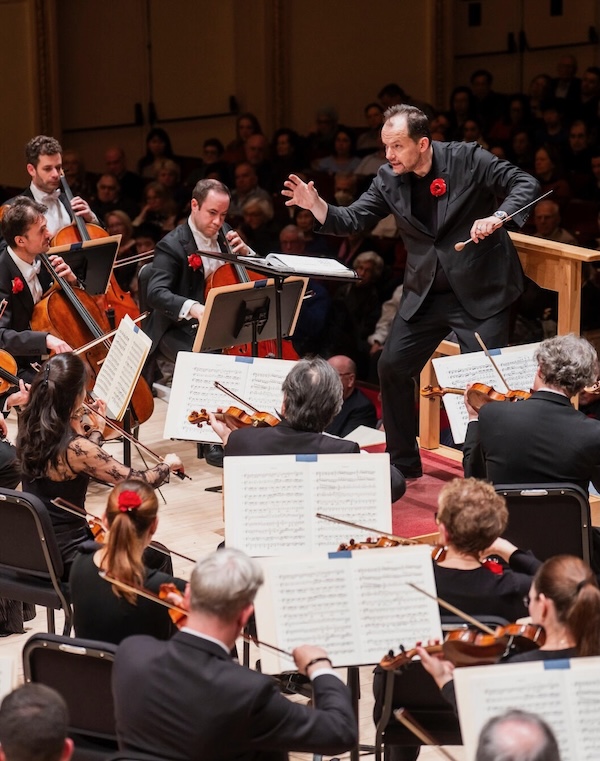
The Boston Symphony Orchestra and conductor Andris Nelsons came into Carnegie Hall Thursday night with a pair of famous vocalists, music by John Adams and Dvořák, seemingly a substantial portion of the population of Boston, and recent extra-musical turmoil in tow. For still-murky reasons, the BSO administration has not renewed Nelsons’ contract, and the conductor’s term will come to an end after next season.
Judging by the vocal response from the audience each time the musicians and conductor took the stage Thursday, the crowd was avidly on Nelsons’ side. As was the orchestra, each member sporting a red carnation in a symbol of solidarity.
The enthusiasm of their playing was exceeded by the response from the crowd for music of and about America, old and new; an arrangement of three scenes from Adams’ opera Nixon in China and Dvořák’s Symphony No. 9, “From the New World,” after intermission. The irony in all this was that the performance had some meaningful flaws that were set against some excellent music making, and all of them were the conductor’s responsibility.
Nelsons has a deliberate approach to a score. The strength is how he maintains the BSO’s gorgeous, old-world range of colors and timbres while still showing off every possible detail, and still holding on to the form of the music. The weakness is that the deliberateness sometimes misses the forest of expressive purpose for the trees of a sequence of gestures or phrases, with the danger of tipping into micromanagement.
Both strengths and weaknesses were prominent Thursday night, and showed up in predictable spots: in every stretch of slow music, Nelsons was so deliberate that he seemed to be carving out sections from the score to put in a frame. At times he micromanaged to the point where all possible meaning was replaced by a diagram of how the notes fit together. In music that moved fast enough that there was no time to ruminate, the performances were full of robust musicality and passion.
There was more of the latter than the former with the Nixon in China scenes, though things did take a while to get going. The excerpts covered arias for Nixon (baritone Thomas Hampson) and Pat (soprano Renée Fleming), with the Tanglewood Festival Chorus singing choral passages and, in the opening Act I, Scene I, Chou En-Lai’s part where the character greets Nixon, who has just arrived.
Set outside of the narrative order, next was Scene 1 from Act II, Pat’s aria “This is prophetic,” then back to Act I with the Scene 3 banquet that mostly focuses on Nixon. Hampson and Fleming were perfect for this—the two sang the roles in February for the Opéra Bastille’s production and last month in Boston—and with their singing, and the shape of the music, this sequence made sense isolated from the rest of the opera.
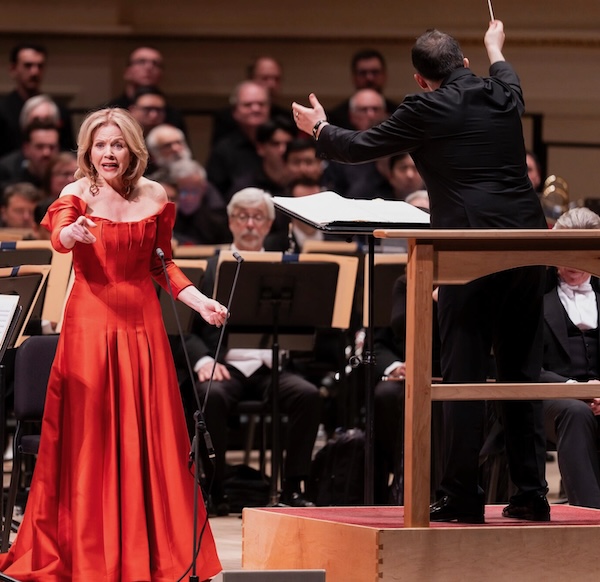
The beginning was so carefully laid out that it was leaden. The music is supposed to charge the air with anxious anticipation for Nixon’s arrival, and while it was atmospheric, there was no tension. The chorus’ entrance added energy, and Hampson’s tremendous vigor, the strength and full, satisfying sound of his singing, kicked things into gear.
He and Fleming added not just life but a sense of truth to Alice Goodman’s incredible libretto. The opera takes Nixon and Pat out of history and humanizes them, without glossing. In just two scenes, Hampson’s Nixon was self-regarding, diplomatic, and also brittle and strange. Fleming’s voice was sweet and silvery, her Pat a little overwhelmed by what was happening around her, both thrilled and afraid. As Nixon sings, “News has a kind of mystery,” so were their portraits mysterious, compellingly elusive.
After a slow ramp up to a satisfying finish in the Nixon scenes, the “New World” Symphony was either wildly exciting or bafflingly frustrating, again depending on the speed of the music. Unfortunately, some of the most moving music in the work is in the slowest passages. The Adagio introduction had the odd technical quality of getting laid out piece by piece without plodding—though also without expressive depth.
One missed the even greater expressive depths in the ravishingly beautiful Largo. Instrumental sound was fabulous, especially the strings, which played with exquisite delicacy and intonation. But Nelsons broke this up into inorganic sections, and micromanaged the flute solo that introduces the second theme. It was odd to hear this movement, with some of the most lyrical music in the entire classical tradition, with genuine warmth from the musicians and obsessive objectification from the conductor.
The rest was the complete opposite, music-making full of verve and spirit, full of purpose. Nelsons’ baton technique and expressive left hand were just as busy, but the score didn’t give him any chance to get in the way.
In gear, the orchestra played with a sense of fullness, of important things being said. The scherzo had exciting, slashing rhythmic phrases, an emphasis on forceful forward motion, and the finale was packed with explosive moments from the ensemble—moments not even Nelsons, trying to, literally, snatch every last sound of the final chords out of the air with his left hand, could dampen.
The Boston Symphony Orchestra, with conductor Andris Nelsons and pianist Lang Lang, play Outi Tarkiainen, Grieg’s Piano Concerto, and Sibelius’ Symphony No. 1, 8 p.m., Friday. carnegiehall.org
One Response to “Nelsons shows good and bad podium sides with Boston Symphony at Carnegie”
Leave a Comment










Posted Apr 10, 2026 at 3:31 pm by john Kelly
Well at least the Dvorak wasn’t boring. The reviewer is absolutely right to mention the curious flute phrasing presumably.engineered by Nelsons. I have never heard it done that way before. Nonetheless conductors have a tough job. When they have “something to say” about a piece that can easily be criticized as an eccentricty. I would rather that than be bored by literalism