Parlando illuminates the darkness with Haas’ “in vain”
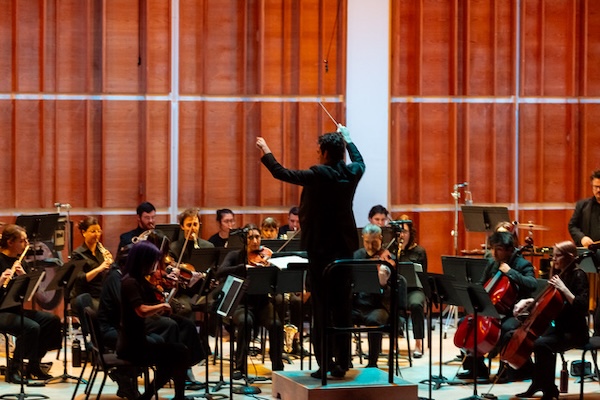
Why is this work a masterpiece? That thought must have been on some minds as Ian Niederhoffer led Parlando in Georg Friedrich Haas’ in vain at Merkin Hall on Sunday afternoon.
To the composer’s fans in the audience, it was self-evident. For others, even if they were not quite convinced of its lofty status, they undoubtedly realized that they had experienced something monumental, if inexplicable.
Haas composed in vain in 2000 in response to the rise of far right parties in Austria. Sir Simon Rattle promptly deemed it the first masterpiece of the 21st century. It is scored for 24 instruments, including two groups of percussion instruments, a bass flute, and an accordion. Lasting about 70 minutes, a defining feature of the work is its two extended sections performed in total darkness with the musicians playing from memory.
In his concise and highly informative introductory remarks, Niederhoffer put Haas and the work in context. Haas’ reaction to the rise of political extremism in Austria and Germany was visceral and deeply personal. His grandparents and parents were Nazis and not of convenience, but genuinely committed to the cause, and remained so long after the war had ended. An uncle joined the Waffen-SS so that he could indulge his sadism. Haas expunges his own darker urges through his exploration of BDMS, a topic that Niederhoffer did not delve into, but is a well-publicized chapter of the composer’s story.
Niederhoffer also provided insights into the work’s relationship to history. He explained that neither history nor in vain progress linearly. Just as we cannot grasp the full impact of current events on the overall arc of history, Haas’ musical impulses and their meanings similarly unfold on a timeline that cannot be fully comprehended. Niederhoffer noted the constant pull towards darkness in the piece, but suggested that in vain is most beautiful in those places where the absence of hope is most evident.
Haas was influenced by the French Spectral School and Niederhoffer explained that Haas employed two different tuning systems in in vain, equal temperament and just intonation. Niederhoffer indicated the different tunings through the use of light Sunday–red for equal temperament, and blue for just intonation. When the music was at its most complex, both colors flooded the stage.
in vain began with a chaotic swarm of luminous, scintillating descending scales, some akin to bird calls, which collapsed into a free fall. This was red-light music, anchored in tonality. The descending passages would be heard throughout the piece. Later, they became slow and ominous, expiring into the void.
Blue lights shone when the harp ushered in long, sustained notes played without vibrato by the strings. Woodwinds, brass, accordion, and ultimately the vibraphone and marimba added complexity to the musical fabric. At times, this was music of pure, almost supernatural beauty, where a sense of hope prevailed. It would be washed away by the sounds that resonated with despair.
Throughout the piece, Haas employed a kaleidoscope of sounds. His writing for the harp defied convention with passages that pierced the musical texture with strident chords and percussive effects. The horns played a melody that hearkened back to a Wagnerian leitmotif, but which, with repetition, degraded into something horrifying. With the accordion, Haas never slipped into nostalgia or cliche. The instrument not only added depth to the musical texture but also excitement with jarring passages that burst forth from the void.
Niederhoffer has a penchant for clarity and structure, although he doesn’t usually employ visual aids. His players are attuned to his sensibilities and respond with precision and transparency. They like him, indulged in the work’s flashes of melodic beauty and lustrous color, which Haas employed sparingly, but to great effect. More importantly, conductor and orchestra served the music, delving deep into the piece’s profound emotions, neither unencumbered nor daunted by the thought of performing a masterpiece.
Parlando presents “The Cabaret Project, Part 2” with works by Ernst Krenek, Hanns Eisler, Abel Meeropol, and Aaron Davis/Margaret Atwood featuring Measha Brueggergosman-Lee, April 27 at Merkin Concert Hall. parlandonyc.com
Leave a Comment