Bellini’s music, fine cast carry the day over directorial excess in Met’s “Puritani”
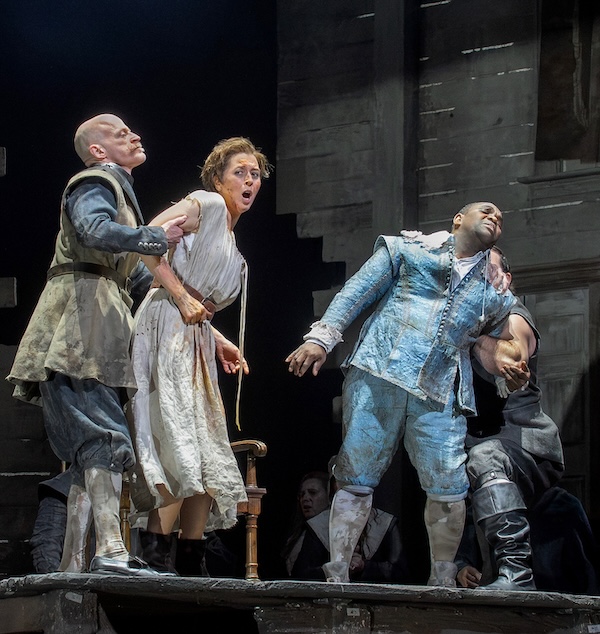
This is a Bellini season at the Metropolitan Opera, which is both a welcome and complex proposition. The composer and his bel canto operas are among the most famous and revered in opera culture, yet in recent years performances have been infrequent enough that they almost seem like fringe works.
So it is good for opera that the Met has delivered not just two Bellini scores but two new productions to the stage: La Sommambula last fall, and I Puritani, which opened New Year’s Eve. This is just Puritani’s 64th performance in Met history. With Charles Edwards making his Met directorial debut , these are the first performances here since 2017, and only the third production in the house’s history.
The stature of I Puritani extends beyond the score. It is Bellini’s final opera before his death at age 34. There is the history of the English Civil War that makes for a Romeo-and-Juliet style mix of romance and enmity, and there is the (now somewhat clichéd) feature of the mad role for a dramatic soprano. Out of that falls the shadow of Maria Callas and Joan Sutherland whose cultural presence both embodies madness in opera and extends far beyond the opera world into general society. (In Werner Herzog’s Fitzcarraldo, it is the desire to present I Puritani that motivates the title character’s river journey through the Amazon, a filmic reflection of operatic madness.)
Every soprano who attempts the lead role of the Puritan Elvira, in love with the Cavalier Arturo, with this legacy behind her. For this production that is Lisette Oropesa, paired with tenor Lawrence Brownlee. These are also great dramatic roles, and both singers have the substantial technical demands of range, agility, and stamina. The coloratura elements aren’t merely ornamental—Bellini’s greatness was in how he extended the voice with an understanding of how expressive it could be.
On Wednesday’s opening night, Oropesa and Brownlee were both excellent. They were equalled in the supporting roles by baritone Artur Ruciński as Riccardo, a Puritan in love with Elvira, and bass-baritone Christian Van Horn as Giorgio, Elvira’s sympathetic uncle. Marco Armiliato leads the orchestra for this brief six-performance run.
Oropesa’s tone and technique were ideal for the role. Elvira is a young woman, and that youth and inexperience explain her breakdown as well as can some burning inner psychological flaw. The litheness of her voice, the agility and fluttering vibrato, put the character’s heart on her sleeve, and were a tight fit for the music and drama. Oropesa didn’t layer herself on Elvira, she sang from inside the character, and as dazzling as the vocalization often was, everything felt appropriate and organic.
Her voice covered the full range of the part. While her tone in the high tessitura was occasionally inconsistent, this has a minor issue. The sheer athleticism of it was exciting to the audience, though the most impressive thing, constant throughout, was her artistry, the bravura part almost a side effect. The cascading representation of her downward mental spiral in “Oh, vieni al tempio” was effectively understated, and the sense in her singing in Acts II and III, before the reunion with Arturo, was an uncanny balance of a mind adrift shown through precise articulation and intonation.
The shape of this opera brings Elvira and Arturo together in Act III for their most extensive and important music. The musical breadth here was most striking with Oropesa gentle in her troubadour aria, Brownlee graceful in “Corre a valle.” The tenor had so much energy that everything sounded almost easy, as he continued through the marvelous duet “Vieni fra queste braccia/Caro, caro, non ho parole,” and then a powerful “Credeasi, misera.” As with Oropesa, Brownlee had the full vocal range in his grasp, and again more importantly sang with the character showing through, rather than the singer showing off.
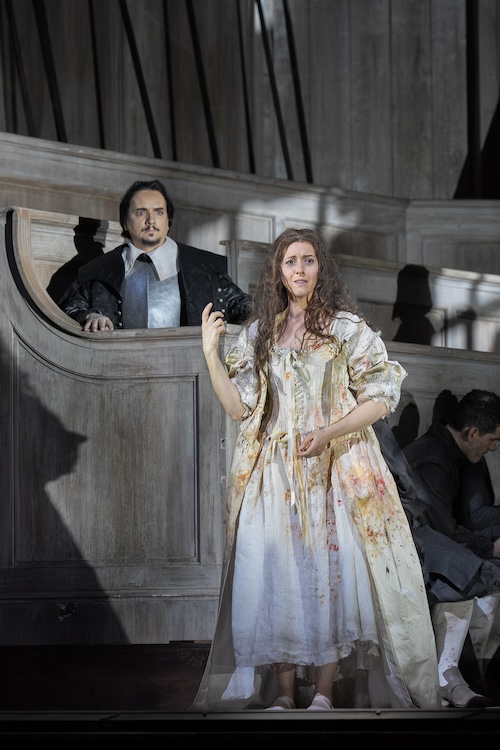
Ruciński was superb as Riccardo. He had an almost conversational quality to his delivery, and a vibrancy that gave force to each word and note. His extended Act I sequence from “Or dove fuggo” through “Ah! per sempre,” was engrossing. His earthiness transcends the artificiality of opera, and each declamatory phrase followed the last with an iron-clad expressive logic.
Van Horn is a similar singer, with a tone that has a slight edge and great robustness. His naturalness was equal to Ruciński’s, and the two made as fine a pair as Oropesa and Brownlee. They also had a smooth comic quality together, which turned out to be essential to getting through some of the unfortunate choices in Edwards’ staging—at the end of Act II the two paint their faces and bodies in the colors of the Roundhead flag.
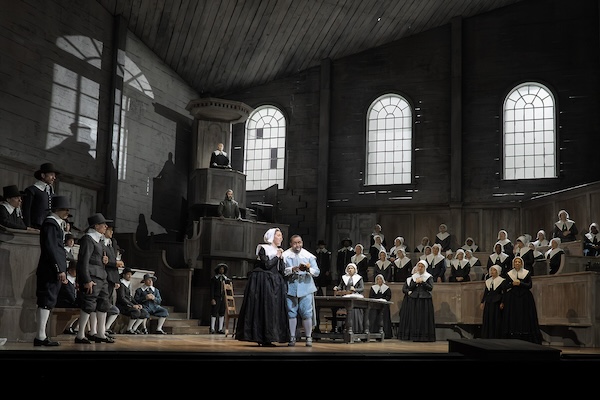
The major thing that lets down this Puritani is Edwards’ production. His sets are literal but have a handsome intelligence to them, the costumes a basic concept of blacks and grays for the Puritans, color for the Royalists.
His stage direction, however, goes from the obvious and acceptable to the utterly ridiculous. Some of that is cheeky and minor—these Puritans do a lot of boozing—while other choices worked directly against both the drama and the performances. Though Oropesa is absolutely fine expressing Elvira’s mental states, Edwards presents her as a painter, surrounded by exaggerated self-portraits of her distress. These are stacked up as kindling for when Arturo faces execution, in case anyone didn’t notice Edwards had already been hitting them over the head with this rickety device.
Throughout, Edwards has an “apparition” of young Arturo (played by Addison DeAundre) appear onstage, another sign that he thought the audience couldn’t get the most obvious things. Perhaps it was really lack of trust in his own ideas. At the finale, Edwards has Arturo leave Elvira and flee toward a representation of King Charles. Everyone on stage and in the audience understood what Bellini was saying in I Puritani, except, unfortunately, the director.
In the pit, Armiliato led a focused and commanding performance overall, with a lovely tone and sense of idiomatic phrasing from the orchestra, and great, robust singing from the chorus. He at times faltered in the details, following the singers skillfully but at times too assiduously. The energy in the music dissipated noticeably at times when Armiliato sacrificed momentum to match every bit of rubato or vocal reshaping. This was the kind of thing one noticed in the moment but that ultimately faded in importance in the overall performance.
I Puritani continues through January 18. metopera.org
One Response to “Bellini’s music, fine cast carry the day over directorial excess in Met’s “Puritani””
Leave a Comment





Posted Jan 19, 2026 at 3:33 am by Richard Levan
Smart review. The singing was world class and the stage direction a total disaster. Oropesa must rank as one of the world’s leading coloratura sopranos today. The review nails its description of her voice (and acting) — both jaw-dropping.
The direction was clumsy, contrived and at times bordered on the ridiculous. (Please! Elvira walking around with a punctured picture frame around her neck, though perhaps Freudian in conception, was laughable.) Your review is spot on.