Honeck, Pittsburgh Symphony make powerful Carnegie stand in Russian program
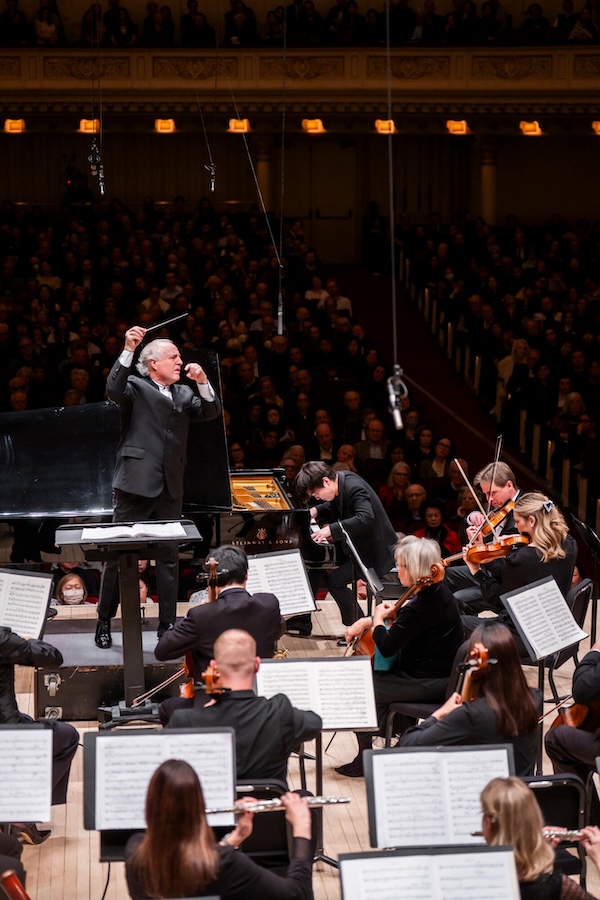
Manfred Honeck has led the Pittsburgh Symphony Orchestra as music director since 2008. The orchestra bears his imprint, a finely tuned ensemble intent on expressing the musical essence of a work. The Austrian conductor is a champion of the Viennese tradition of Mahler, Mozart, Brahms, and Bruckner.
In a rare Carnegie Hall appearance to a sold-out house Wednesday night, Honeck revealed the orchestra’s artistic breadth in what amounted to an all-Russian program.
Honeck cuts an authoritative figure on the podium, with a clear yet flexible baton technique. Histrionics are not in his nature, but total command is, extending beyond the orchestra to the audience as well. There were memorable moments throughout the concert, where Honeck drew the softest sounds imaginable from the orchestra, when nary a breath could be heard from the audience. He also treasured the impact of silence, whether in the midst of a piece or after it has ended.
The concert opened with the New York premiere of Lera Auerbach’s Frozen Dreams, a PSO commission. While in her teens, Auerbach was one of the youngest and last artists to defect from the Soviet Union in 1991, which would formally dissolve later that year. After studies at the Juilliard School and the Hannover Hochschule für Musik, Auerbach has achieved international acclaim as a composer, pianist, visual artist, and poet.
For Auerbach, music exists in a paradox because of its inherent fluidity and the act of preserving something that is already dissolving. Her orchestral work Frozen Dreams epitomizes this aesthetic, in which she sought to expand the sound world of an earlier version for string quartet. Despite its title, the piece is about movement, with themes appearing, vanishing, and then receding into the musical thicket.
Frozen Dreams began with a primeval cry emerging from the woodwinds and cymbals. Intricate pizzicato passages followed, which the strings executed with mechanical precision, pierced by bits of melody clearly etched by concertmaster David McCarroll. Honeck unleashed the orchestra in a brief display of power with violent, turbulent thrusts that subsided into an eerie, transparent soundscape, and ultimately faded to nothingness.
That emotional state proved the ideal curtain raiser for the engrossing and equally otherworldly performance of Rachmaninoff’s Rhapsody on a Theme of Paganini with Seong-Jin Cho as the piano soloist.
Rachmaninoff was Russian through and through, proudly laying claim to the mantle of Tchaikovsky and Rimsky-Korsakov, but charting his own stylistic path. The Rhapsody is foremost a dazzling tour de force for the pianist with the most manifest Russian flavor coming in the broad, sweeping expanse of the 18th of its 24 variations.
Honeck launched the piece with a sense of madcap humor. The jocularity was fleeting, as Honeck provided an ever-changing progression of colors, textures, and tempi, permitting Cho to impress through both the majesty of his playing and the silvery delicacy of his touch.
The soloist delivered with fleet playing, utmost sensitivity to dynamics, and a deep emotional connection to the music. Cho was spellbinding in Rachmaninoff’s more introspective moments, but dazzling in the brilliant ones. Honeck propelled the most electrifying playing with carefully crafted crescendos, launching Cho’s torrents of arpeggios and cascades of scales. The final variation was a whirlwind of color and emotion, which evaporated into the ether.
With his choice of encore, Cho was as intent as Honeck in asking the audience to concentrate rather than thrill to a virtuoso display. His delicate, lighter-than-air performance of Chopin’s Waltz in C-sharp minor seemed to echo Auerbach’s Frozen Dreams, in which time also stood still.

With his Symphony No. 5 in D minor, Shostakovich regained favor with Soviet authorities after four terrifying years in the wilderness. Much ink has been spilt divining Shostakovich’s motivation, whether the work was overt obeisance to Stalinist dictates or a cleverly disguised repudiation of them. Nonetheless, the symphony was a popular success, which garnered Shostakovich the Stalin Prize in 1940, the highest honor attainable for a Soviet composer.
Honeck led a performance of the Fifth Symphony in which structure and clarity reigned supreme. In the first movement, he drew dark, urgent, rhythmically charged playing from the strings, but always managed to find the lyricism that lies at the heart of Shostakovich’s music. The spirit of Mahler hung over the grand, jocular march that drove the first movement to its end. The Allegretto bubbled with a Ländler-like feel buoyed by the jaunty violin playing and the swagger of the brass.
The third movement was stunning for its profound beauty and emotional impact achieved through seamless legato phrasing. It also contained the most exquisite pianissimi imaginable, which Honeck coaxed from the violins. After captivating playing from the solo clarinet and cellos, it ended in a moment of repose, shattered by the full force of orchestral sound unleashed by Honeck at the start of the Allegro non troppo finale.
The brass and percussion vied for glory with their fierce thrusts of sound, although Honeck provided space for lyricism to shine, especially in the splendid horn playing. The final measures resounded triumphantly with all eyes on the bravura playing of the Pittsburgh Symphony percussionists.
Franz Welser-Möst leads the Cleveland Orchestra in the Verdi Requiem, 8 p.m. January 20, 2026 at Carnegie Hall. carnegiehall.org
4 Responses to “Honeck, Pittsburgh Symphony make powerful Carnegie stand in Russian program”
Leave a Comment

Posted Dec 04, 2025 at 12:24 pm by John Kelly
A terrific review with which I heartily concur. Not since Celibidache have I heard such gorgeous, sustained pianissimo playing (from a string section of around 60 players). It was devastatingly effective. But Honeck was not just “making effects” this was a thoroughly thought-through very “symphonic” account, and played by a stunning orchestra, the equal of any in the country. Cho is a “must hear” pianist and this account left me in no doubt that he is one of the foremost pianists before the public, beautiful tone colors as well as thundering fortissimi. Bravi tutti!
Posted Dec 04, 2025 at 10:38 pm by Fran
Great, accurate portrayal of Honeck’s incredible skills as conductor. One of the greatest ever!
Posted Dec 05, 2025 at 12:51 am by Mutsuko Tani
Dear New York Classical Review,
I read the review from New York Classical Review by Rick Perdian.
I am delighted by his comment, which so accurately evaluates Seong-Jin’s abilities as a pianist. Expressing something through the piano, a keyboard percussion instrument, is an extremely difficult task. The paint, brush, and even the canvas must be created with one’s own ten fingers, requiring unimaginable effort and perseverance from a young age. In an age where instant culture is becoming more prevalent with the advent of the internet, the existence of a sincere young man like Seong-Jin is a bright light for the future of humanity. I would like to pay tribute to Korea, which has produced such a wonderful young man.
Mutsuko Tani
Posted Dec 06, 2025 at 12:09 pm by richard sogg
I totally agree with the reviewer’s remarks