Pianist Kobrin goes with the flow of Haydn, Schubert, Schumann in Carnegie recital
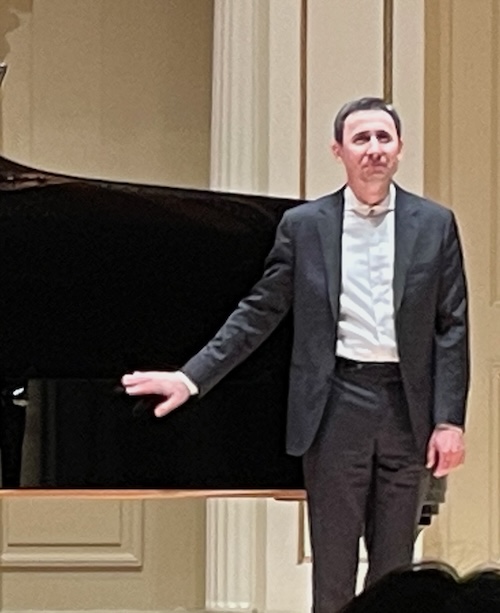
On the evidence of his recital Thursday night in Carnegie’s Weill Recital Hall, pianist Alexander Kobrin plays in a fluid, Horowitzian style rarely heard in these more literal-minded days. In a program designed to emphasize the subjective side of Schubert’s, Schumann’s and even Haydn’s personalities, Kobrin often seemed to turn notes on the page into clouds of sound, making one forget that the piano is a box full of hammers—until he forcefully reminded one of exactly that.
The flying technique and imagination that earned Kobrin the gold medal in the Van Cliburn Competition in 2005 was on display Thursday night, as his recital launched the tenth season of Key Pianists, an organization dedicated to foregrounding keyboard artists of particular interest, whether veterans or newcomers.
His goal was not to elucidate Classical and Romantic styles, but to blur those labels, revealing the three composers, writing over a 45-year span, to be soul brothers under the skin.
Interestingly, none of Thursday’s composers were noted for prowess at the keyboard. Yet each spoke most intimately through the instrument they could control with their own hands.
In Haydn’s Andante and Variations in F minor,the composer’s musing on two themes, one in F minor and one in F major, created light and dark corners in the piece, a foretaste of the major-minor colorations Schubert would later use to memorable effect. Whether sunny or cloudy, Kobrin’s piano tone always matched the moment.
His touch seemed uncommonly liquid throughout, from the little sprays of notes that decorated the F major theme to the burble of trills to the fountain-like dialogue of scales in the last variation. But there was contrast in the occasional Schumann-like grand gesture, and the work’s tragic coda, tortured and chromatic, its obsessive dotted figure tolling like a bell.
Coincidentally, the first of Schubert’s Four Impromptus, Op. 90, D. 899, opened with a double-octave bell stroke, and its opening theme had a fateful tread. As triplet rhythms first rippled then chugged, Kobrin gave them a melodious shape to interact with the right hand’s melodies, but at the end of this restless, happy-sad journey, the mystery of Schubert’s undefinable moods remained intact.
At Kobrin’s very fast tempo, the sweeping scales of the Impromptu No. 2 became mere wisps of smoke over the keys, and the dramatic forte interruptions seemed to be over before they began. A friend of Schubert described his playing as “hands running around the keys like mice,” which suggests at least some articulation of the notes. A prescription for Thursday’s performance might be: More mice, less Horowitz.
The more moderate tempo of No. 3 enabled Kobrin to make it more than a “harp etude” with a pretty tune on top and a blur underneath. Instead, the pianist’s sense of tone color and drama brought the rippling arpeggios to life, allowing the listener to savor the gentle two-against-three clash between them and the melody, while trills and rumbles in the bass commented ominously.
The pianist went for maximum mood contrast in No. 4. Its skittering right-hand figures became a fairy apparition, while the middle section was buttressed by sonorous repeated chords, which shifted from stormy to thoughtful as the mode lightened from minor to major. A straightforward recapitulation of the fairy music brought this “insubstantial pageant” to a close.
After intermission, it was Schumann’s turn on the couch. The session began, as these things do, with a bit of small talk before getting down to the business at hand. In Thursday’s performance of the Arabeske, Op. 18, the composer came across as a charming if slightly moody guy offering something (as he teasingly told Clara in a letter) “for the ladies” in Vienna. Kobrin’s free rubato gave him a devil-may-care air, and the more appassionato moments would not have upset a dinner companion.
Not so the mad rush that opened Kreisleriana, Op. 16, the kind of tortured outburst that caused the young Clara a moment of trepidation that “the man who could write such music was going to be my husband.” All but the last of this piece’s eight movements have tempo markings beginning with the word sehr (very), except for the first, where the word is äußerst (extremely). The violent mood swings are not just between movements but within them, leaving a listener disoriented even as to where he is in the piece.
Kobrin navigated this chaotic landscape with assurance and insight. Even the most fiery passages had a feeling of shape and direction. A tonal palette ranging from clear singing to a nimbus of sound enabled him to conjure voices from the cloud, sometimes several at once, as if one were hearing conversations from the next room, or the next world. Fortissimos rang out without banging, dancing staccato passages had a kind of manic grace, and moments of enigmatic pianissimo gave a glimpse of the void beyond.
As the work’s title implied, all of this musical chaos was happening inside the mind of a Schumann alter ego, the E.T.A. Hoffmann character Kapellmeister Kreisler, whom the composer depicted, and the pianist exquisitely rendered, as a half-mad old man hobbling down the road in the piece’s closing bars.
Schumann had wanted to dedicate Kreisleriana to Clara, but to avoid further friction with her father, who disapproved of their marriage, the dedication went instead to Chopin. Appropriately enough, Kobrin capped this evening of dark introspection with a single encore, Chopin’s wistful Mazurka in G minor, Op. 24, no. 1.
Key Pianists will present pianist Terry Eder in a TBA program, 7:30 p.m. Feb. 12, 2026 in Weill Recital Hall. keypianists.com
Leave a Comment