Greenwich Village Orchestra brings a New York state of mind to American works
Seldom is there such synergy between a piece of music and the space in which it is being performed as at the Greenwich Village Orchestra’s first concert of the season. Each of the three works in “Time & Place” evoked a specific location and era, but the auditorium of the High School of Fashion Industries, where the concert was performed, summoned the zeitgeist of the final days of the Great Depression—as did Copland’s Quiet City, the first work performed at this Sunday afternoon concert conducted by music director Barbara Yahr.
The auditorium, originally the Central High School of Needle Trades, is dominated by two massive murals painted by Ernest Fiene between 1938 and 1940. They depict the history of the needlecraft industry in New York intertwined with the ideals of the New Deal in what the artist described as “a lesson in democracy for the young.” There is debate as to whether the murals received funding from the Works Progress Administration, a government program that provided support to out-of-work artists and musicians during the Depression, but regardless, they are true to its spirit.
Copland is one of the American composers most associated with the WPA and its progressive ethos. He composed Quiet City in 1939 (without WPA funding) and the work, Fiene’s murals, resonates with the spirit of New York at a crucial time in the history of America and the world. Understanding this connection was not essential to enjoying the GVO’s performance but it certainly enriched the experience.
The music that became Quiet City was originally composed as the incidental music for Irwin Shaw’s play of the same name, whose main character is a lonely Jewish boy who plays the trumpet. The play was unsuccessful, but Copland’s subsequent orchestration of the music for trumpet, English horn, and string orchestra wasn’t. The result was a lyrical piece that delved deep into solitude, not despair.
Yahr’s reading of Quiet City bent more towards eloquence and introspection than loneliness. English hornist Jacob Slatter and trumpeter Steve Miller engaged in a smooth, free-flowing dialogue that was equal parts blues and a cantor singing in a synagogue. Their playing was melancholy at times, but beautiful. The strings created a shimmering sense of anticipation as night gave way to morning, which climaxed in a brilliant evocation of sunrise in which the solo instruments joined. The piece ended as it began, with Miller’s trumpet calls fading away.
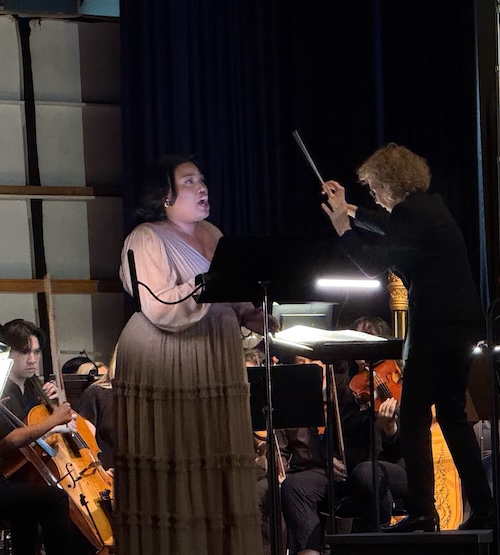
In Knoxville: Summer of 1915, Barber set excerpts from James Agee’s text poem of the same name for soprano voice and orchestra. The music captures the wonder of a child reacting to the sights and sounds of a lazy summer evening, layered with nostalgia for simpler times and the comfort of family. Yahr led the orchestra in a performance that flowed gently, ebbing and cresting, in which the crisp articulation of Barber’s pointed rhythms never disrupted its comforting, gauzy aura.
The soprano soloist was Jasmin Ward, a member of the Metropolitan Opera’s Lindemann Young Artist Development Program. With her warm, radiant voice, Ward expressed the wonder of the scene with an appealing restraint and awe. Her narrative style was natural, whether nonchalantly reciting the mundane or bristling with agitation when recounting the passing of a streetcar. She infused Agee’s description of family with tenderness, and prayer for their well-being with fervor. Her voice bloomed in the final climactic passages, pierced by the sound of the GVO’s fine horn section.
For an encore, Ward sang “Song to the Moon” from Dvořák’s Rusalka, which revealed the warmth and depth of the middle range of her voice and its creamy, free-floating upper range. Her phrasing and smooth, flowing legato lines were as impressive as the rich, ringing high notes she sang in the aria’s climax. The Barber and this luminous aria are beloved by lush, lyric sopranos, and Ward claimed them as her natural domain.
Schumann’s Symphony No. 3 in E-flat major “Rhenish” was the final work on the program. In September 1850, Robert Schumann, his wife Clara, and their seven children moved to Düsseldorf to assume the position of the city’s music director. The symphony was inspired by a train trip the Schumanns took to Cologne later that month, and a subsequent one he took alone to tour its famous cathedral. Exhilarated by these experiences, Schumann completed the five-movement symphony in five weeks.
Yahr mastered the auditorium’s acoustic in the cleaner, clearer musical texture of the Copland and Barber, despite the latter’s lushness. Schumann’s richer, denser orchestrations proved more of a hurdle, with the sound often becoming dense and opaque at slower tempi. None of this dented the audience’s appreciation of the performance.
In the first movement, the horns sounded terrific in the sweeping first theme, as did the woodwinds in theirs. Yahr conjured the perpetual motion of the Rhine flowing placidly at sunrise in the ensuing one. Winds and horns played the lyrical melody of the third to perfection. The fourth was majestic and solemn, just as Schumann requested, abetted by the sonorous sounds of a chorus of trombones. The finale bristled with energy, with Yahr drawing rhythmic acuity and lightness from the players that propelled the symphony to an exhilarating end with the horns again doing yeoman work.
The Greenwich Village Orchestra performs music of Debussy, Shostakovich, and Berlioz 3 p.m. November 16 at the High School of Fashion Industries. gvo.org
Leave a Comment