East of the River celebrates with music of the Sephardic diaspora
Music is a magnet for outside influences, and Sephardic Jews had plenty of them. After their expulsion from the Iberian peninsula in the 1490s, the Sephardim fanned out across the Mediterranean and affected, and were affected by, every other culture they came in contact with.
Whether at prayer or celebrations, their music became a rich stew with a Spanish-Portuguese base and ingredients from Morocco, Egypt, the Balkans and the Ottoman Empire. Their language, called Judeo-Spanish by some and Ladino by others, was likewise enriched by words and expressions from all over.
The early-music group East of the River, specialists in this tradition, brought world-spanning flair to a Rosh Hashanah season-opener in the Music Before 1800 series Sunday afternoon. Hearing it in the series’ customary venue, the Roman Catholic Corpus Christi Church in Morningside Heights, seemed for a moment to touch base with the long-ago events that made this music possible.
Such thoughts were most present during the devotional songs that opened the program. “Adon Haslichot” was a confession of sins and plea for God’s mercy, lightly sung in a cantorial style by Daphna Mor and accompanied on a small historic clarinet by Mor’s fellow co-founder of the group, Nina Stern.
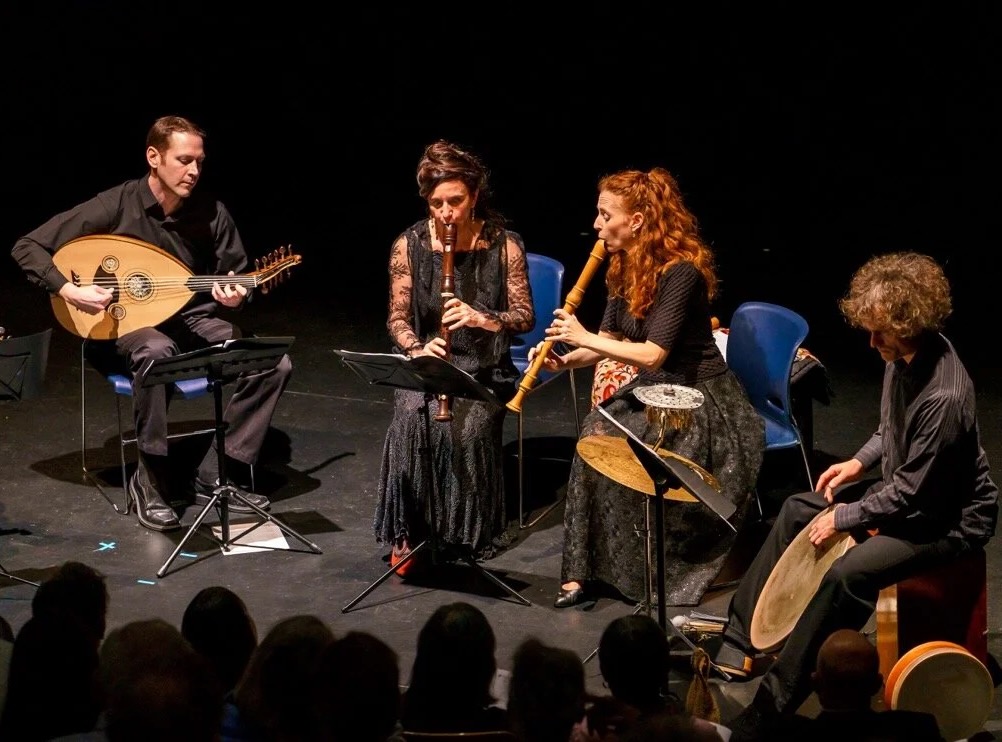
Their supporting ensemble—Hasan Isakkut, kanun (hammer dulcimer); Kane Mathis, oud (Arabic lute); Tal Mashiach, plucked double bass; and Shane Shanahan, percussion—created musical atmospheres during the concert that put one in mind of a classical basso continuo one minute and an Istanbul café the next, even veering into jazz and bluegrass at times. Apparently that’s what you get when you pour the bottles marked African, Iberian, Ottoman and Jewish into the same beaker.
Spanish rhythms, popularized by composers from Spain and elsewhere (Bizet, Rimsky-Korsakov) tapped in the background of the praise-to-God songs “Yigdal” and “Ein Keloheinu,” a swinging Andalusian rat-a-tat in 3 for the former and a leisurely habanera for the latter. Arms raised, Mor as much danced the songs as sang them.
Mor joined Stern on recorders for the light-stepping dance tune “Kürdi Peşrev,” one of the few items on this program attributed to an individual, in this case the 17th-century composer Solakzade Mehmed Hemdemi. Oud player Mathis began it with some hot picking in a solo cadenza, matched later by kanun player Isakkut’s fiery, note-bending solo.
Another striking monologue—this time clarinetist Stern, showing extraordinary breath control in long, softly inflected phrases—introduced the slow, sinuous dance “Porke Yorach.”
Over a spare accompaniment in lively, ever-shifting meters, Mor sang the prayer song “Anenu” (Answer Us)—which was also the overall title for this concert—softly but fervently.
The jazz club came to Turkey with the Ottoman dance “Rast Sirto,” Mor and Stern tweeting on soprano recorders, Shanahan waving his jangly tambourine, and the audience applauding mid-piece for blazing solos by kanunist Isakkut and oudist Mathis.
Following intermission, the sound of a lone clarinet floated down from the church’s mezzanine, as Stern brought liquid legato and astonishing agility to the traditional night song “Tarde de Verano.”
An impassioned, flamenco-style oud monologue set the scene for the prayer song “Achot Ketana,” with Mor and Stern exchanging tender phrases. The song was in a rare (for this program) major key, but, thanks to Mor’s delivery, managed to sound plaintive anyway—as well it should, with a pathos-laden text begging God to relieve the suffering of “the little sister” (the Jewish people) whose “soul has been melted…in the pit of exile.”
It fell to percussionist Shanahan to make the transition to lighter fare with his own composition (improvisation?) titled “Invocation,” which deployed his full battery plus vocalizing into a frame drum and Tuvan overtone singing to build a climax that brought cheers from the audience.
And so the stage was set for the comical wedding song “Anzi dice la nuestra novia” (Says the Bride-to-Be), with a pert singer Mor raising a slightly salacious eyebrow at the bride’s descriptions of her groom. The band swung between verses, and the audience clapped long.
The fast dance “Hiçaz Sirto” by the 19th-century composer Sultan Abdülaziz found Mor and Stern playing the twisty tune in unison on recorders, synchronized superbly.
More vocal hilarity ensued, as a mother offered various virtuous men to her daughter, who gleefully chose a drunkard instead, in “Ija Mia” (My Daughter).
The group kept the good times rolling in their encore, “Quando el rei Nimrod,” with Mor singing, Stern sparkling on sopranino recorder, Shanahan firing off another percussion solo, and more clapping along in the house. To paraphrase an old advertisement, you don’t have to be Jewish to love Rosh Hashanah.
Music Before 1880 presents Sandeep Das, tabla; Suhail Yusuf Khan, sarangi and voice; Jay Gandhi, bansuri; and Abhik Mukherjee, sitar, in “Rhythm of Light: A Diwali Celebration,” 5 p.m., Oct. 19 at Corpus Christi Church. mb1800.org
Leave a Comment