With Hernández debut, big voices and big drama in Met’s “Tosca”
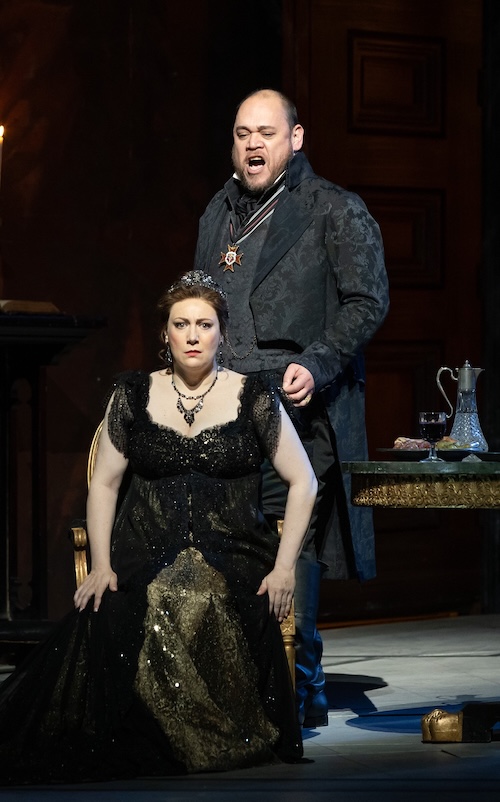
After a defiant “O Scarpia, avanti a Dio!”, Saioa Hernández leapt from the Castel Sant’Angelo, and the audience roared as the curtain fell Sunday afternoon.
Hernández was making her Metropolitan Opera debut in the company’s first Tosca of the season, joined by SeokJong Baek as Cavaradossi and Quinn Kelsey as Scarpia. For those who like full-throated, unapologetically dramatic singing, this is a dream cast for you.
Before this, Hernández had sung in New York only once, in concert at Carnegie Hall with Madrid’s Teatro Real in June 2025. Four arias in Spanish gave a tantalizing taste of her voice and artistry.
The Spanish soprano has appeared at many of Europe’s most prestigious opera houses, from La Scala to Covent Garden. She describes her instrument as falling between lyric and dramatic soprano, with a particularly strong lower and middle register, which hits the nail on the head.
Montserrat Caballé and Renata Scotto count among Hernández’s teachers, and their influence is felt in her artistry. She has a commanding presence, and grand gestures come as naturally to her as small details, such as the meticulous way she arranged the candles and crucifix after stabbing Scarpia twice. She was ready to strike a third time, but he died too quickly on Sunday.
Hernández entered in a flurry of piety, love, and, most of all, jealousy. Her voice commanded attention from the outset, with streams of sound soaring above Puccini’s orchestration. She was at her fiery best when confronting Scarpia, vocal allure giving way to torrents of rage. The final measures of “Vissi d’arte” showed that her shimmering pianissimo was as compelling as her forceful high notes.
Since his Met debut in 2023 as Ismaele in Verdi’s Nabucco, Baek has delivered one adrenaline-charged performance after another. Vocally, he is as impressive as ever, but he has since developed into a real stage animal, commanding the stage with ease and zeal. He begins “Recondita armonia” full-voiced, rather than with softer, soaring lyrical lines, but his lovely description of Tosca’s gentle hands after learning that she has killed Scarpia reveals the romantic beneath the bravado.
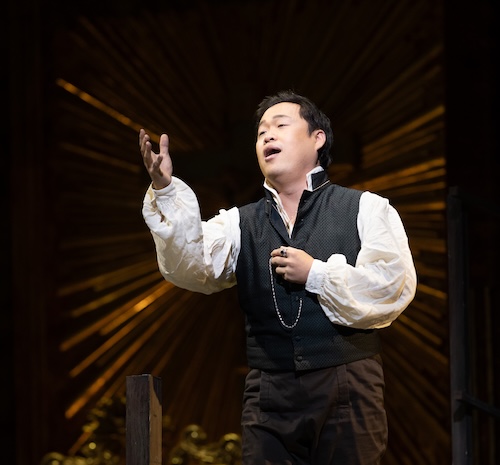
Tossing restraint and taste aside, he held his triumphant shout of “Vittoria,” celebrating the news of Napoleon’s victory at Marengo, for an eternity, which was thrilling. Returning to earth, he revealed Cavaradossi’s artistic sensibility and poetic soul in a heart-rending “E lucevan le stelle,” caressing its final phrases rather than exploding them.
Kelsey probes the black depths of Scarpia’s soul with a subtler touch. The malevolent force Kelsey unleashes in the Te Deum is overwhelming, fueled by comparable power and dread from the orchestra and chorus.
His Scarpia can feign seduction, but torture is what he thirsts for, whether his victim is a political prisoner or a woman he discards once he has had his way. Kelsey’s voice was magnificent throughout Sunday, an imposing carpet of sound that rises to every occasion.
Paul Corona offered a restrained Sacristan, one not out for broad laughs, with the kind of rich, velvety bass seldom heard in the role. William Guanbo Su was equally effective as a dignified Angelotti, with a compelling, natural stage presence and an equally plush voice. As Spoletta, Thomas Capobianco was briskly efficient and just as tidy vocally, but a greater measure of malice would have made his portrayal more compelling.
The performance caught fire from the downbeat, fueled by tremendous energy from the pit. With such a cast, Oksana Lyniv could paint in the broadest emotional strokes, and so she did. This is a conductor who understands that opera can be a blood sport and she drew similarly intense performances from the Met chorus and orchestra.
David McVicar’s historically accurate, atmospheric production has proved its worth, permitting the music to reign supreme in a setting just as Puccini might have imagined.
Tosca continues through November 20. Additional runs with different casts begin January 6 and April 28. metopera.org
Leave a Comment