Powerful singing, visual spectacle overcomes staging lapses in Met’s “Samson et Dalila”
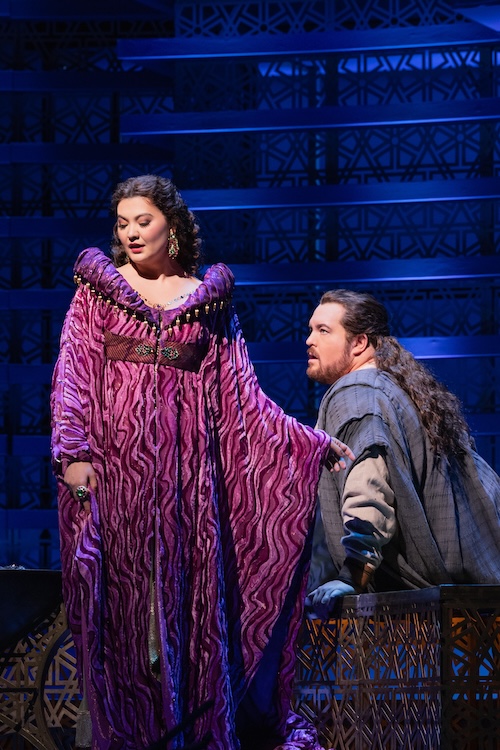
In its 2018 staging of Samson et Dalila, the Metropolitan Opera went for monumental scale and old-style Hollywood glamour; some might even say kitsch. Many critics found it boring with the action in need of an update.
The Met production of Camille Saint-Saëns’s opera returned on Friday night and the prior focus on spectacle and a starry cast remained paramount. Director Darko Tresnjak, best known for his Broadway work, set designer Alexander Dodge, and costume designer Linda Cho all made their Met debuts with this production. Towering twin edifices dominated the stage in Act I, creating the exterior of the temple of Dagon, the god worshipped by the Philistines.
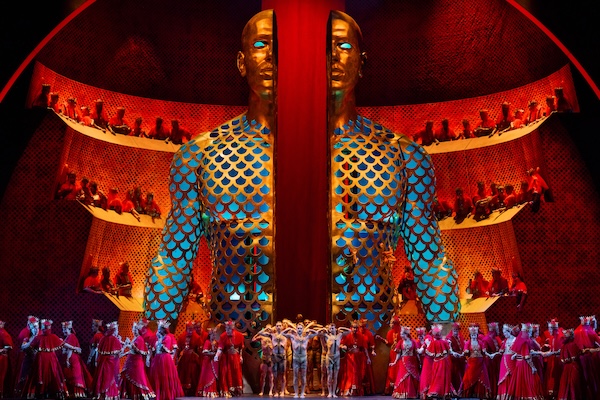
The scene introduced two recurring decorative motifs: the intricate tracery on the stone walls and mirrored imagery, which returned in the final scene in the form of a golden statue of Dagon, split in half. It also exposed Tresnjak’s inexperience in staging a chorus. He seemed content to let the singers mostly stand and sing, an uninspired approach in an opera in which the chorus is central to the drama.
Donald Holder’s lighting made the first act pop visually, with the temple walls evolving from parched bone white to a soft amber glow, then to lovely, sensual hues of gold and rose. Dalila’s home was palatial, if nondescript, dominated by two tall braziers. Blinded and shorn of his hair, Samson toiled at a millstone, while the Philistines, costumed in garish red and gold, then worshipped with abandon. The ending fizzled. No walls crashed down, just a bit of dust.
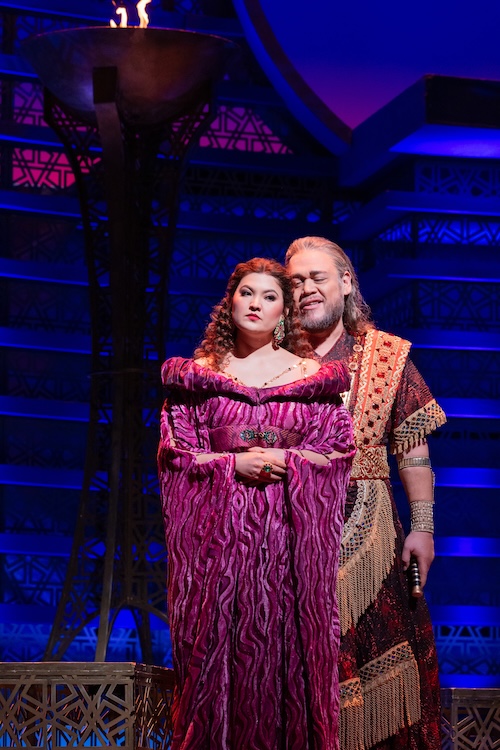
Clay Hilley made his eagerly anticipated Met debut as Samson. The American tenor is being hailed as a rising Heldentenor, and he has the goods. He came on like gangbusters in the opening scene, rousing the Israelites to revolt, but quickly settled into a performance marked by equal ardor and a more refined palette of vocal colors and dynamics.
Hilley cuts a more massive than heroic or romantic figure, which made the image of Samson pushing the millstone in the dungeon particularly moving. Vocally, he was at his best there, imploring God to punish him and spare the Israelites. Although his strength was restored, his final cries for vengeance seemed strangled, or at least obscured in the closing scenic muddle.
Aigul Akhmetshina’s Dalila alternated between smoldering and seething. Every inch the silver-screen seductress, she is particularly alluring in the simple green sheath she wears when Samson succumbs to her charms. The calculated coolness of her icy glamour extends to her singing, in which sensuality gives way to Dalila’s determination to crush the man who has rebuffed her.
Many today bemoan the homogenization of voices, with few discernibly distinctive qualities. Akhmetshina bucks the trend, especially in the middle and lower registers, which are central to Dalila’s role. Her notes do not ring out with force, but the sound she produces is captivating and complex. The opera’s most famous aria, “Mon cœur s’ouvre à ta voix,” was less an outpouring of passion than an exercise in calculated seduction. In the final scene, crowned and robed in red, she was proud, imperious, and triumphant.
Quinn Kelsey notched up another win with his role debut as the High Priest, dominating every scene in which he appeared. In contrast to Akhmetshina’s cool Dalila, Kelsey’s High Priest was ebullient and boastful, yet equally cold-blooded. His luxurious voice and commanding temperament held the stage, especially when cursing Samson after the Israelites’ successful revolt and later mocking him and his God, words he came to rue.
As Abimélech, Alfred Walker forcefully denounced the Israelites and attacked Samson, who dispatched him in short order. His foil was Morris Robinson’s Old Hebrew, who rallied the Israelites to revolt with a robust, authoritative bass. With even less time on stage, Derrek Stark made a strong impression as the Messenger, displaying a gleaming lyric tenor in his Met debut.
Austin McCormick’s choreography for the Bacchanale was heavy on the sensual but light on the delirium Saint-Saëns instilled in the music. More male flesh was on display than female, with rotating couplings of all sorts as the main theme. The Philistine women’s chorus, which opened the scene by greeting the dawn, was richly colored and full of expectation.
Conductor Giacomo Sagripanti drew uninhibited energy from the orchestra, with the oboe adding aural sensuality and the percussion steadily ratcheting up the intensity. The conductor’s command of the score was evident from the first downbeat. He guided the chorus through a tension-filled evolution from despair to an intense affirmation of faith.
The men were particularly effective in the solemn, chant-like prayers of Act I, while the women welcomed spring in lilting tones. Sagripanti favored long, shimmering lines, which, for all their beauty, at times drained forward momentum from the more lyrical passages. Still, when the music called for excitement, he never stinted.
Samson et Dalila runs through December 23. metopera.org
Leave a Comment