Dudamel, singers and Philharmonic bring finely detailed brilliance to “Tosca” at Carnegie Hall
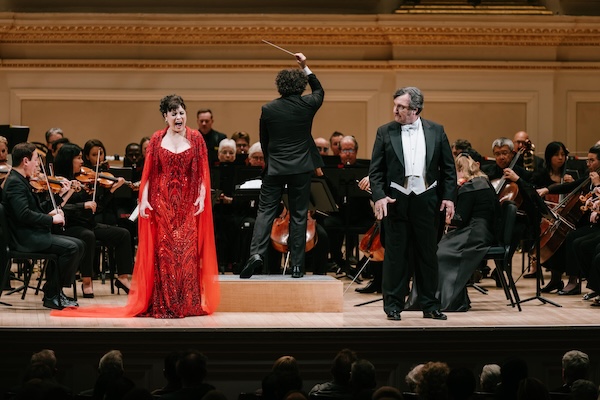
Giacomo Puccini was such a red-blooded man of the theater that the idea of performing one of his operas in concert format, as if it were Messiah or Beethoven’s Ninth, might seem incongruous. But Friday’s performance of Tosca by the New York Philharmonic under its newly-installed music director Gustavo Dudamel offered several reasons it was worth a try.
One was the opportunity for a New York audience to hear superstar tenor Jonas Kaufmann sing an entire role, not just an aria here and there, as well as an incandescent Tosca in Latvian soprano Marina Rebeka.
Another was to get Puccini’s colorful orchestra out of the pit and observe its works, like a watch with a transparent face.
Yet another was to see how conductor Dudamel’s well-known skills on the symphonic canvas translated into character and atmosphere on the opera stage.
Staging in the concert was minimal, the singers entering and interacting with each other on the stage apron in front of the orchestra and Dudamel on the podium. As is traditional, formal concert attire reigned for the top three roles of Tosca, Cavaradossi and Scarpia, with variations on black-suit-and-tie for everyone else (including conductor Dudamel). The most visual variety was provided with three magnificent gowns for Rebeka as Tosca—one for each act, in white, red and black, respectively.
Kaufmann’s vocal instrument was in superb condition—the manly middle, the broad and ringing top—and he used it with the sensitivity and intelligence for which he is famous, if without projecting much animal magnetism as the passionate painter Cavaradossi.
Kaufmann’s rafter-rattling cry “Victoria!” on hearing that Napoleon’s army was coming to rescue the Roman republic, seemed to come out of the blue, more a show-off moment for the tenor than an emotional peak for the character.
Soprano Rebeka splendidly inhabited the role of Tosca, originally created by the playwright Sardou for no less a figure than the legendary Sarah Bernhardt. Rebeka’s projection of the character’s conflicts and torment in action and aria—especially the half-choked, tenderly inflected “Vissi d’arte”—was beyond reproach. Rebeka’s performance in Act III, notably her retelling of action we’ve already seen (the murder of Scarpia), gave fresh meaning to the term “dramatic soprano.”
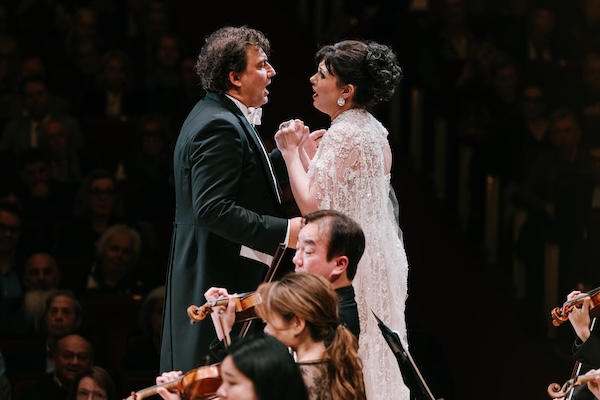
With his diabolical shout rising over the grand choral Te Deum at the end of Act I, the lustful police chief Scarpia rarely fails to steal the show from the “good guys,” and baritone Ludovic Tézier filled the bill admirably. A dignified presence in his formal attire at first, he soon made clear what corruption may lie beneath such respectable appearances, his smooth voice growing rough and edgy as he confided his plans to his assistants, then going buttery as he attempted to seduce Tosca, then coerce her.
Two bass-baritones, Andrew Moore and Ben Brady, projected well as the fugitive Angelotti and the Sacristan respectively, the latter bypassing the customary old-man shuffle in the role for a sort of music-hall soft shoe, for unknown reasons.
Ben Reisinger and Benjamin Taylor attentively followed orders as Scarpia’s lieutenants Spoletta and Sciarrone. Christopher Humbert Jr. appeared as a jailer, and young Emrys Pengelly unaffectedly sang the shepherd boy’s song.
Every singer in the cast, from Rebeka to boy treble Emrys, was listed in the program as making her or his New York Philharmonic debut.
Dudamel led the proceedings with his back to the action—unusual for an opera conductor, but familiar enough in a symphonic context with soloists. Pulling the orchestra out of the pit made visible the care with which the conductor created Puccini’s effects, beginning with the powerful drama of the opening pages, but melting soon enough into the lush harp and perky woodwinds that underlay Kaufmann’s floating high notes in Cavaradossi’s meditation on art, “Recondita armonia.”
Similarly, the orchestra had its moment to shine—or rather, shimmer—in the pastoral opening to Act III, as Dudamel coaxed barely-there murmurs and sighs from strings and woodwinds as a backdrop to Cavaradossi’s soliloquy in his cell, “E lucevan le stelle.”
Even when the spotlight was on the singers, Dudamel was just a few feet away, cushioning their phrases or driving the action toward the drama’s climaxes.
Singers from the New York Philharmonic Chorus, directed by Malcolm J. Merriweather, and the Brooklyn Youth Chorus, directed by Dianne Berkun Menaker, squeezed into the sides of the stage to swell the sound of the Act I finale to great effect.
Carnegie Hall presents the Chamber Orchestra of Europe, conducted by Yannick Nézet-Séguin with pianist Beatrice Rana, in an all-Brahms program, 2 p.m. Dec. 6. carnegiehall.org
Leave a Comment