Bach cantatas scaled down and livened up by The Sebastians
Decades after Joshua Rifkin proposed it in 1982, the hypothesis that J.S. Bach had his choral works performed not with large choirs but with just one vocalist per part is still such a subject of debate that it has its own shorthand: OVPP.
In the absence of definitive documentary evidence about Bach’s own practice, the proof of this pudding is in the performing, and—no surprise—this composer’s fabulous music sounds great either way.
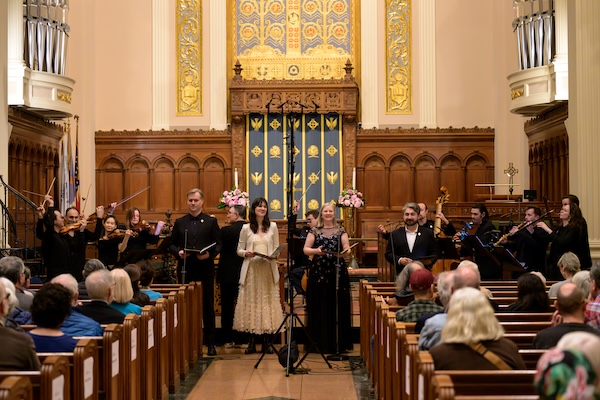
The Sebastians made that point last April with an OVPP performance of no less a monumental choral work than Bach’s Mass in B minor. Saturday afternoon at Brick Presbyterian Church on Park Avenue, the early music group gave the same treatment to two of the composer’s most beloved church cantatas, with similarly expressive and insightful results.
Bach composed over 200 such works for Sunday morning worship, each one artfully weaving a familiar Lutheran hymn through poetic meditations on spiritual themes. On Saturday, the ensemble of four singers and an eleven-piece Baroque orchestra seemed well-suited to such intimate utterances, while still able to fill a good-sized church sanctuary with glorious vocal and instrumental sound.
The cantatas were cannily selected for contrasting character: “Wachet auf, ruft uns die Stimme,” BWV 140, a midnight tableau of wise virgins (the Church) slipping out to meet their bridegroom (Christ), and “Ein feste Burg ist unser Gott,” BWV 80, fairly dripping with imagery of war against Satan.
The opening chorus of “Wachet auf” set the scene: violins tiptoeing over a steady double-bass beat, oboes providing sparkly adornments, as soprano Clara Rottsolk floated the hymn tune (“’Wake up,’ the voice calls to us”) in long, golden notes, while the other three singers commented contrapuntally.
The story advanced with increasing anticipation through a sequence of narration, chorales, and what can only be called love duets for soprano Rottsolk as the Soul and bass Paul Max Tipton as Jesus. Violinist Daniel Lee, a scholar of and performer on the piccolo violin, accompanied the duets sweetly on his tiny instrument.
Tenor Jacob Perry turned up the suspense in the recitative “He comes, he comes,” and warmly led the chorale verse “Zion hears the watchmen singing.” The first duet was anxious (“When are you coming, my salvation?”), the second ecstatically fulfilled (“My beloved is mine”). Alto Sylvia Leith rejoined the others for the room-filling final chorus (“Glory be sung to you”) over a strong walking bass in the orchestra.
Soprano Rottsolk stood out in ensembles with her powerful, vibrato-less head tones, which when turned loose could fill the room by themselves. Alto Leith, tenor Perry, and bass Tipton performed with strong, well-supported, forward-placed voices with minimal vibrato in the Baroque style, and all could adapt their tone to the sense of the text.
That latter trait was a must when shifting from the (spiritual, of course!) pleasures of the Soul and the Bridegroom to the bloody battle to defeat Satan in “Ein feste Burg.” That cantata opened seemingly in the middle of the action, the four singers standing behind the orchestra and blending with it as the hymn tune was barely glimpsed in the contrapuntal opening chorus.
Bass Tipton sang the fast aria “Whoever is born of God” with running strings while soprano Rottsolk and an oboe simultaneously intoned the hymn’s second verse. He continued in that vein, preaching vigorously in the recitative “Consider, child of God,” recruiting Christians for the battle, but softening enough by the end to invite the soprano’s eager reply aria, “Come into my heart’s house,” a swirl of melismas and delicate vocal ornaments, finely tuned by Rottsolk.
God’s legions set gaily forth in the next chorale verse, an orchestral piece in a swinging three with hunting horn and scampering strings, and lines from the hymn interleaved by the singers in unison. Tenor Perry led the cheers exuberantly in the recitative “Stand fast, then”—but then the focus changed suddenly from the battlefield to the heart of the faithful individual. The duet “How blessed indeed”—significantly, for the quartet’s middle voices, alto and tenor—looked inward to the victory of the faithful soul over death, with mellow obbligato solos by violinist Nicholas DiEugenio and oboe da caccia player Priscilla Herreid.
Orchestra and singers delivered the closing hymn verse’s rather bracing message—“They shall let that Word abide,” while the faithful lose everything else in this mortal life—straight in four-part harmony, without adornment.
Of course the audience applauded the fine performance enthusiastically, but that would still have left them staring into the severe face of Martin Luther at the end of the concert, had not the Sebastians already programmed an encore: the Duet and Chorus “Happy we” from Handel’s Acis and Galatea. This bouncy number in jig tempo featured tenor Perry and soprano Rottsolk as the ecstatic lovers, eventually joined in chorus by the other singers, as the word “happy” was sung approximately 400 times.
Prior to that, at mid-program, the Sebastians also offered a very brief concerto by Vivaldi, the G minor, RV 157, as a sorbet between the cantatas and, as the group’s keyboardist and leader Jeffrey Grossman said, “a chance for our strings to shine.” And shine they did, first the two violins and viola in a passacaglia full of variations of phrasing and touch, then a lively Largo, and finally an intricate, very fast Allegro with cello and double bass getting into the virtuoso act as well.
The Vivaldi made for an agreeable interlude, and maybe also a commercial for the Sebastians’ next concert.
The Sebastians, with violinist Robert Mealy, will perform “Violin Violin Violin,” a program of works featuring three violins by Schmelzer, Gabrieli, Purcell, Buonamente, Pachelbel and others, 5 p.m. Feb. 6, 2027, at Saint Ignatius of Antioch Episcopal Church. sebastians.org
Leave a Comment