At 50 “Einstein on the Beach” continues to reveal new depths and mysteries
In his memoir, Words Without Music, Philip Glass explains that when asked to describe who he is as an artist, he says he’s a theater composer. The sheer number of operas, several of which are masterpieces of the form, might make that obvious, but there’s an underlying and essential theatrical quality in his composing that extends into his vast catalogue of instrumental music.
Glass is always trying to tell a story through the classic means of harmony and thematic development, it may be as simple as the feeling you get moving from minor to major, but it’s something he’s try to get you to feel. That expressive transformation is the essence of music drama.
The truth of it is also clear in his collaboration in experimental opera with Robert Wilson, Einstein on the Beach. It’s an opera because, yes, it is a music drama, with a libretto. It also has no plot, no story, the libretto is spoken and the only sung words are numbers or solfège syllables.
And as the 50ᵗʰ anniversary concert of the work Thursday night at the Brooklyn Academy of Music showed, it delivers a powerful feeling of transformation from one state to another.
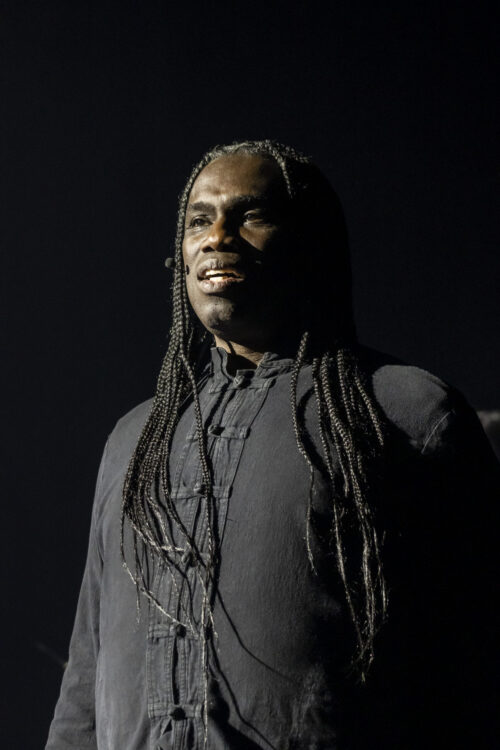
These performances, which run through Saturday, are not fully staged, but a concert version played by the Philip Glass Ensemble, with actor Kye Grant Kauffman, violinist Aliayta Foon Dancoes, and a chorus that includes bass-baritone Joe Chappel performing the closing monologue originated by actor Samuel M. Johnson. Glass kept the sequence of scenes in order in this version, while removing most of the dances and compressing some elements of different scenes—“Trial” in Act I is cursory, for example, rather than the half-hour plus from the 1984 production at BAM. With that and limiting the number of repeats throughout, this cut the performance time down from around four hours or more to three hours, including an intermission.
Duration is fundamental to this fabulous piece, which is not only the science opera in Glass’ trilogy, with politics (Satyagraha) and religion (Akhnaten) but is about time. The “Train” and “Spaceship” scenes connect to Einstein’s breakthrough about the effect of velocity on the flow of time. The opera works through music that holds each scene in place for extended durations while swirling through constant activity, repetitions that seem to chase their own tails with alacrity. A concert performance strips things down to their core and tests the music mercilessly—Thursday the results were often beautiful and exhilarating, ultimately profound and mysterious in the way of great art.
That relied, of course, on Glass’ score. The Ensemble’s playing and the vocal performances were often superb, rich and thrilling with expressive and physical excitement. Kauffman, in the speaking role first handled by choreographer Lucinda Childs (who wrote the libretto with poet Christopher Knowles) and then Suzanne Vega, had a relaxed stance with a witty and slightly aggressive edge to her delivery that set her apart from Childs and Vega—without sets and staging, Kauffman was the drama and one began eagerly anticipating each new entrance. Dancoes had a meaty, grainy sound as she played the “Knee Play 2” solo. The Ensemble was energetic but slightly disorganized at first, not everyone attacking the notes at the same moment; as the opening moved from “Knee Play 1” to “Train,” synchronization improved.
The concert not only laid bare the score but the state of the Philip Glass Ensemble itself, which has been a critical question the last couple of years. Still led from the keyboard by Michael Riesman, who played the premiere in 1976 and, as he noted in the program, 148 total performances, it’s not clear how much longer they’ll be playing this and Glass’ other great masterpiece, Music in Twelve Parts. While most of his music has moved into the repertoire, these pieces are still the PGE’s domain.
Thursday night’s playing was mostly expert but, at times, almost disastrous. There were three major stumbles that, like in the 50th anniversary performance of Music in Twelve Parts, came from Riesman. The first, in “Dance 1,” was upsettingly anxious, Riesman fumbling his part, different subgroups of the ensemble on different beats, like a car on two wheels on a fast curve, before regathering themselves. At a later passage after intermission, he and Dancoes fell apart from the ensemble and had to struggle to get back into the flow. This is a critical thing in Glass’ music, the constant flow is like the peloton in the Tour de France where one rider crashing threatens the entire group.
The musicians held it together, and that flow and the power of the score drove everyone along—like a passing train gathering passengers without stopping. Einstein is simply a fantastic, engrossing live experience, and there were extraordinary stretches Thursday night. Not only Kauffman but Chappel was excellent, a spellbinding orator holding time still in his hands. The Act IV “Building” scene was one of the most exceptional musical experiences of recent memory, Andrew Sterman playing an extended, Michael Brecker-esque tenor saxophone solo while Ensemble vocalist Lisa Bielawa stood alongside Riesman, conducting a choral improvisation by placing massed vocal chords alternately in different registers and at different dynamics. Dancoes at her best, including the final “Knee Play 5,” played with beautiful phrasing and fine touches of rubato.
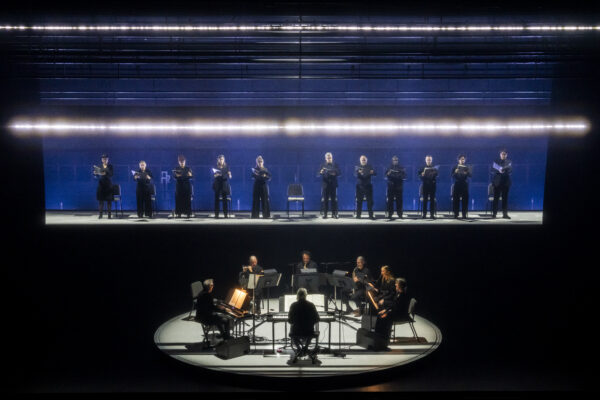
Though not staged, the performance moved the chorus around, flanking the Ensemble of elevated behind it. Marc Heimendinger lighting design was a series of bright, different colored horizontal lines moving vertically, and it seemed to expand the space as the music stretched time. Chapel’s final monologue, ending on, “with fervent osculation,” was uncannily moving. For however long this music can be heard live, one was immensely grateful for the experience.
The Philip Glass Ensemble performs Einstein on the Beach, 7:30 p.m., Friday and Saturday bam.org
Leave a Comment