Akhmetshina soars from Rachmaninoff to Styne at Zankel Hall
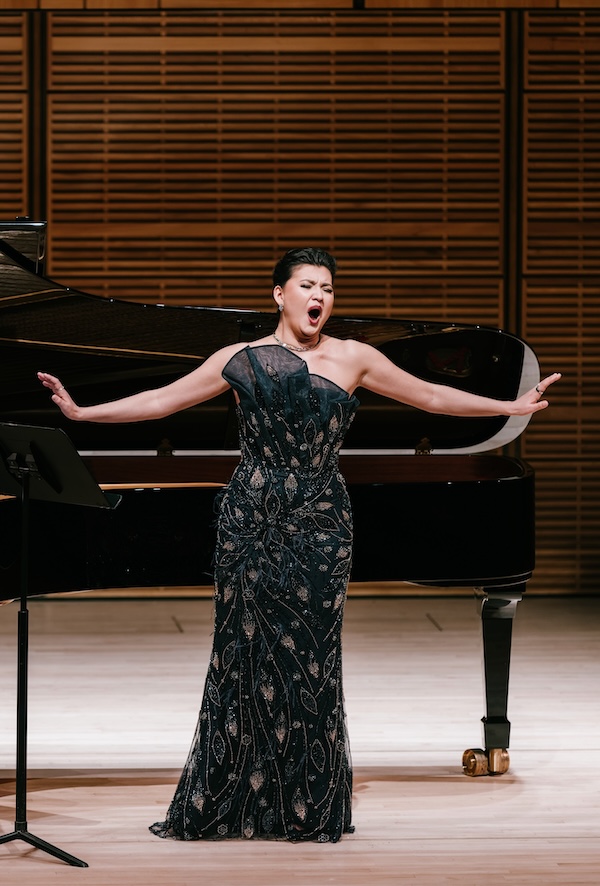
“Sold Out” was plastered across the marquee for Aigul Akhmetshina’s Zankel Hall recital on Wednesday evening. That’s an increasingly uncommon sight for a song recital, but Akhmetshina is no ordinary singer.
New York audiences have encountered her only in operatic roles to date. Her big break came as Carmen on New Year’s Eve 2023, a combustible portrayal praised even by critics unimpressed with Carrie Cracknell’s revisionist production. She was an absolute delight as Rosina in The Barber of Seville and will return to the Met later this month as Dalila. In her New York recital debut the mezzo-soprano triumphed once again.
Akhmetshina developed the program entitled “Love Without Borders: A Journey in Three Chapters” with pianist Jonathan Palmer Lakeland, her “partner-in-crime,” as she described him. True to that billing, he contributed some remarkable virtuoso flourishes and occasionally stole the spotlight himself.
Their goal was to explore love as broadly as possible in a program mixing cultures, styles, languages, and genres. They professed little interest in a happy-ending story in which the lover always returns and passion remains in check. But beneath the gimlet-eyed realism, both are romantics at heart, and fun-loving ones at that.
The first chapter began with Russian songs expressing love at its most idealistic. That description proved somewhat misleading, given the dusky quality of Akhmetshina’s voice, which infused even the most chaste expressions of love with sultry passion. Her form-fitting black-sequined gown reinforced the impression.
That dichotomy was present from the start. Akhmetshina began Rachmaninoff’s “Morning” in low, cavernous tones as dawn whispered words of love. By the end, when she sang of dew like diamonds, her voice had turned light and sparkling. “I Wait for Thee” followed a similar progression, although her smoldering expressions of longing dispensed with any notion of innocence.
The rarity was “I Loved Him” by Mily Balakirev, whose influence as a mentor to the young Tchaikovsky is better known than his songs. Akhmetshina gave this portrait of desire a conversational quality before unleashing an outburst of high notes at its conclusion. Lakeland, who had provided lyrical support in the Rachmaninoff, responded to Balakirev’s urgent piano introduction and rapturous postlude with considerably more dramatic intensity.
In Rimsky-Korsakov’s “Enslaved by the Rose, the Nightingale,” Lakeland conjured the colors and atmosphere of Middle Eastern music, creating an exotic soundscape for a deceptively simple tale of unrequited love. The vocal writing sat higher in Akhmetshina’s range, and she brought the song to a captivating close with an extended vocalise.
The Russian songs had an authoritative air, given that Akhmetshina was born and raised in Russia, but she has a Latin soul. Carlos Guastavino, known as “The Schubert of the Pampas,” was represented by “La rosa y el sauce,” an allegory of lost love. Lakeland established the mood in the beautiful opening, which returned as a wordless vocalise that Akhmetshina imbued with simple sadness, without a hint of sentimentality.
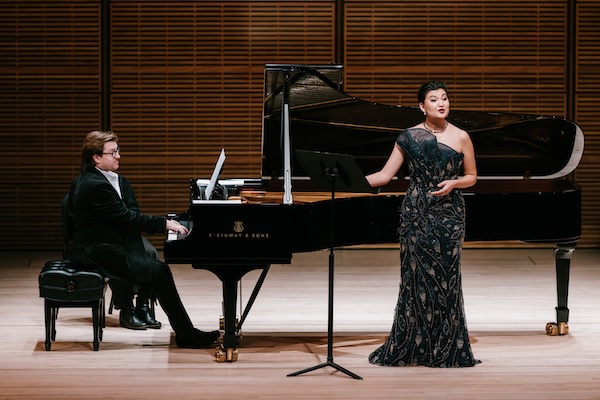
In Kurt Weill’s “Je ne t’aime pas,” Akhmetshina caught the bitter contradiction between a woman’s insistence that she no longer loves her former lover and the raw emotion betraying her words. She delivered it with the sophistication of a chanteuse, without diminishing its anguish.
The centerpiece was Elena Roussanova’s “Mujer Fatal,” composed especially for Akhmetshina. Drawing on the Spanish-inflected world of Carmen, particularly its habanera rhythms, it offers a more complex portrait of feminine independence. A natural fit for Akhmetshina, it exploited the dusky sensuality of her lower register, the brilliance of her upper range, and her agility in executing vocal leaps and elaborate roulades. Lakeland supplied more Spanish flavor, alternating seductive lyricism with flashes of rhythmic intensity.
After the introspection of Weill and the sensuousness of Roussanova, the pair burst onto the scene with the irrepressible tango energy of“Yo soy María” from Astor Piazzolla’s tango opera María de Buenos Aires. Akhmetshina relished its swaggering declamation and soaring vocal flourishes, capturing the defiant spirit of Buenos Aires’s most provocative inhabitant. Lakeland matched her theatricality with incisive rhythms, propelling the song to a triumphant conclusion.
In a chic, sophisticated black gown, Akhmetshina got down to business with Britten’s deliciously irreverent setting of W. H. Auden’s “Tell Me the Truth About Love.” She relished the poem’s absurdities about why what comes naturally to others eludes her at the ripe age of 31, changing Auden’s 35 to match her own. Lakeland was again an essential partner, adding cabaret flair with his adroit handling of the syncopated figures and jaunty rhythms.
Frustration yielded to sultriness in Gershwin’s “The Man I Love,” while the rich throatiness of Weill’s “Speak Low, When You Speak Love” was tempered by Akhmetshina’s nonchalance as she contemplated love as gold and time as a thief with a startling lightness of voice. Incongruous as it might seem, Rachmaninoff’s “How Fair This Spot,” with its intimacy and sense of fulfillment, proved the perfect response to the preceding songs of hope and seduction.
After the dreamlike Rachmaninoff came Lakeland’s “The Temple Bell Stops,” a piano arrangement of a larger work he is composing for Akhmetshina, scored for mezzo-soprano, orchestra, and choir. Its text draws on poems by the seventeenth-century Japanese haiku master Matsuo Bashō, in which the boundary between the human and natural worlds dissolves. Lakeland’s vocal writing captured Bashō’s evocative imagery, which Akhmetshina imbued with quiet expressiveness. At the piano, Lakeland conjured rippling water and other natural phenomena with delicate intensity.
The program ended with searching renditions of “Somewhere” from Bernstein’s West Side Story and “People” from Jule Styne’s Funny Girl, the latter giving Akhmetshina an opportunity to belt a bit.
The first encore continued the contemplative mood with “The Nightingale,” a traditional Bashkir folk song connecting her to her homeland and childhood. Then the lid came off of Zankel Hall with Lakeland’s arrangement of Consuelo Velázquez’s “Bésame Mucho,” and Roger Edens’ “The Joint is Really Jumpin’ Down in Carnegie Hall” from Thousands Cheer.
Carnegie Hall Presents continues with mezzo-soprano Rihab Chaieb and pianist Ammiel Bushakevitz, 7:30 p.m. November 18. carnegiehall.org
Leave a Comment