Pegasus flies high with warhorses and a Nielsen dark horse
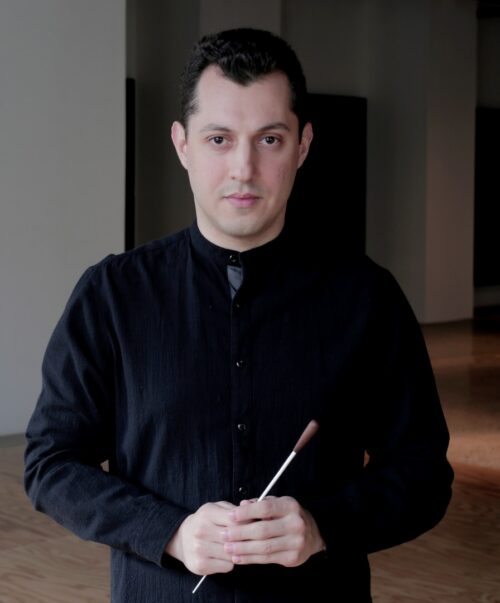
The ensemble that styles itself Pegasus: The Orchestra continued its tenth anniversary season Saturday night with a program at Merkin Hall, titled “Brilliance in Motion,” that demonstrated one thing if nothing else: This horse can fly.
Fittingly, a true warhorse led the charge: Glinka’s Overture to Ruslan and Lyudmila took wing in a flurry of strings, double basses included, as it has for countless orchestral concerts over the generations. The orchestra’s founder and principal conductor Karén Hakobyan led a snappy performance that also included some well-timed woodwind jokes and a soulful tune for cellos.
But then the traditional overture-concerto-symphony scheme got flipped, as the program continued with Carl Nielsen’s turbulent Symphony No. 1 in G minor, Op. 7, the better—explained conductor Hakobyan in a program note—to set the stage for the “brilliance, virtuosity, and release” of Prokofiev’s Piano Concerto No. 3 in C major, Op. 26.
At age 27, Nielsen didn’t labor 20 years over his First Symphony as Brahms did over his, but a similar youthful earnestness and feeling of struggle drive this piece. The first movement’s marking “Allegro orgoglioso” won’t be found in any music dictionary, but the adjective for “proud” or “arrogant” suited the slashing strokes and harsh drama that opened the piece, only briefly relieved by tender moments and a lyrical theme for strings.
Hakobyan and his players brought out the shifting moods of the Andante, with string lines gradually swelling to an oceanic forte, then thinning to a gauzy background for some novel woodwind doublings, and finally giving way to a golden sunset for horns.
It was Brahms who invented the not-quite-a-scherzo third movement for symphonies, and Nielsen carried the concept further in his First, shifting capriciously among dance rhythms and between energetic tutti and small ensembles. The movement closed, however, with a backward look: multiple quotations of the three-note head-motive of the scherzo of Beethoven’s Ninth.
Looking even further back, Nielsen evidently learned from Haydn the power of an upbeat to drive an entire finale. Insistence on that rhythmic kick enabled Hakobyan to keep this restless, harmonically unmoored music charging ahead to its affirmative conclusion in C major—the key, incidentally, of the Prokofiev concerto to follow.
The orchestra’s preparation was evident in the overall balance of the sound and the way each section took its turn in the spotlight without a lot of finger-pointing from the podium.
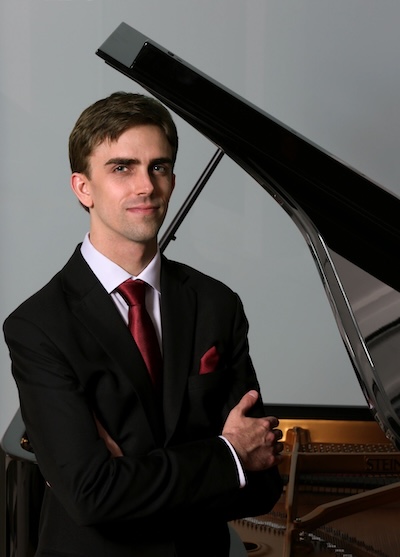
The concert’s theme of “brilliance” found an apt exponent in piano soloist Reed Tetzloff, who dispatched Prokofiev’s scurrying scales and interlocking-hands pyrotechnics with unflappable cool. In fact, some sort of affect would have been welcome, be it pleasure in athleticism or sparks of wit, to humanize the whole business—unless a 1920s age-of-machines aesthetic was what the pianist was after. In any case, his digital prowess was definitely a wow. And to be fair, he did project the first movement’s lyrical theme nicely when he had a chance.
The cozy confines of Merkin Hall, while not conducive to a big, blended symphonic sound, perfectly suited some of the neoclassical aspects of Prokofiev’s concerto, particularly the almost chamber-music scoring of the second movement, a theme and variations on a gavotte-like tune. Soloist Tetzloff and orchestra sections combined to create colorful miniatures ranging from a thumping march to a nebulous nocturne to a bit of cocktail piano.
“And they’re off!” again in the Allegro con fuoco finale, as the sixteenth-notes went flying with Tetzloff and Pegasus neck-and-neck in the back stretch. But this being a Russian concerto, everything had to stop for a grotesque little hopping tune and then a love theme that just kept soaring higher and higher. Pianist, conductor and orchestra did full justice to all these elements before getting back to the business at hand: brilliance and motion, to the max, to the end.
For an encore, Tetzloff played an arrangement of music from an opera by Jean-Philippe Rameau, revealing some fine voicing and luminous tone that the motoric concerto hadn’t called for.
Pegasus: The Orchestra, conducted by Karén Hakobyan with pianist Vyacheslav Gryaznov, will perform “Fire & Folklore,” a program of works by Rachmaninoff, Shostakovich and Kodály, and a new work TBA, 7:30 p.m. March 12, 2027 at Merkin Hall. pegasustheorchestra.org
Leave a Comment