Lim’s breathless speed race leaves Mozart sonatas largely in the dust
The Emperor Joseph II is famously said to have told Mozart that one of his compositions contained “too many notes.” Admirers of Mozart’s piano sonatas might wish they had a few more notes, if only to discourage virtuosos from tossing them off as a warmup for a recital of heavier fare.
Happily, that custom in recital programming is receding, but even now something about those spacious pages of Mozart score with just a trickle of sixteenth notes running through them tempts pianistic Maseratis to gun their engines.
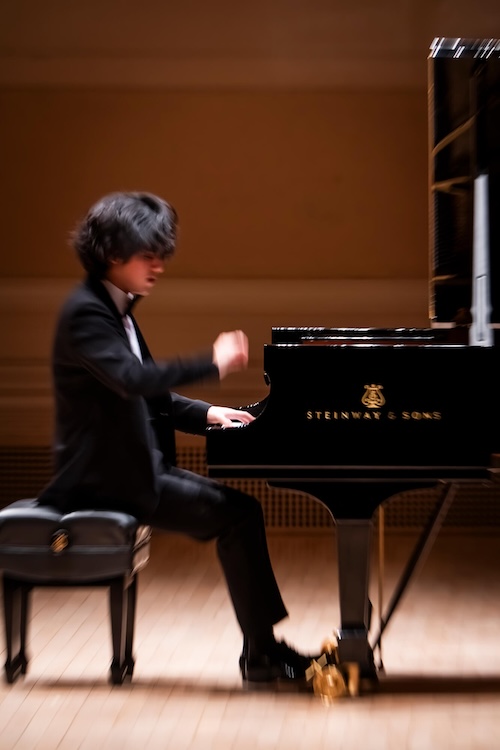
Even Yunchan Lim, who seems to bring a special brand of sensitivity and imagination to everything he touches, took Mozart on the Autobahn Wednesday night, in the first of four Carnegie Hall recitals devoted to all 18 of the master’s mature piano sonatas.
As artfully inflected phrases and figurations whizzed by on fast forward, it almost seemed as though the pianist’s internal clock ran at a different speed than other people’s. But it must be said that the general reaction in the audience was delight at the fireworks, with their curtains of sixteenth-note sparks and popping sforzandos. And at times Lim did succeed in making Mozart’s elegant designs audible, even at that speed.
Recital No. 1 in this Carnegie series began with the piece traditionally designated Mozart’s Piano Sonata No. 1, although the chronological order of the first five sonatas isn’t known. He composed them all at the ripe age of 19, in order to display his keyboard skills to audiences in Munich, where he had gone to supervise a production of his opera La finta giardiniera.
The Sonata in C major, K. 279, is certainly the “earliest” in terms of musical language, hewing closely to the style galant of J.C. Bach and other models. Lim’s fleet, articulated performance of the opening Allegro looked back even further, to Scarlatti.
The 1770’s were, in fact, a time of transition between the harpsichord and the fortepiano, literally the instrument of “loud and soft.” Mozart made clear which one he was writing for in this sonata’s Andante, whose score is littered with f’s and p’s. Lim leaned into those dramatic twists, and freely indulged in stretchy vocal rubato, to weave a luxurious mood in maximum contrast to the sonata’s sparky outer movements. The finale, with its ubiquitous tapping theme, went by in a playful flood of notes.
It was customary in the 18th century to issue sonatas, concertos, etc. in sets of six. A request from a local nobleman enabled Mozart to complete his Munich set with the Sonata in D major, K. 284. By this time, the composer’s restless invention had already developed the genre in several directions. This last of the group, for example, closes not with a bouncy rondo but with a set of eleven substantial variations that, even without the observance of indicated repeats, can run longer than the previous two movements combined.
In K. 284’s first movement, one begins to encounter the Mozart of the later concertos: the fertility of invention leading to wild mood swings bar by bar, the sighing lover becoming the impudent showoff, the pompous march sliding into brooding “Neapolitan” harmonies. Could Lim convey all that at the blistering tempo he took “Allegro” to mean? Mostly not, but at least he gave everything a second look by taking the indicated repeat of the exposition.
The sonata’s “slow” movement is marked “Rondeau en Polonaise” and Andante, meaning a stately dance in three to a bar and, literally, “going.” Mozart again sprinkled f’s and p’s liberally through the score. Lim chose mostly to ignore these markings and any semblance of dance in his free, meditative interpretation, but his glowing tone and ability to draw out long melodic lines were impressive.
Lim seemed very much in his element in the finale’s variations, crafting each as a brief character piece, whimsical, dreamy, or brilliant by turns. The penultimate variation sang in ornate lines like a Chopin nocturne, only to be capped by a short, snappy final variation, abruptly closing this one-of-a-kind sonata.
The pianist opened the recital’s second half with the brooding, Bach-like arpeggios of Mozart’s Fantasy in D minor, K. 397. One felt the tension and pathos of the arioso theme as it sang out of the D minor gloom, then accelerated into a breathless agitato. Enigmatic, cadenza-like scales slashed through the darkness. A bright new Allegro in D major appeared, and the piece seemed headed for an incongruously cheerful conclusion—but Mozart, apparently stumped for an ending, had left it unfinished. Presented with a choice, Lim opted to return, quite convincingly, to the D minor shadows where the piece began.
The Sonata in F major, K. 332, has been a recital favorite for its brilliant finale, obligingly marked “Allegro assai” (very fast) by the composer. Its profusion of fresh ideas in the first movement is the very definition of “Mozartean”: at least seven, possibly ten distinct themes in the first two pages.
How does one hold such diverse material together? One way is just to blitz through it, á la Lim on Wednesday, trying to note the character of each theme for the few seconds it lasts. The development section went better, unfolding more gradually over a sequence of modulations that the pianist outlined clearly.
The Adagio was simply a lovely aria over a steady accompaniment, arrestingly phrased whether softly or in a more urgent dynamic. On this night in particular, such islands of repose were most welcome. The finale’s blazing sixteenth-notes were fabulously accurate, but the movement was rhythmically a mess, as the pianist pretty much discarded the 6/8 meter and played any way he wanted.
Music historians have variously attributed the dark emotions of the Sonata in A minor, K. 310, a rare Mozart work in a minor key, to the composer’s disappointment in love, or the unexpected death of his mother, or a vogue in Paris (where he was visiting) for works of tragic character. Whatever the cause, Lim presented this work Wednesday as Mozart’s “rage” sonata.
The first movement began in orderly sonata form, with a major-key second theme offering relief from dark thoughts, but Lim let go in the development, as fury simmered, boiled over, and spilled into the recapitulation, scalding everything on its way to the angry coda. Even the lovely Andante cantabile con espressione in warm F major was interrupted by a glowering D minor episode. The final Presto was a Chopinesque “wind over the grave,” its almost meterless gusts rising to a howl and banging to a pitiless close.
The audience called Lim back repeatedly after this bracing performance, and he obliged with a note of cheer to end the evening: a true “encore” actually, a repeat of the finale of the Sonata K. 279, at an even dizzier tempo than the first time.
Carnegie Hall presents pianist Hélène Grimaud performing the last piano sonatas of Beethoven and Schubert, 8 p.m. Dec. 2. carnegiehall.org
Leave a Comment