Great music, moving moments vie with libretto, structural issues in Met premiere of “Lincoln in the Bardo”
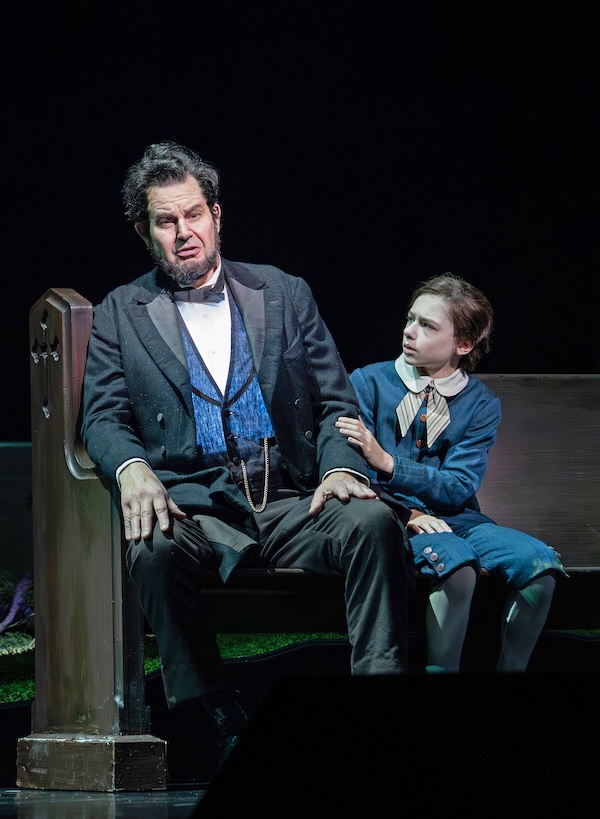
The Metropolitan Opera mounted the world premiere production of Missy Mazzoli’s Lincoln in the Bardo on Monday night. This is the first opera the Met has commissioned from a female composer, and is an adaptation of George Saunders’ 2017 novel of the same title.
The result is a fertile combination of creative minds and material. Saunders’ novel is populated with multiple characters speaking and thinking in multiple voices— almost begging for a set of singers—and Mazzoli is one of the most talented, if not always consistent, living opera composers. Throw in the fantastical nature of the story, and there’s a good possibility for some magic to happen.
And there was magic on the stage Monday night, including an enviable cast that includes baritone Peter Mattei as Lincoln, mezzo-soprano Stephanie Blythe, countertenor Anthony Roth Costanzo, bass-baritone Ryan McKinny, and soprano Janai Brugger. There were prosaic moments as well, some from the story itself, and some from the adaptation by Mazzoli and librettist Royce Vavrek.
The “bardo” is a limbo-like space populated by the dead, but unlike limbo, in the bardo the people don’t know they’re dead. They think they’re sick (in Buddhism, this is a liminal state before rebirth), but in the opera the implication is a way station before Heaven or Hell). One of these is Willie (child treble singer Everett Sobers in his Met debut), Abraham Lincoln’s 11 year old son who has just died from typhoid fever. The year is 1862, and mourning is constant; Lincoln goes out to the mausoleum—as he actually did—to hold Willie’s body. Both Lincoln and Willie are trapped by the boy’s death—Willie in the bardo, Lincoln within his own mourning.
Also there are narrative voices from the novel who are unrelated to Willie and Lincoln: Vollman (McKinny) and Bevins (tenor Jonah Hoskins), caught in longing for their beloveds; the Reverend (soprano Christine Goerke), who turned away from his fate in the afterlife; black men and women Thomas Havens (tenor Joshua Blue), and a young woman named Litzie (soprano Viviana Goodwin in her Met debut), who are vitally important at the very end; and other minor characters, the chorus, and various mysterious entities. Yannick Nézet-Séguin conducts.
The relationship between Willie and Lincoln, and his sorrow, drives the drama and guides Willie and everyone else to their inner transformations and final destinations in the afterlife. The opera’s theme is, plainly, the acceptance of death, for both those in the bardo and Lincoln himself. Mazzoli’s score moves the drama toward those moments of realization, both small and large. The latter are the hard-won epiphanies for Willie and Lincoln. In Act II, the opera’s deepest emotional resonance and most gripping moment comes in Lincoln’s aria, “Dear Little Chap,” itself designed to culminate on the line “Willie is dead.”
Mazzoli’s music is mostly well made, with evocative colors and moods, lyrical sung passages, and a structure that fulfills the fundamental demand in opera composing, which is to carry and reinforce the drama with sound.
Mattei has beautiful music to sing and delivered a typical moving performance with a full, gentle tone and perfectly articulated and modulated expression. To the overall musical care Mattei put into his singing, he added a wrenching feeling of sorrow in “Dear Little Chap,” singer and music finding the balance between tragedy and the strength to endure it. Sobers, who was miked, was a poised performer, his voice clear and at ease all night.
Even as the opera reaches this deeply haunting point, the atmosphere frequently dissipates into a normality that is out of place within the dramatic conceit.
“The problems in Lincoln in the Bardo come from the libretto, which swings drastically between an elegant partnership with the music and writing that makes better dialogue than song.
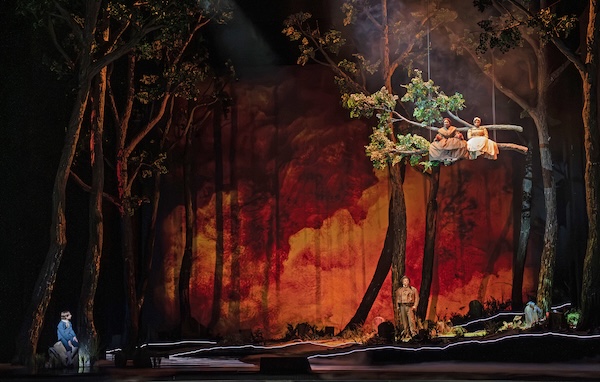
This is an issue at the very start. The curtain opens on Lileana Blain-Cruz’s ghostly, mysterious staging—the bardo is a weird, gothic forest—melding with Mazzoli’s music, and a wordy exposition between Vollmann and Bevins. Inside Adam Rigg’s set of mist, weird colors and vegetation, with tones of both the cemetery and H.P. Lovecraft, this begins with a joke that seems insanely out of place and stalls the opera right at the start. Eventually, Vollmann and Bevins get to expressing something more germane to the drama.
As the words accumulated through McKinny’s strong, grounded voice and Hoskin’s piping tenor, one’s anticipation of the unexpected disappeared. To be fair, Saunders’ book leaves an unsolved problem for the libretto and staging: the portmanteau “matterlightblooming” to describe what happens when someone moves out of the Bardo. This is done with bursts of literal fireworks, another too-obvious response to something that demands to be extraordinary.
As is often the case with Vavrek, there is just so much text here, and in other places, that it occludes the music and turns the singers into word-spitters. Mazzoli’s style has a built-in languid quality, always seeking to curve itself into a resonant moment, but that needs some space. With the bawdy Mr. and Mrs. Baron, sung with relish by Colclough and Blythe, the words and mood of the music work.
Other times, there are jarring misfits. The garrulous Reverend is the main focus of both conditions. Goerke sounded full and lovely, but barely had any moments in which to display the richness and power of her voice. In a key scene to begin Act II, the Reverend also realizes his state. But the sung line “I am dead,” in a clear tragic context, brought titters of laughter from the audience, which meant that something in the opera wasn’t working as intended—it was more declared than sung and fell flat.
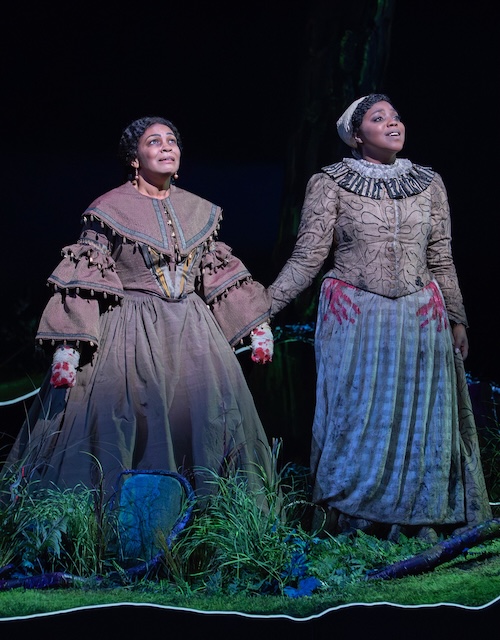
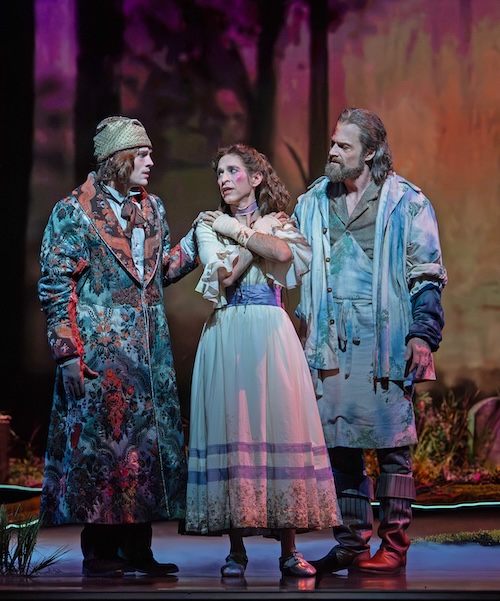
When music and libretto are working together, Lincoln in the Bardo is quite alluring. Traynor, Havens, Hodge, and Litzie are secondary characters but colorful and important ones. Traynor has kept herself in the bardo so long she’s no longer fully human. It’s the kind of extreme figure Costanzo is so good with on stage, and his voice had an eerie feminine quality inside its beauty that was scintillating. Litzie sings only at the end, and one was impressed by the sweetness and carry of Goodwin’s voice.
In an odd and ultimately unresolved way, Havens and Hodge become the main characters at the conclusion. The in-the-moment music is fine, but that this happens is a problem with the opera’s structure, which is ungainly. Act I is long, Act II much shorter and unbalanced. The climax is stirring, despite the clumsy text of the refrain, “all is allowed me now.” After this, it continues with a long, near-static epilogue between Lincoln, the formerly enslaved Havens, and Hodges, a woman who had her children stolen from her.
That was a very different drama. Musically, it brought together Mattei’s stateliness, Blue’s expressive warmth, and fire from Brugger. This all hinted vaguely at, perhaps the gestation of the Emancipation Proclamation? Something else? This all felt underdeveloped, as if it was a draft for a discarded Act III.
On first hearing, in the pit the orchestra sounded smooth and well-balanced. Despite the large-scale of the first act, the music never dragged, and the concluding loungeurs came from the score, not the playing or Yannick Nezet-Seguin’s attentive conducting.
Intriguing, at times moving, at other times frustrating, Lincoln in the Bardo is perhaps the appropriate expression of a post-mortal world of inner confusion and mystery.
Lincoln in the Bardo continues through November 14. Michael Hurst replaces Sobers on October 31 and November 14. metopera.org
Leave a Comment