From scenic folksong to Mendelssohn, Camerata Nordica impresses at Carnegie
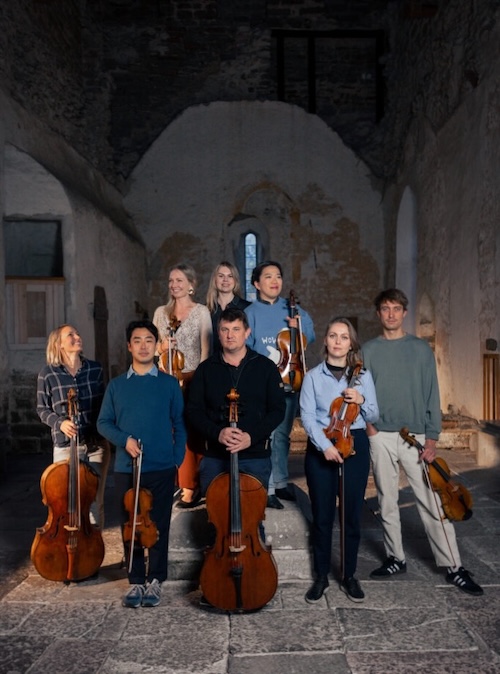
It would be easy to underestimate the Camerata Nordica octet.
Here are eight young string players from Sweden (and other points near and far) bringing gifts of Swedish folk tunes in catchy rhythms. But as their program Wednesday night in Carnegie’s Weill Recital Hall turned the corner from picturesque Scandinaviana into the challenges of Shostakovich and Mendelssohn, the group revealed exceptional qualities of tonal range and ensemble interaction.
The dessert-first program began with “Låt till far” (Song to my father), a melancholy-to-fast tune by the traditional fiddler Pers Erik Olsson. While a glance at the group‘s roster—violinists Shuichi Okada, Hanna Helgegren, Daina Mateikaitė, and Katarzyna Szydłowska; violists Kimi Makino and Sebastian Steinhilber; and cellists Zéphyrin Rey-Bellet and Sabina Sandri-Olsson—suggested national origins as far-flung as the Baltics, Poland and Japan, everyone was an honorary Swede in the Olsson piece and in Karl Lindblad’s waltz-like Polska in A minor.
Swedish folk style was also specified in the commission Camarata Nordica gave one of its own members, violinist and composer Hanna Helgegren, resulting in The Nordic Seasons, a multimedia piece for string octet in four movements (of course) with videos by Jack Walton, a British video artist based in Sweden.
The overall effect of this piece was of a sumptuous nature documentary, alternating dizzying aerial footage with detailed close-ups of Swedish landscapes at all times of year, accompanied by a lively or contemplative score. Unlike Vivaldi’s Four Seasons, teeming with animals and people, Helgegren’s and Walton’s point of view was of an individual contemplating an unpopulated world.
The seasonal movements were listed in the program, and described in the composer’s program note, as beginning with the oncoming sadness of Autumn and concluding with the warmth and optimism of Summer. Wednesday’s actual performance, however, was in the Vivaldi order, beginning with Spring and ending with Winter.
That gave the piece an entirely different emotional arc. While Vivaldi’s winter was a time of relaxation and contentment by a roaring fire, the icebound one of Helgegren and Walton epitomized what the composer called “Nordic melancholy.”
Felicitous touches abounded in Helgegren’s score: skittering violins over the rushing waters of “Spring,” sun ripples in a shallow stream to a languid waltz in “Summer,” a warm and lively viola accompanying a golden-tinted “Autumn,” and frozen landscapes in half light to a dying fall in the music of “Winter.”
Then it was on to the teenage geniuses: 16-year-old Felix Mendelssohn penning his immortal Octet, Op. 20, and Dmitri Shostakovich, at a ripe old 19, composing a Prelude for Octet and, six months later, matching it with an insolently contrapuntal Scherzo to make his Two Pieces, Op. 11.
Shostakovich was up first, in a stunning conclusion to the program’s folksy first half. The players dug deep into the fervent lines of the adagio of the Prelude, then set the middle section dancing frenetically. The Scherzo featured not only a virtuoso eight-part canon in progressively shortening note values but impressive massing of string sound and fine voicing in the softer passages. Actually, “soft” would hardly describe the attitude of this audacious young modernist, as he fired off the kind of dissonances and smeary glissandos that Soviet authorities would later forbid. The Camerata delivered it all with gusto.
The string octet literature is not large, but its summit is high. Mendelssohn told his sister Fanny that he wanted his Octet to sound like a full orchestra, and Camerata Nordica followed that instruction Wednesday—almost too well, in fact, as the violins’ bounding opening theme was almost obscured by its eager, chattering accompaniment.
The performance was enhanced by the musicians’ playing standing up and from memory, enabling them to move freely with the music and put plenty of drive behind their Mendelssohnian grace. (The two cellists sat on a foot-high platform that put them more on a level with their colleagues.)
Violinist Okada took the first position for this piece, displaying brilliant tone and agility high on his instrument. The ensemble made the most of the movement’s dark, introspective episodes, the better to rev up into the sunny con fuoco and crisp coda.
The low instruments led the way into the Andante, its exploratory episodes driven by a gentle pulse of triplets, its darker colors never allowed to become heavy. The featherlight Scherzo was played precisely together and in time, to exhilarating effect. And the players’ standing posture unobscured by music stands made for striking visuals during the tour-de-force fugal finale for eight voices, as Presto lines and a bold Handelian theme rippled through the ensemble, building to a splendid all-hands finish.
The enthusiastic applause brought the players—and stagehands bearing music stands—back to the stage for an encore, a lively arrangement of a Swedish folk song, “Slängpolska efter Byss-Calle.” Maybe the best meal is the one that begins and ends with dessert.
Leave a Comment