Carnegie’s Mahler cycle off to an unsettled start with a Fifth Symphony of anticlimaxes
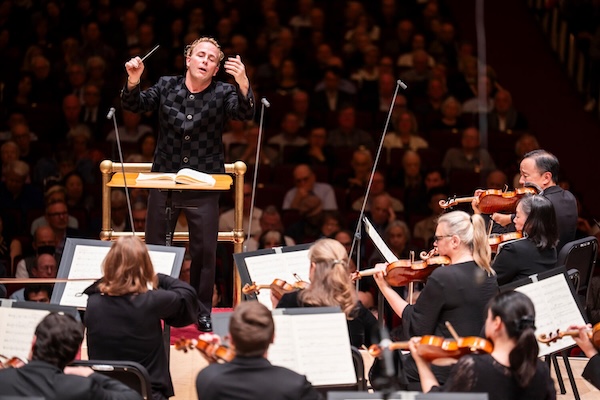
One of the biggest events on this season’s classical music calendar is the Mahler Symphony Cycle Yannick Nézet-Séguin will be leading at Carnegie Hall with three different orchestras: the Philadelphia Orchestra, the Vienna Philharmonic, and the Met Orchestra.
One approaches this series with an unsettled feeling that is a combination of excitement for the chance to hear all this astounding music and hesitance over the extremely varied quality of the conductor’s previous Mahler performances.
Tuesday night was the first in the series, with the Philadelphia Orchestra and a program that opened with Anton von Webern’s Im Sommerwind and the New York premiere of Julia Wolfe’s Liberty Bell. Mahler was represented with the Symphony No. 5.
Im Sommerwind was an interesting choice in a couple ways. It might be Webern’s most frequently performed orchestral work, and also his most atypical. The latter is the reason for the former, as Im Sommerwind has a public appeal as pretty, Straussian pastoral tone poem that predates Webern’s brilliantly etched, abstract, atonal miniatures. It is contemporary to Mahler’s symphony, with the context of the musical world of late romanticism that Mahler was leaving behind beginning with his Fifth Symphony.
This was played with great musicality by the orchestra. The strings in particular had a substantial body of sound that made the opening pianissimo and development of the first harmonies into a glowing, sonic sunrise. That was a promising prelude to a piece that seems to outline the shape of a summer’s day, but it didn’t quite go that way. Nézet-Séguin interrupted the stream of music to isolate some woodwind details—a little stop-and-go stumble—and when the piece reached the concluding stretch, most of the focus in that playing that arisen from the opening had dissipated. There was a mismatch between volume and energy. The sun also sets.
Wolfe’s new piece, a Carnegie co-commissioned is named after the Liberty Bell itself, and has a larger idea in it about liberty, specifically the never-ending effort and frequent conflicts required to establish it and preserve it against the atavisms of barbarism and authoritarianism. She represents this with aggressive, syncopated cross-rhythms and spiky gestures, like the Bartókian snaps in the low strings and, wild, quick-turning gestures in the winds and brass. This is spry and muscular music, echoing the West Side Story dances and the thrust of John Adams’ Harmonielehre.
For a while, it’s also gripping and suspenseful, claustrophobic and a bit brutal, like a knife fight in a phone booth. But then there’s a change to some James Bond-ish orchestral rock, music that cannot rhythmically or stylistically maintain the scintillating edge of threat from the start. The experience sagged here, and never fully recovered. Formally, Wolfe brings back the opening ideas at the end, but also layers them with this weaker one, and it’s ultimately unsatisfying.
This theme of promising beginnings and wayward, desultory endings held after intermission with the Symphony No. 5. The opening moments were fine, with a strong, fraught trumpet fanfare from James Vaughen and a funeral march pace that was slightly slow but had an expressive gentleness that shaded the music with sorrow. The orchestra’s playing was superb, with a sound that was a concentrated, colorful amalgam of the forces on stage.
The emotional key to the second, “Stürmisch” section of Part I was also fine, conductor and musicians crafting the essential feeling of a Sisyphean emotional weight pushed up to the first (and false) grand climax, only to dissipate into loss.
But there were problems that also started popping up and accumulating. The main one was an interpretive range that wasn’t that broad to begin with and kept narrowing as the performance went on. The fortissimos were big and meaty, but there were no real pianissimos, unlike the opening moments of the concert. Nézet-Séguin also used a limited range of tempo changes.
This meant a lack of nuance, and as enormous and powerful a composition this is, Symphony No. 5 is a universe of nuance, of complex and conflicting emotions held together and passing around and through each other. It needs careful, detailed attention to dynamics, tempo, and also phrasing, colors, and timbres.
The playing was colorful enough to start, but the hues gradually snuffed out like candles, starting with the “Stürmisch” but especially, and sadly, through the fantastic scherzo. Jennifer Montone’s horn solo had good presence but, like much else, a narrow expressive range. There were also small but distracting moments of sloppy playing throughout the orchestra, and many of them. The ideas kept diminishing into what felt like an iron pipe through which Nézet-Séguin was pushing the music. The darkness was dark, but there was no spring in the music; the climactic stretch, maybe the most colorful music Mahler ever wrote, sounded bland and simplistic.
With too few changes in tempo, the ten-minute Adagietto felt extra sluggish, and also monochromatic, though the strings made this a rich color. The finale was limited to Nézet-Séguin’s two favorite musical ideas: loud and fast. Though he pushed the tempo to an extreme in the run up to the final, true climax, the explosion that set up never came, and the big chord was actually smaller than in Part I. He was even faster getting to the last note, treating Mahler like a horse to be whipped into a froth. That excited the crowd, but wasn’t really Mahler.
The Met Orchestra Chamber Ensemble plays Janáček and Schubert (arranged by Mahler), 7:30 p.m., November 5, in Weill Recital Hall. carnegiehall.org
Leave a Comment