Carnegie serves up exhilarating Steve Reich feast, with no slowing down at 90
Can composers live, at least musically, on reputation alone? It’s important to ask that question in classical music culture which looks to the past so frequently that one can get the impression that the older the music is, the better it must be.
Of course, it’s true that repeated exposure to music helps to reveal its greatness, and that is the exact problem modern music faces. So much work of the past hundred years is as fine as anything from before the 20ᵗʰ century, but most of it is it heard with nowhere the same frequency.
That brings us to Steve Reich, 90 now, and not only one of the titans of modern music but one of the historical greats. Hearing the fantastic Music for 18 Musicians through the years shows what a masterpiece it is.
But that’s just one work. Thursday night’s “Steve Reich at 90” concert at Carnegie Hall presented five pieces, all of which gave concentrated confirmation of his stature.
That greatness is ongoing. Two of the works, Two Pianos and In All Your Ways, had their U.S. premieres Thursday. The latter was composed just this year, and Jacob’s Ladder, is only three years old. There was also Double Sextet, another 21st century composition. Dating from 1987, the opening Electric Counterpoint was the oldest on the program.
Reich’s music is so well made that if musicians have the chops to play it, things always sound great. And with the combined forces of the Bang On A Can All-Stars and Ensemble Signal, with conductor Brad Lubman, the musicians clearly had the chops.
Even more, the playing approached astounding levels. Reich is well known for his repetitive structures, but all of those are on a bed of propulsive, syncopated rhythms—his few peers in this regard in the canon include Beethoven and Stravinsky—and in the right hands these are not just explosive and exciting but expressive.
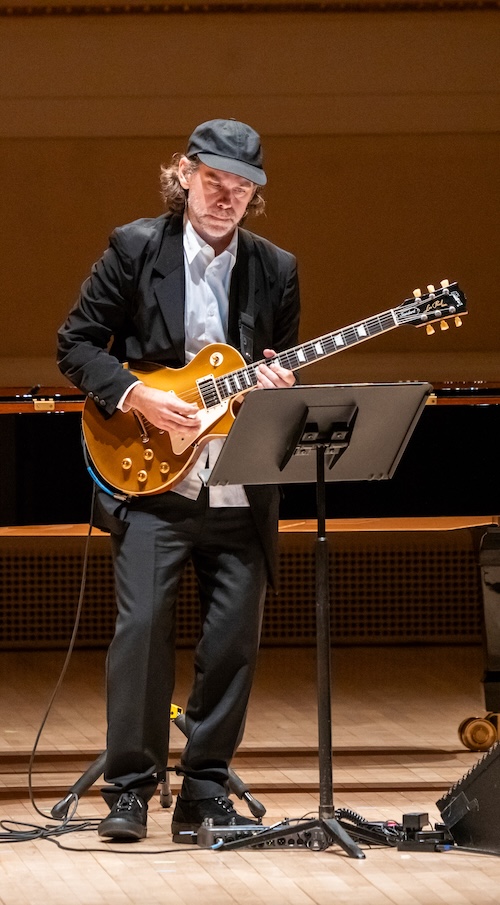
Bryce Dessner performed Electric Counterpoint, for solo guitarist playing against a layered backing track of 10 additional guitar and electric bass parts. It’s a piece that shows the often unexpected interpretive range in Reich’s music. Written for the great jazz guitarist Pat Metheny and his clean tone, other guitarists take it on with their own sound and rhythmic feel. For Dessner, that was a bright, slightly jangly timbre, the sound emphasizing the treble range. He played with a relaxed, bright feeling, letting the backing track carry things along while he floated on top. The slow middle section was gentle, and the fast finale had an irresistible bounce from the bounding baseline and the leaping major modulation in the finale section.
Nico Muhly and Lisa Moore played the miniature Two Pianos. This was fascinating for being so atypical from Reich’s body of work. Rather than repeated patterns with notes added and subtracted, this was a heavily syncopated antiphonal dialogue between the two instruments. With aggressive attacks and tense little silences—and far more dissonance than one hears from Reich—this was like a musical arm-wrestling contest.
The first half finished with Double Sextet, and the remaining ensemble pieces came after intermission. This was the finest performance of Double Sextet one has heard, starting from a place of substantial energy and expanding from there. Like all the great composers, Reich gets maximum use out of the simplest devices, and the musicians got the most out of his rhythms and phrases by leaning into accents at the beginning of each line. Every note seemed to have kick behind it that pressed it forward against the steady tempo, a kind of swing that is built into the music.
This also created a vibrant excitement in the fast music of Double Sextet and the following works. What was unexpected was the deep expression in the slow section. Reich has expressed his disinterest in the romantic era, but the amount of feeling that came out of the music and through the musicians sounded close to Schumann, without anything added to or distorted from Reich. Then the way the players launched each line in the finale had explosive verve.
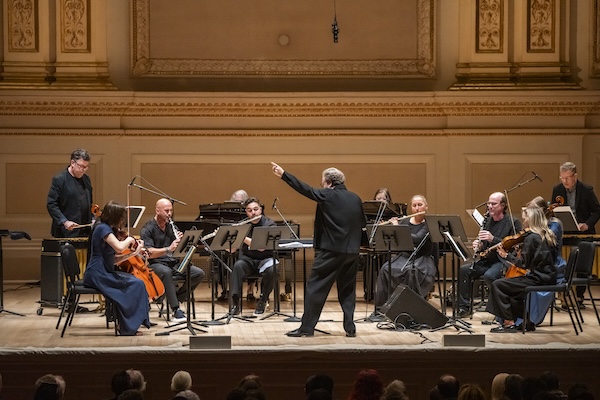
The ensemble pieces cemented Reich as one of the most important modernists. Everything he does comes straight out of the common practice period of classical music, updated in contemporary musical vernacular. The counterpoint and delicate early music type singing in Jacob’s Ladder, the short melodic responses from the violins and woodwinds, sounded like a natural against Handel or Haydn. On top of that, this piece and In All Your Ways share an expanded harmonic and historical palette, with more chromaticism than most of his past works, and discrete backward looks toward music like Ravel and his own ensemble pieces from the mid-1970s.
Both also come out of Reich’s exploration of the Old Testament. Jacob’s Ladder is a rich, elegant vocal work. Premiered by the New York Philharmonic in 2023, it has a text from Genesis that isolates Jacob’s image of angels ascending and descending a ladder connected to heaven. The text is set in sustained tones, while the instruments climb and descend through pentatonics and quartal intervals, all over a constant 16th-note pulse.
In All Your Ways is not just new, but a clear, ingenious step in Reich’s composing. There is text from Proverbs behind it, but only to derive that rhythm of the main phrase that is repeated throughout. This is an instrumental work with a structure closer to John Cage’s early music, and a compositional method that lays out lines and moves section to section based on metrical units of 16th-notes, eighths, quarters, and triplets. It also moves through several key areas. With a constant pulse, the music felt like a squeezebox, expanding and contracting at different rates, dancing fast, then relaxed, then slow, then fast again.
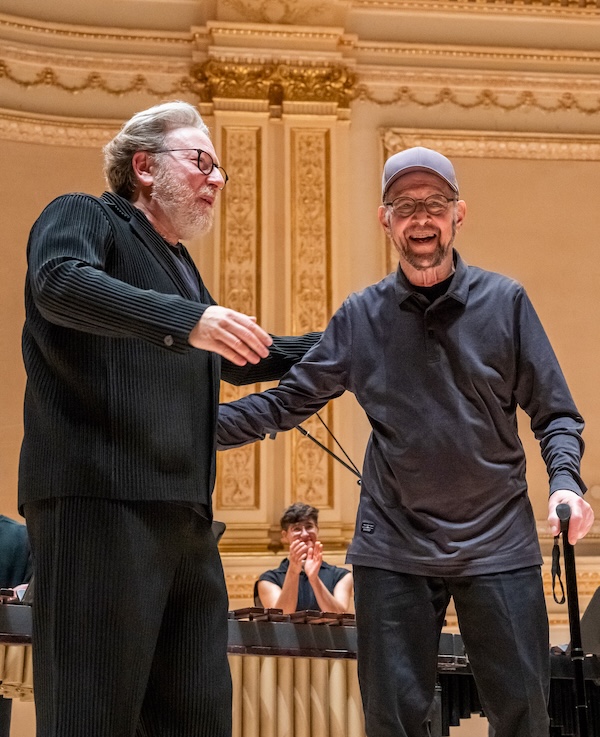
This was, again, simple ideas assembled in complex ways that providing an involving pleasure to musicians and listeners alike. The multiple ovations, and Reich raising his walking stick in triumph from the stage, were a visceral measure of this experience.
Carnegie Hall presents “Philip Glass: The 90th Birthday Concert,” 2 p.m., January 31. carnegiehall.org
Leave a Comment