Berlin Philharmonic brings fresh conviction to familiar Brahms and Strauss
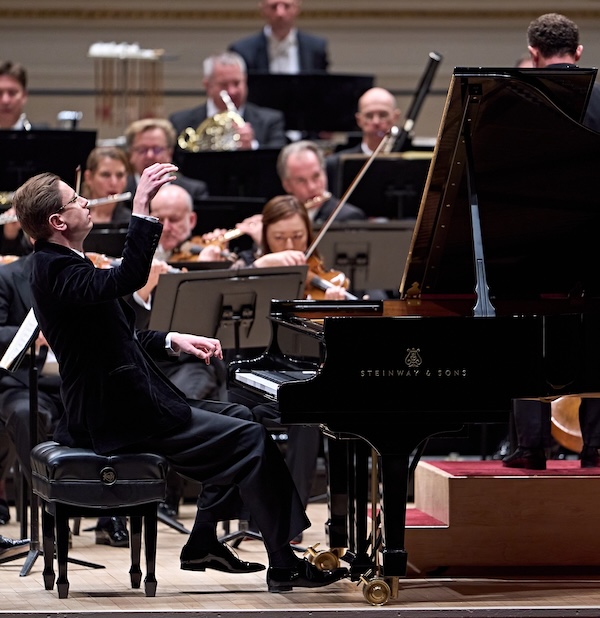
Never let it be said that the Berlin Philharmonic shies away from controversy. Friday night in Carnegie Hall, the crack German ensemble, under its chief conductor Kirill Petrenko, gave brilliant, committed accounts of two of the most argued-over works in the repertoire, Brahms’s Piano Concerto No. 1 in D minor and Richard Strauss’s Also sprach Zarathustra.
There have always been Brahms haters among us, from the composer Tchaikovsky to contemporary critics who find his music congealed and academic. Their Exhibit A is this concerto, a youthful effort with the emphasis on effort, showing the struggle of its birth in every furious timpani roll and angry trill.
For its first audiences in 1859, accustomed to the blithe concertos of Mendelssohn, Chopin, and Brahms’s mentor Schumann—not to mention the note-spinning likes of Hummel and Kalkbrenner—this Heathcliff of a piece was simply beyond the pale. But even though it flopped ingloriously in its first performances, something about its shirt-grabbing intensity, its demand that you listen, has kept it before the public ever since, despite its challenges to performers and listeners.
And it is, for sure, not the easiest work to make “sound.” Many an orchestra has become lost in its thick scoring, and many a fine pianist has fallen short with its two-fisted keyboard part.
That’s why it was so gratifying to hear Petrenko take this superb ensemble right into the thicket of Brahms’s orchestration and give it force and texture, and to hear the Brahmsian weight and glow that soloist Vikingur Ólafsson brought not only to the crashing fortissimos but to the finely voiced rising chords of the second theme. With its well-paced interludes and dramatic strokes, and sensitive interactions of the soloist with sections of the orchestra, one imagines this performance of the “problematic” first movement might be something even a Brahms hater could love.
As if exhausted from so much intense emotion, the performance dropped to pianissimo for the Andante, barely rising from there except for a couple of impassioned surges at mid-movement. But within that soft dynamic were many shades of emotion, as Ólafsson’s glowing piano wove gently through the orchestra, only to end the movement alone and despondent.
The vigorous finale in Brahms’s heel-clicking Hungarian style is marked Allegro non troppo. Ólafsson’s blazing tempo was definitely “troppo,” but he carried it off by playing cleanly and right in time, without rushing. Even his countermelody to the second theme came through clearly, despite the speed. Sparkling scales for two hands an octave apart, a witty orchestral fugue, a sudden piano cadenza—the unbuttoned Brahms threw it all in and the skilled players threw it all back in style.
For an encore, the pianist played a leisurely, winding Bach aria, accompanied pizzicato by a dozen or so string players from the orchestra.
Unlike Brahms’s apparently stillborn concerto, Strauss’s Zarathustra was, at least by some enthusiasts, instantly proclaimed the “music of the future.” For his cogent note in Friday’s program, Jack Sullivan unearthed some glowing early references to Strauss’s “colossal daring” and praise for his “attempts to seize not only certain elusive psychical states, but to paint pure idea.” For his part, the composer claimed no philosophical intention, but only (only!) to depict “the development of the human race” from its “origin…up to Nietzsche’s idea of the superman.”
Coincidentally (or not?), Stanley Kubrick’s 2001: A Space Odyssey had the same implied program—early primates to super-baby (with in this case a prescient digression for a homicidal AI)—and took for its musical motto none other than the opening “sunrise” of Zarathustra. So if Strauss’s piece was not quite the music of the future in 1896, it eventually became the music of the futuristic.
Following those familiar but still irresistible opening pages, Friday’s performance flowed compellingly, carrying the listener through one vivid episode after another, Petrenko leading the stormiest passages like a serene captain on the bridge. The rambunctious fugue on the three-note sunrise motif in the “On Learning” section seemed, on Friday night at least, to tease Brahms for putting a fugue in his concerto. “On Convalescence” followed with a blaze of strumming harps, triangle, and trilling winds, while the “Dance Song,” with its flirty violin solo and bloop-bloop harp accompaniment, eventually swelled to an intentionally gross fortissimo. The finely-tuned winds in “Song of the Night Wanderer” climbed high, closing the work—and this exceptional concert—on a pianissimo enigma.
Carnegie Hall presents the Berlin Philharmonic, conducted by Kirill Petrenko, in works by Elgar and Tchaikovsky, 8 p.m. Saturday. carnegiehall.org
Leave a Comment