Kramer opera fails to conjure Yeats mystery effectively at Fordham
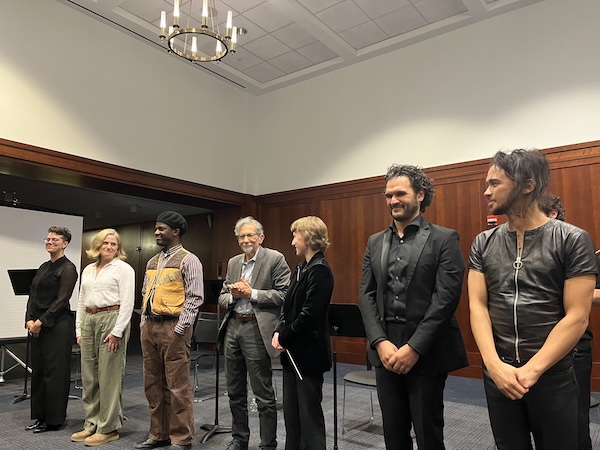
For Irish history lovers, Lawrence Kramer’s new chamber opera The Dreaming of the Bones, inspired by W. B. Yeats’s play of the same name, might be just the ticket. But be forewarned: it helps to brush up on Irish history beforehand.
The opera premiered Friday as part of “Voices Up!” at Fordham University in a concert version with minimal staging. Kramer, a musicologist and Fordham professor, organizes the series, which focuses on contemporary vocal music, particularly the interplay between words and music.
Yeats wrote The Dreaming of the Bones in the aftermath of the 1916 Easter Rising, an armed insurrection in Dublin in which Irish Republicans sought to end British rule and establish an independent republic. The rebellion was quickly suppressed, but the subsequent execution of its leaders helped shift Irish public opinion in favor of independence, making the Rising a pivotal event in the struggle for self-government.
Although Yeats was a committed Irish patriot, he was not an uncritical nationalist. The Dreaming of the Bones reflects his complicated response to Ireland’s revolutionary history, exploring the burdens of political violence, betrayal, and historical memory. Inspired in part by Japanese Noh theatre, Yeats deliberately created a highly stylized drama in which the action is secondary to poetry, symbolism, and atmosphere.
A Fugitive who took part in the 1916 Rising and was at the General Post Office in Dublin, the rebels’ headquarters, flees toward the sea, hoping to escape to America. Along the way, he encounters the ghosts of Dermot and Dervorgilla, doomed 12th-century lovers whose actions helped set in motion the Norman intervention in Ireland. Wandering the ruins of Corcomroe Abbey, they seek forgiveness for the historical consequences of their actions. The Fugitive withholds it, while their encounter prompts him to confront his own responsibility for the deaths in Dublin.
Kramer’s work is scored for five voices and four instruments. The composer’s sensitive, natural setting of the text lent itself readily to a score in which narration and ballad-like songs predominate. There was also fascinating writing for two voices, notably his eerie, spectral duets for the two Ghosts, in which unison and dissonance made their impact through the singers’ precise tuning. The vocal writing, however skillful and varied, did not compensate for the lack of action or draw the listener into the story in this bare-bones presentation.
As the Fugitive, baritone Wayne Arthur’s diction was impressive, but his delivery needed more intensity and urgency. Tenor Gabriel Hernandez excelled in both respects as the Male Ghost, making the text come alive. As the Female Ghost mezzo-soprano Daniele Buonaiuto, too, was called upon to produce a wide range of colors, as well as special effects, which she did impressively.
As the Musician, Amy Justin employed vocal color effectively, ranging from rich warmth in a ballad to a harrowing, bleached-white, wispy sound. Hidden from sight as the Offstage Voice, Jordan Rutter-Covatto’s countertenor added a more sinewy texture to the final scene, which contained some of Kramer’s finest writing.
Kramer was at his best composing for the instrumental quartet (flutist Roberta Michael, clarinetist Kristina Teuschler, violinist Finn Shanahan, and cellist Titilayo Ayangade). All are members of Contemporaneous, a New York ensemble dedicated to contemporary classical music. Soprano Justin not only sang but also played the drum, contributing to the work’s atmosphere of mystery and tension.
Throughout, the chamber music was vital and engaging, with the instrumental line propelled by exciting rhythms. Kramer conjured fascinating musical dialogues and rich textures from just four instruments—or five, if you count Teuschler doubling on bass clarinet, which added greatly to the score’s depth of character. Conductor Claire Lewis brought crispness and clarity to the score, consistently maintaining balance and momentum.
Some admired Yeats’s play for its poetry, symbolism, and atmospheric qualities, but it was also considered difficult and obscure. Music has the potential to clarify the text and amplify its dramatic momentum, but Kramer’s opera does not consistently achieve either.
The sparse program notes provided inadequate context, while the story itself offers too little action or human connection to engage the listener. Scenery or costumes would do little to remedy these shortcomings.
Leave a Comment