Dudamel opens new Philharmonic era with a 9/11 remembrance and a raucous premiere
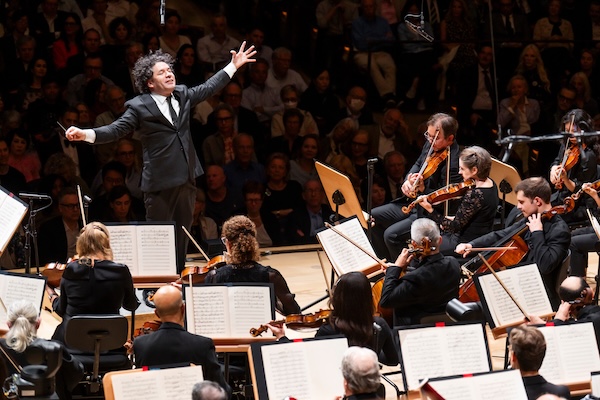
It might seem odd to celebrate the arrival of a long-awaited orchestra leader with music that came from war, trauma and loss. But such was the dark background of Gustavo Dudamel’s first subscription concert as the New York Philharmonic’s music director Wednesday night.
Taking place just five days after the 25th anniversary of the September 11 terrorist attacks, the concert seemed an appropriate occasion for the revival of John Adams’s 9/11-inspired On the Transmigration of Souls—the first in New York since its 2002 premiere.
On Wednesday, the Adams work was matched with the world premiere of a Philharmonic co-commission, Invisible House by Zosha Di Castri, a daringly raw-sounding piece vibrating with the indomitable spirit of the composer’s Ukrainian ancestors, and Prokofiev’s Fifth Symphony, a powerful product of his evacuation from Moscow to the countryside during World War II.
Though born amid violence and inhumanity, each of these works, in its own way, ended up “glorifying the grandeur of the human spirit,” as Prokofiev said of his symphony.
The Philharmonic’s triple-Grammy-winning recording of the Adams work—which calls for large orchestra, two choruses, and electronic tracks—presented the impression of a mystical symphonic tableau, through which the souls of the departed floated toward their next state of being.
The experience in Geffen Hall Wednesday night was far richer: besides the undulating tissue of orchestral sound, the taped spoken words and phrases from the victims’ loved ones ricocheted through speakers around the hall, the poetry of everyday speech exalted by music.
The human presence of the New York Philharmonic Chorus and the Brooklyn Youth Chorus—finely prepared by Malcolm J. Merriweather and Dianne Berkun Menaker, respectively—not only bathed the scene in wordless choral tone but articulated more of that everyday speech remembering the dead, sometimes with startling passion.
Supertitles were used sparingly but effectively to help listeners in the large hall match the words to the music. The middle crescendo made more sense when heard live—growing out of the chorus singing a widow’s fierce words “I wanted to dig him out. I know just where he is”—and touching off a blaze of high percussion and dissonance that evoked passion, determination, and hands clawing at rubble.
For the most part, however, Adams’s piece—delivered with great sensitivity and concentration by Dudamel and the Philharmonic musicians —had the character of a meditation with Adams discovering the extraordinary in the ordinary rhythms of life and love, so cruelly violated on 9/11. His piece evoked the “transmigration,” as he wrote in a program note, not just of the living to the next world, but “of those who suffer pain and loss and then come away from that experience transformed.” Ineffably delicate for much of its length, his music had the power to evoke that transformation in the listener’s mind.
Enough listeners felt that power Wednesday to give Adams a more than usually warm composer’s welcome when Dudamel invited him onstage for the bows.
The program then proceeded from Adams the watchmaker to Zosha Di Castri the noisemaker. Without seeing the score, one can only speculate what “extended techniques” and microtonal tunings Di Castri used in her rough-and-ready tribute to songs and tales from her grandparents.
You’re not likely to hear anything like Invisible House on your mellow classical radio station—the title comes from a Ukrainian poet’s metaphor for the aerial bombing he witnessed and now sees in his dreams—but Dudamel and the orchestra put their backs into this “barbaric yawp.”
There were mutes in the brass instruments, but their sound was anything but muted as they evoked strident open-air singing. Pounding and rattling percussion coalesced at times into a communal beat like a disjointed samba, building the invisible house of shared stories and culture that shelters people during hard times—which, the composer implied in a program essay, beset not just Ukraine but the U.S. right now.
For all its folk energy, the piece closed in a nostalgic mood, dropping suddenly to pianissimo amid shreds of melody in flute and clarinet, a kind of zooming out that evoked the distance between refugees and their native soil. Afterward, this composer also received appreciative applause onstage.
As often happens when a more familiar piece comes along to close an ambitious program, Prokofiev’s Fifth did not seem to have the performers’ full attention. The orchestra displayed impressive virtuosity and crisp ensemble, especially in the quicksilver scherzo, and its sound was balanced and well-knit, but imagination and long-range shaping were in short supply.
In the first movement, Prokofiev’s piquant scoring offered many opportunities for relief and contrast in texture and mood, most of which slipped by as the music got louder and softer and not much else. Without a sense of direction or cumulative momentum, the spectacular endings of the first movement and the finale sounded tacked on.
The Adagio began promisingly with melancholy wind solos leading to massed strings over a tuba-rich bass. But Dudamel, a master at crafting musical moments, had less success finding a through line that would carry the listener forward, making the long movement sound even longer.
In his inaugural subscription concert, Gustavo Dudamel exhibited courage and wide-ranging imagination in two complex new scores. (Even at more than two decades old, Adams’s infrequently revived piece still qualifies as “new.”) And we can hope Dudamel’s new tenure brings better outings to come with the modern classics like Prokofiev.
The program will be repeated 7:30 p.m. Thursday, Friday and Saturday. nyphil.org.
One Response to “Dudamel opens new Philharmonic era with a 9/11 remembrance and a raucous premiere”
Leave a Comment




Posted Sep 18, 2026 at 7:06 am by Evan Sarzin
The concert’s throughline did not make itself felt in performance. Di Castri’s piece bore the imprint of post-9/11 trauma, despite its programmatic differences from the Adams work, which opened the concert. Yet the two works were not sufficiently distinct as soundscapes; instead of illuminating one another within the first half of the program, they seemed to occupy much the same expressive territory.
I join your review’s assessment of Prokofiev’s Fifth Symphony. The performance sagged during the Adagio, which at times seemed aimless, precisely where a stronger sense of cohesion was needed-—one that could connect the symphony’s grandeur and tragedy not only to the catastrophes of the last century but also to those of the present.