Canellakis, NYO-USA and Gerstein make a superb team at Carnegie Hall
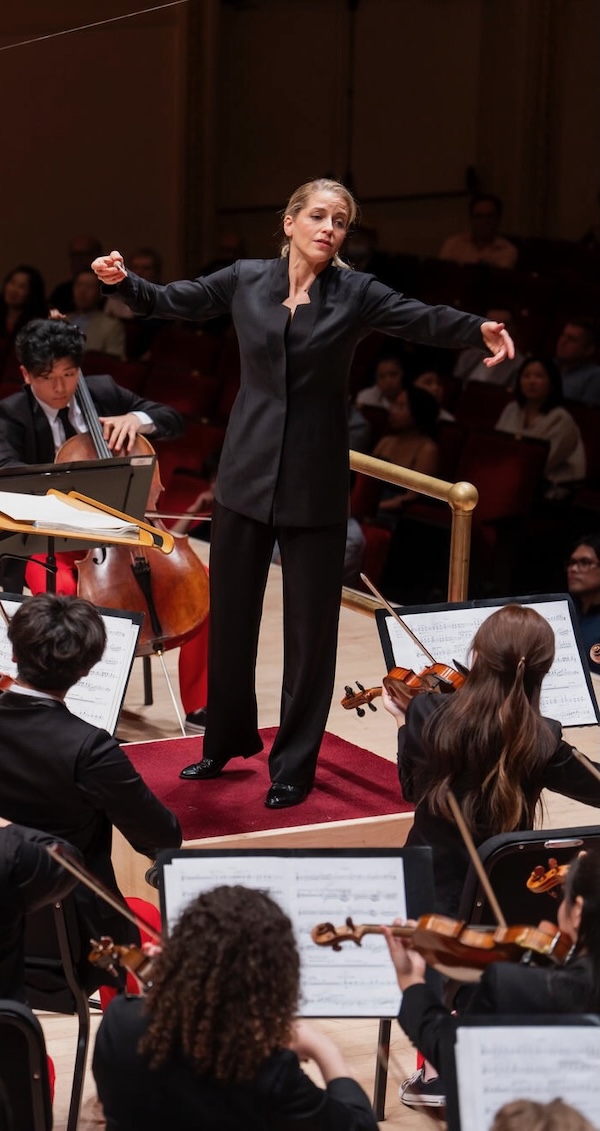
For a parent, there can be a mix of deep satisfaction and regret seeing your children grow up. It’s thrilling to see them becoming who they are and gaining confidence in what they can do. But each day that passes has to be consigned to memory, a collection of experiences that will never be repeated.
There’s something of that in experiencing each year’s National Youth Orchestra of the United States of America concerts at Carnegie Hall.. Each iteration is full of tremendously talented young musicians—some of whom might be in the ensemble for just a couple seasons, passing through like dazzling shooting stars. Their very existence points to a promising future, and they showed this again Friday night in Carnegie.
The conductor this year is Karina Canellakis, the soloist pianist Kirill Gerstein. That’s a draw in any concert hall, and the program was one that any professional orchestra would be proud to present: Samuel Barber’s Overture to The School for Scandal, George Gershwin’s Concerto in F, and after intermission Bartok’s Concerto for Orchestra. This was also a performance a lot of professional orchestras could feel proud of.
The differences between NYO-USA and most other orchestras that come through the hall come down entirely to age and experience. This was a big orchestra, close to the size one sees for something like Alban Berg’s Three Pieces for Orchestra, but they can’t yet produce the volume of sound an older, professional group does. Nor do they have emotional and intellectual experiences, even painful ones, to produce the haunting, unsettling atmospheres Bartók created in the first and third movements of his concerto, which emerged rather dry in expression.
Everything else was excellent. Under Canellakis’ brisk, precise energy, the balances were clear, and intonation was almost flawless throughout. It was a pleasure to be able to hear Barber’s overture in concert, especially with such rhythmically sharp and refined playing from the strings and the orchestra as a whole. The woodwinds relished their colorful, succinct solos, and the ensemble reinforced one’s conviction that Barber should be heard more often, not only played by students.
The same for Gershwin’s concerto, which surpasses his much more famous Rhapsody in Blue for depth and execution of form, especially when played as fabulously as Gerstein did Friday night. One expects young musicians to play with the jaunty spirit the NYO-USA showed, and the same for the virtuosity of a classical soloist. Yet Gerstein brought so much more. His sense of phrasing and touch were like those of a jazz pianist, and details of his playing channeled the subtle articulation of Bill Evans and the suave logic of Keith Jarrett.
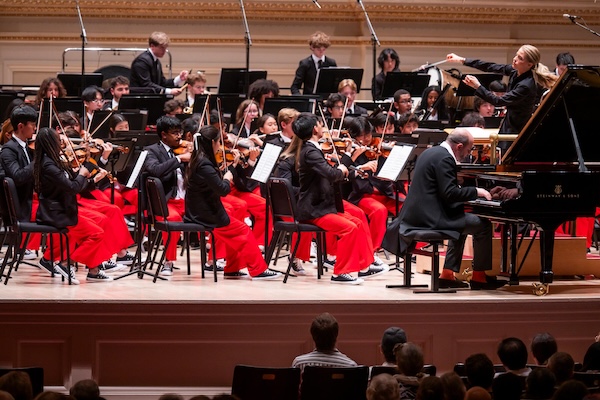
He flowed through the part not just as a soloist in front of an orchestra but as the lead, playing together in a larger ensemble. Following the excellent, idiomatic trumpet phrases that opened the second movement, Gerstein’s cadenza was marvelous, the blues phrases coming so naturally to him, and with such relaxation—even in the more active passages—that it had the illusion of pure improvisation.
In the scintillating finale, Gerstein showed off exciting chops, bringing the performance to a rousing close. He returned with an encore, a quietly colorful, romantic “Blame it on my Youth,” by Oscar Levant, a nod to another infrequently heard great American musician, like Jarrett.
Even lacking that last bit of atmosphere, the Concerto for Orchestra was quite fine. The musicians were at ease with the demands of Bartok’s rhythms, articulation, and especially his phrasing, which is deeply rooted in the language of Eastern Europe. Even more, they were at ease with his idiosyncratic, fast-switching logic.
The most challenging parts, the second movement game of pairs, the mockery of Shostakovich and riotous orchestration in the fourth movement, and the swirling, frantic finale—and how it coalesces into a massive fanfare—were all superb.
So, with another year here and gone, along with another excellent roster of this group relegated to memory, more Gershwin was offered in an encore medley for a\sweet goodbye with “I Got Rhythm,” “Embraceable You,” and “But Not for Me.”
Leave a Comment