Schumann’s chamber music well served at 92NY
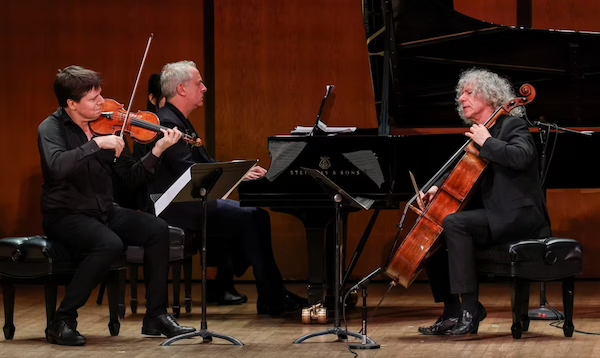
There was a compact and dense Schumann chamber music series at 92NY this week, headlined by the starry trio of violinist Joshua Bell, cellist Steven Isserlis, and pianist Jeremy Denk. Thursday night, with the addition of violinist Irène Duval and violist Blythe Teh Engstroem, the group played three works for piano trio and the Three Romances for Violin and Piano, Op. 94.
One saw most of this group at the end of May with Evgeny Kissin at the keyboard, and the quality of the playing was mixed. Thursday night’s concert in contrast was excellent across the board. The ensemble playing was superb throughout and there was a gripping robustness to the expression, musicians putting their excitement and pleasure in these works on full display.
Even with Bell and Duval taking turns with the violin parts, there was nothing but strong, satisfying moments. Duval opened each half, first with the Fantasiestücke for Piano Trio, Op. 80, then the Romances, respectively. Bell played in the Piano Trio No. 3, Op. 110, and then the finale, the great Piano Quartet in E-flat Major, Op. 47.
This made for a fascinating contrast inside the concert. Duval played beautifully, with exact intonation, a glistening, dark tone, and sensitivity to Schumann’s exquisite melodies, especially in the first movement of the Fantasiestücke in the whole of the Romances.
As fine as she was, this context put Bell’s stardom in relief. It’s not that he’s the only one who can play the notes in the score—Duval was clearly just as capable—but that each one exploded with vibrant purpose and personality. Bell has one of the finest violin sounds in classical music, but what sets him apart is the mysteries of his inner being and personality, and how those erupt through the instrument.
With him and Isserlis and Denk in complete concert, every note and moment felt full of declarative purpose and a drive that kept pushing into the next event and toward the final double bar. In each configuration, there was the sense the musicians were relishing Schumann’s personality. and craft. Isserlis spoke briefly before the concert begin, noting most of the works on the program were lesser known (except for the Piano Quartet). Perhaps the Op. 80 is played less often because it’s not as fully formed as the Piano Trios.
Yet each individual movement is imaginative and evocative, especially the gorgeous opening Romance and the idiosyncratic Humoresque, The Op. 110 is itself overshadowed by masterpieces like the Op. 47, but is one of Schumann’s most haunting works, with his inner mental anguish wrestling in full view.
But there are no weak moments in this music, nor were there in the performances. Along with Bell’s charismatic playing, it was a pleasure to hear Isserlis play with such a fully formed, rich voice. He played through every line from beginning to end, concentrating on the fullness of each note and phrase and eschewing stylistic gestures. Denk had an uncanny mix of what felt like a light touch and light-hearted spirit, and energy that in other hands would have felt stolid but Thursday night seemed effortless.
The sense of purpose and the satisfaction of it cannot be overstated. It’s a true enough cliché that chamber music has a conversational quality, but in this performances that felt like a discussion where everyone kept finding the same shared consensus, intuitively, and worked together to follow Schumann’s paths as he laid them out. With two, three, and four (Engstroem’s viola was remarkably rich and met the expressive and sonic energy the main ensemble was putting out) voices working together, each performance built up with unerring emotional logic to a feeling of finality,
This was serious in intent but never too much in spirit. About a minute into the joyous finale of the Op. 44, one of Bell’s strings broke. He jumped up, said “Almost done!” with a smile, and went off stage to replace it. When he came back, they started the movement again, with maybe a touch less tension but even more drive. That pause seemed to get them even deeper into Schumann, and the result was wrapping up this terrific concert with what seemed the living voice of the composer.
One Response to “Schumann’s chamber music well served at 92NY”
Leave a Comment


Posted Jul 10, 2026 at 8:46 pm by Ellen F. Diamond
Mr. Grella,
A friend who knew I saw the Schumann concert last night found your review and read it to me. I wanted to write you to say that amateur musician that I am, you put into words everything I wanted to tell people about the concert. It was one of the most uplifting musical experiences I’ve had in a long while., and so deeply needed!
I think one indication of the atmosphere they created was very apparent in the way the audience reacted to the disruption. There was no murmuring and the applause when he returned was warm and friendly.
Frankly, I had more trouble when the page turner made a bad mistake … I wondered if Denk would be able to put aside any anger and not have it enter into the piece! I don’t think it did, and maybe he wasn’t angry — maybe this sort of thing happens — but the way he flipped two pages back, well … who could blame him if here were a bit miffed!
Sincerely,
Ellen Diamond, NYC