Nézet-Séguin, Met Orchestra still finding their way with Mahler
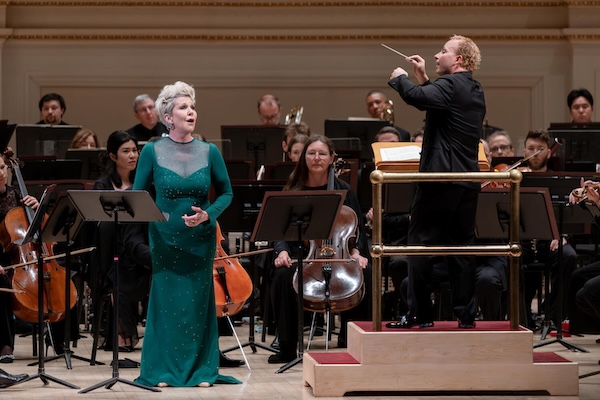
Everything is a work in progress, even in classical music. Scores and parts on music stands have the illusion of being fixed and done, but most premieres are readied for a certain date, but often not yet in their final versions. And even when they are, getting those fixed notes on the page in shape for a performance is itself a process, one that’s rarely complete by curtain time.
That was the story of Thursday night’s Met Orchestra concert in Carnegie Hall. Conductor and Metropolitan Opera artistic director Yannick Nézet-Séguin led the orchestra in music from Kaija Saariaho and Gustav Mahler.
With Mahler, the concert itself was part of a larger work in progress: Nézet-Séguin is going to be leading this and the Philadelphia Orchestra in a Mahler cycle as part of the upcoming Carnegie season. Based on his Mahler performances the past few years, the conductor is clearly figuring out the composer’s music, and this concert was another step along that path.
The music was Saariaho’s short Lumière et pesanteur, then Mahler’s Rückert-Lieder and Symphony No. 4 (after intermission), with mezzo-soprano Joyce DiDonato as vocal soloist. This first half was strong and the second more mixed.
Saariaho’s delicate, moody tone poem, distilled from her Simone Weill oratorio La Passion de Simone, is a showcase for her exquisite orchestration and what good musicians can do with it. The orchestra played it beautifully. There are overlapping waves of sound, bursts of sonorities like stars sapearing from behind clouds. The music upends normal orchestral practice, with icy strings—playing harmonics and without vibrato in perfect ensemble intonation—and warm brass, with buttery tones from the trumpets. Balances and dynamics were smoothly and carefully managed. For six minutes, one was lost in time to the sheer beauty of the sound and the performance.
The Rückert-Leider were marvelous. These five songs seemed to sit in DiDonato’s vocal sweet spot, her rich sound seeming to float effortlessly out of her body and above the orchestra. Without having to serve an operatic character, her phrases were uninflected and with her excellent articulation, one heard Mahler coming through her lovely sound and graceful yet complex expression. Mahler is not thought of as understated, but his song cycles are just that. They celebrate joy, as in “Blick mir nicht,” sung first, but when the text is more fraught, they use specificity and control to penetrate. DiDonato nailed this, with a stately “Liebst du um Schönheit” a compelling, stark “Um Mitternacht,” and a fantastically gentle “Ich bin der Welt.”
Nézet-Séguin is a consistently sensitive and responsive accompanist, and textures were transparent, almost pointillist, behind the singer. This is the first time one has heard him elicit a real Mahler sound out of an orchestra, which had all the colors and flavors, from light to dark and sweet to sour. The strings were velvet and woodwinds piquant.
But then, the closing work, the Symphony No. 4 showed the conductor is still trying to figure out Mahler. The expressive colors and psychological dimensions and details of Mahler’s orchestration were there, with the exception of the brass section which had problems with intonation, tone quality, and even getting the right notes throughout the symphony.
One came away with the impression that Nézet-Séguin still doesn’t completely grasp how Mahler works. For every satisfying moment in this performance there was a flawed one.
As much as this symphony has the reputation of being Mahler’s most conventional, this is still Mahler. The Fourth is deceptive, Mahler using song material, but experimenting with it in a more standard form. Compared to the earlier pieces, this has a much more vertical feel, and is on the brink of the revolutionary freedom of Symphony No. 5. It’s full of little bits of weirdness, like the sleigh bells in the first moment, and the strange, scordatura solo violin in the second.
Those were fine. The conductor’s quick tempo to start and agile transition into the first theme was above par, and concertmaster Benjamin Bowman was a star in the second movement, playing the quasi-sinister fiddle solos with the kind of bite and relish one doesn’t hear often enough in this part.
But the grand slow movement, a highlight of the piece, was a real problem. Nézet-Séguin’s tempo was slow, more largo than poco adagio in the prevailing, and unfortunate, contemporary interpretive style. A musician is free to make choices but he has to make them work. He couldn’t maintain the pulse, which stopped at the end of each phase in the opening section. The rest of the movement was solid, but the initial tempo made all subsequent tempo changes feel arbitrary rather than logical.
DiDonato was an idiosyncratic choice that also didn’t pay off. The song in the final movement is a child’s dream of feasting in heaven, and it’s supposed to sound like a child singing. DiDonato sounded great, but there’s simply too much of the adult in her voice and manner—this was a grownup narrating a child’s story, not the child itself. It was a great vocal performance, but it wasn’t Mahler.
NYO2, with conductor Mei-Ann Chen and violinist Tessa Lark plays Michael Torke, Gershwin, Respighi, and more, 7 p.m. Thursday, July 30. carnegiehall.org
One Response to “Nézet-Séguin, Met Orchestra still finding their way with Mahler”
Leave a Comment







Posted Jun 22, 2026 at 8:26 am by Richard
I also thought the Mahler 4 was just okay. But I was surprisingly pleased with the encore of 4th movement from Mahler 3. Now that was unique programming.