Bruckner Eighth builds cumulative power, cohesion with Yannick, Met Orchestra
Anton Bruckner, the country boy who toiled long in obscurity but eventually wowed musical Vienna with his massive symphonies, frankly acknowledged his debts to Beethoven and Wagner—the former for symphonic form and the latter for orchestral sonority.
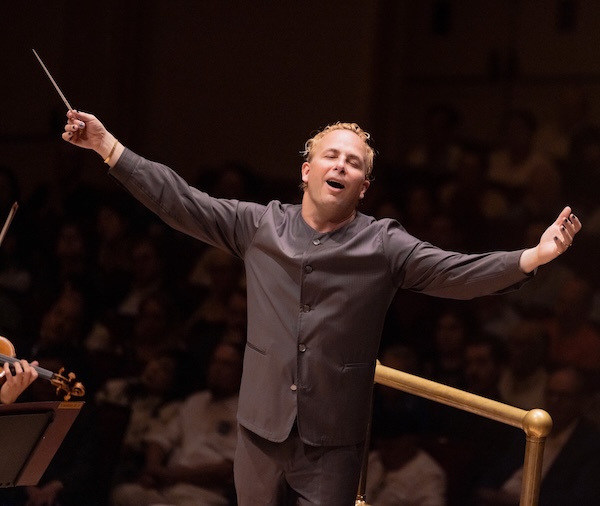
Thursday night’s performance of Bruckner’s Symphony No. 8 in Carnegie Hall by the Met Orchestra under music director Yannick Nézet-Séguin sounded at first like a series of scenes—understandably for these escapees from the pit of the Metropolitan Opera—but eventually acquired a symphonic sweep quite independent of characters and events.
In the symphony’s hushed opening bars, it was not hard to imagine the curtain going up on a mythic scene in the opera house. But what opera hits its fortissimo, brass-reinforced climax two minutes in? And where could this 80-minute symphony go from there?
The answer was a series of crescendos and retreats to calmer music, with not much sense of development other than trying to top the previous climax with an even bigger one—a strategy invited by Bruckner’s robust orchestration, but not helpful in presenting the first movement’s grand sonata form. But at least Nézet-Séguin’s sense of the moment was keen, whether digging deep for a string melody boosted by horns or thinning the texture to a flute-oboe dialogue amid wispy tremolo. The pianissimo C minor conclusion left a deathly stillness, a question hanging in the air.
The Scherzo was appropriately boisterous, in a broad 3/4 meter that left room for organ-style switching between “ranks” of woodwinds and strings. (Bruckner started his musical career as the organist of his village church.) The music could have used more rhythmic life, especially in lighter moments, for contrast with the lyrical trio section; the recapitulation of the first part was much improved in that regard.
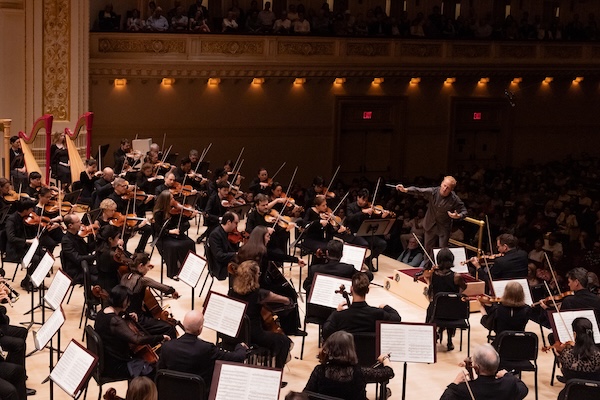
Nézet-Séguin’s symphonic hat was firmly on by the time he reached the vast Adagio, expertly managing everything from the details of sighing string phrases to the long line of unfolding thought in this half-hour of music inspired by the great slow movements of Beethoven. The piercing organ sonority of high woodwinds was well-tuned, as was the suspenseful counterpoint of horn and violins. Nézet-Séguin kept all in proportion, expertly turning the dials of volume and tension to keep the music airborne and nudge it toward its fff peroration.
The answer to the first movement’s question came at last in the finale, where Nézet-Séguin followed Bruckner’s indication “Grand, not fast” as the composer subtly wove together themes from the other movements, and threw in quotations of Wagner’s heroic “Siegfreid’s horn” motive for good measure. Less subtle was the performance’s “Let Bruckner be Bruckner” ethos, building mighty edifices of sound on a solid foundation of double basses and low brass.
If in the first movement such spectacular crescendos seemed like distractions from an orderly and ultimately tragic sonata form, here in the finale one could relax and revel in Bruckner’s enormous sound world, and Nézet-Séguin and his musicians did exactly that, building to a dazzling affirmation of C major at the close.
Carnegie Hall presents the Met Orchestra, conducted by Yannick Nézet-Séguin with mezzo-soprano Joyce DiDonato, performing works by Saariaho and Mahler, 8 p.m. Thursday. carnegiehall.org
Leave a Comment