Stars come out for a musico-historic bash at Carnegie Hall
“This is no ordinary structure.”
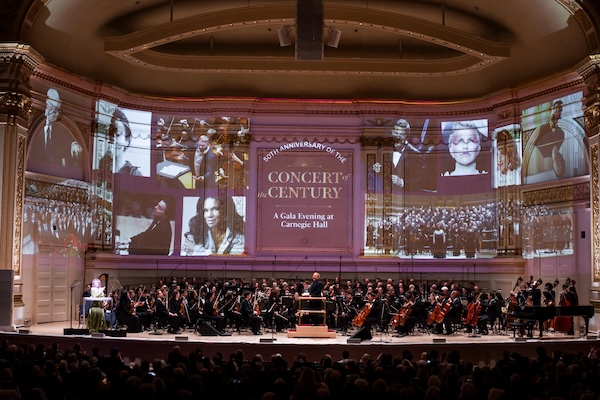
So began the quotation from Andrew Carnegie projected on the back wall of the stage at Carnegie Hall Tuesday night, as a stellar roster of musical performers prepared to celebrate the anniversary of an anniversary celebration.
If the hall’s management learned anything from the building’s near-death experience in 1960—when a public campaign led by violinist Isaac Stern saved it from the wrecker’s ball—it was this: Preservation begins with PR.
Carnegie Hall has lovingly tended its reputation as America’s Concert Hall ever since—as well as doing an impressive job of living up to it. No single picture sums this up as eloquently as the now-familiar photo of six 20th-century musical icons together on stage in 1976 singing along with Handel’s “Hallelujah,” no first names needed: Menuhin, Fischer-Dieskau, Rostropovich, Horowitz, Bernstein, Stern.
The occasion for that unique constellation was a combined concert of thanksgiving and mega-fundraiser, celebrating the rescued hall on the 85th anniversary of its dedication in 1891. So distinguished were the participants that the event quickly acquired the moniker “Concert of the Century.”
It’s been half a century since the Concert of the Century, reason enough to spin the hall’s Rolodex one more time and see what talent tumbles out. Tuesday’s concert demonstrated that one thing hasn’t changed in 50 years: If it’s Carnegie Hall on the line, music stars take the call.
Something that has changed is the public’s appetite for visual stimulation along with musical performance. Carnegie’s splendid cream, gilt, and red setting may be enough for most concerts, but this one was enhanced with photos, posters and even video clips, many from the hall’s own extensive archives, projected on the stage wall during the evening’s performances.
Late in the evening, Bernstein himself put in an appearance in a video, reflecting on why music moves our emotions so much in a Young People’s Concert broadcast from Carnegie Hall in the late 1950s.
Instead of program notes on the musical selections, an engagingly personal essay by Gino Francesconi, Carnegie’s founding archivist and historian emeritus, hopscotched around the story of the hall and the historic concert.
As for Tuesday’s live program, with just a few minutes for each artist to make an impression, the music-making tended to be on the hectic side, in both the repertoire selected and the performances. But attention was paid to overall pacing, and singers in particular provided some quiet moments to catch one’s breath.
This concert had not one but two curtain-raisers, with the hall’s resident youth orchestra, NYO-USA All-Stars, proving its mettle under the baton of Yannick Nézet-Séguin: Bernstein’s madcap Overture to Candide and the exuberant scherzo-march from Tchaikovsky’s “Pathétique” Symphony. (Following the latter’s slam-bang finish, it was hard to overcome a lifetime of learning not to applaud after this third of four movements, but one managed.)
Soprano Renée Fleming came onstage several times as the event’s M.C., and also gave the audience a break from orchestral hilarity with an expressive, prayerful performance of “Laudate Dominum” from Mozart’s Vesperae solemnis de confessore,K. 339, backed by the Oratorio Society of New York, the organization that inspired Andrew Carnegie to build the hall 135 years ago.
Pianist Evgeny Kissin was to have played Chopin at this point in the evening, but was indisposed and did not appear.
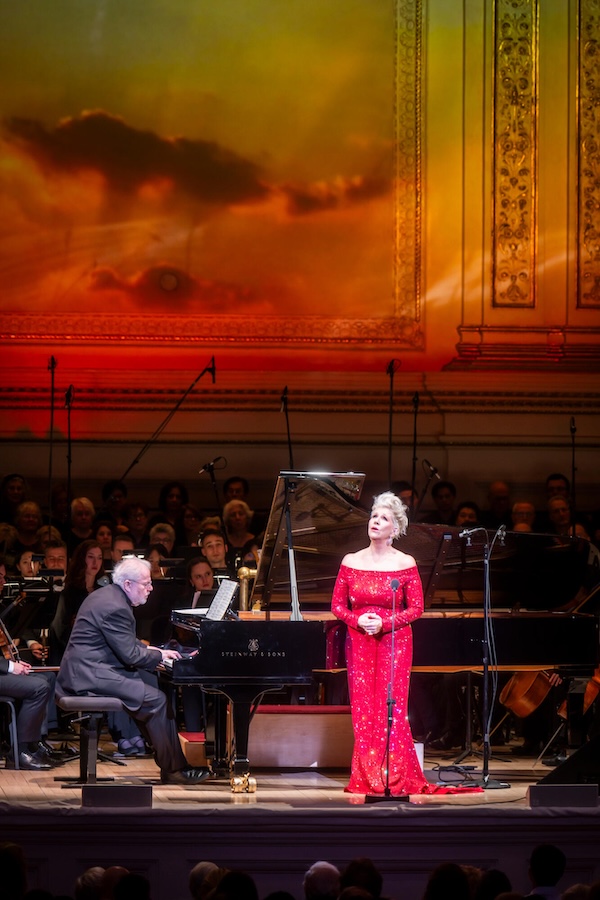
Instead, vocal distinction continued with mezzo-soprano Joyce DiDonato’s mesmerizing performance of two of Mahler’s Ruckert-Lieder, “Ich atmet’ einen linden Duft” and “Ich bin der Welt abhanden gekommen,” discreetly but alertly partnered by pianist Emanuel Ax. Heard after a large orchestra going full blast, the ease with which DiDonato’s lone, rounded mezzo voice filled the hall even in a soft dynamic was breathtaking.
Then it was back to Nézet-Séguin and the orchestra with the first of two piano concerto finales where the emphasis was on speed above all else. Daniil Trifonov blazed through the last movement of Gershwin’s Concerto in F, at least staying together with the orchestra and noting musical details where possible. Later in the evening, Lang Lang’s brittle fortes, arbitrary rubatos and gesticulations took much of the music out of the finale of Tchaikovsky’s Concerto No. 1.
Between those two finales, jazz and pop had excellent outings, as first singer Audra McDonald and pianist Andy Einhorn, then singer-pianist Michael Feinstein, worked the American songbook. McDonald began “Sophisticated Lady” elegant and clear, then decorated it smartly with whooped high notes. She and Einhorn tussled head-spinningly over elaborations to the already plenty-syncopated “Fascinating Rhythm,” in an arrangement by the late Michael Tilson Thomas, mentor to McDonald and, as she noted in her comments, veteran of at least 100 Carnegie Hall performances.
Feinstein played and sang “That’s Entertainment” in an andante tempo, enunciating substitute lyrics by Jerry Herman that, while alluding specifically to Carnegie Hall, paid tribute to Judy Garland, the star of some of the hall’s most memorable evenings. Then Nézet-Séguin and the orchestra put a glow and percussion highlights behind Feinstein’s smooth rendition of the sentimental Michel Legrand ballad “How Do You Keep the Music Playing?”—a question Carnegie’s management has to answer every day.
Following Lang Lang’s Tchaikovsky, mezzo-soprano Isabel Leonard displayed some virtuosity of her own, spinning the melismas and hitting powerful top notes in “Nacqui all’affanno… Non più mesta”—yet another finale, this one to Rossini’s La Cenerentola.
Then it was time for one more moment of reflection, this time on New Yorkers’ resilience in adversity, as the orchestra played Valerie Coleman’s Coplandesque and jazzy Seven O’Clock Shout under a projected photo of healthcare workers wrapped head to toe in their PPE’s. At the conductor’s cue, players and audience recalled the Covid era’s seven o’clock ritual by clapping and yelling encouragement.
Finally it was all hands on deck, with the evening’s featured artists strung across the front of the stage joining chorus and orchestra as they pealed out “Make Our Garden Grow,” the inspiring finale of Candide, neatly bookending this “Concert of the 21st Century.”
It had been a swell party, of mixed musical interest but a well-earned acknowledgement of past glory. Now it’s back to answering that question.
Carnegie Hall presents Rhiannon Giddens and assisting artists in “The Hidden Soundtrack of America,” a program of music from Africa and North America and from the 1700s to the era of minstrelsy and the early recording industry, 8 p.m. Friday. carnegiehall.org
Leave a Comment