Some missteps apart, Decoda brings vigorous advocacy to American program
Charles Ives had some rough things to say about what he called the “Rollos” of the world. He used that name as a stand-in for critics and listeners who he felt were dilettantes, not “manly” enough to be able to listen to any kind of dissonant, non-conformist music.
The other side of that was vigorous advocacy for just that music, which for him in his era meant American classical music. There was no need for special pleading, it could speak for itself as long as anyone gave it a chance.
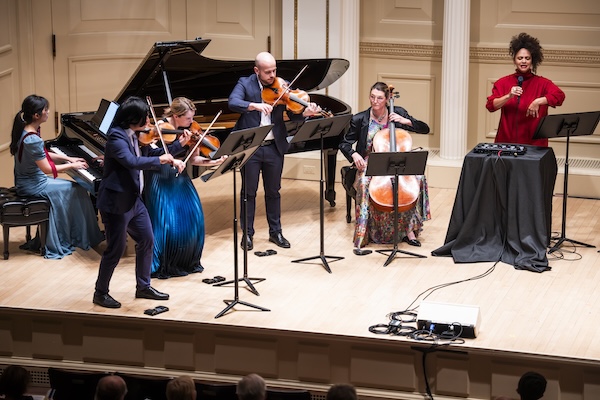
That advocacy is what Decoda took a stab at in Weill Recital Hall Tuesday night, with sincerity and enthusiasm alongside some awkward and jumbled thinking and presentation. The concert was part of Carnegie’s “United in Sound: America at 250” series, and in key ways was an exemplary statement of the range and depth of this country’s fundamental musical traditions. The program started with Ives’ The Unanswered Question, continued with “Summerland,” from William Grant Still’s Three Visions piano suite, and concluded with Florence Price’s Piano Quintet in A Minor. All these were played with skill, robust energy, and clear, fulfilling expression.
In between, and filling out the first half after “Summerland,” was a recent woodwind quintet by Carlos Simon, then arrangements of songs by Margaret Bonds, Zenobia Powell Perry, and Sarah Elizabeth Charles, with Charles as vocalist. This was fine music but with some stretches of awkward presentation and performance. That awkwardness came out in some of the playing and also a confused feeling that surrounded the concert—as if Decoda’s head was pointing one way and feet going another.
The program had “American Renaissance” as a title, and violinist Clara Lyon gave a short, jumbled speech to the audience that lacked a clear central point and never touched on what was plain in the music the ensemble chose—that this was a concert specifically around American classical music from African-American composers who were part of the Harlem Renaissance, or connected to its legacy.
That is a vital argument to make, and an easy one. The classical music establishment in America still pays insufficient attention to this country’s music—despite it being the greatest musical culture force on the planet for 100 years—and has historically shown even less interest in the work of African-American composers, until recently. All this neglected American music stands on its own, it just needs to be played as what it is.
The Unanswered Question wasn’t what it usually is. Decoda is a string quartet plus woodwind quintet plus piano—with no trumpet this chamber arrangement gave the musical question to the oboe, the ensemble response played by flute, clarinet, bassoon, and horn. With all the winds in the balcony and the strings slowly sliding through muted harmonics on stage, this has a mesmerizing performance. The contrast between the two groups was extreme and fascinating, the winds so focused and articulate they sounded almost angry. This was Ives as querulous mystic, which felt right.
After this, Still’s shining, dreamy fantasy of the afterlife, arranged for string quartet, was sunny and sweet. Simon’s Giants had a similar extroverted, positive attitude, but some clumsiness too. The piece is in five short sections dedicated to some of Simon’s heroes: blues great Bessie Smith, writer Maya Angelou, astronaut Ronald E. McNair, scholar Cornel West, and jazz titan Herbie Hancock. The music is vernacular, with blue notes, shout choruses, modern-ballad stretches, and more, all composed.
That’s already tricky in classical music, writing things like a blues bass line for bassoon and getting it to sound like the actual language, not a simulation. It relies on musicians who can play the music and make it sound natural. Decoda didn’t quite have the idiomatic phrasing and rhythmic feel, sounding like classical musicians playing notated jazz, and seeming not to grasp that vernacular musical language is one of the stepping stones of American modernism. But, in fairness, not many classical ensembles can do this authentically.
The songs were more in their wheelhouse. Each had a different arranger, with varying results. There were excellent transformations of Charles’ “Discover This country,” on a poem by Angelo, and of Bonds’ “Troubled Water,” by Monique Brooks Roberts and Jeremy Ajani Jordan, respectively, with pointed rhythms and colorful textures. Xiaobao Ha’s and Brad Balliet’s arrangements of Bonds’ “Dream Variations” and Perry’s “Life,” one of her Paul Dunbar Songs, were more pedestrian, doing the obvious and not much more.
There was also an odd and unsuccessful choice in these performances, which was to have Charles miked but the rest of the ensemble playing acoustically. Even though the singer was in the middle of the group, her voice was in the speakers at each side. Everyone was together in time but sounded in two different spaces. The amplified quality was also poor, shallow and with a wet, metallic artificial reverb that further split Charles from the instruments. Through this did make for some effective processing of her voice in “Discover This Country,” one missed hearing her warm vocal timbre and the fullness of her voice. The overdubbing effect the setup created was an enormous obstacle to expression the performances couldn’t always overcome
In contrast to the bookends of the program, there was a feeling of too much demonstration in the middle, less attention on making music. The stellar Price quintet performance was more proof. Her chamber music is full of charm, lyrical expression, with a completely natural integration of ideas and aesthetics from folks music and spirituals into a Dvořákian manner—and in this Quintet Price shaped some small, but memorable, phrases with a taste of Debussy.
Decoda’s playing was superb, exemplary. They had a big, satisfying sound that didn’t come from playing loud so much as playing with certainty of expression, energy, sense of purpose, and a strong feeling that the music was meaningful and exciting to them.
The quick encore was connected to McNair, who was also a musician; Balliet wrote a small piece of lyrical post-minimalism based on McNair’s playing, and Decoda dispatched it with elan.
The Met Orchestra Chamber Ensemble plays Valerie Coleman, Leonard Bernstein, Gabriela Lena Frank, and more, in Weill Recital Hall, 7:30, May 18. carnegiehall.org
Leave a Comment