Period instruments rock Baroque and new works with The Sebastians
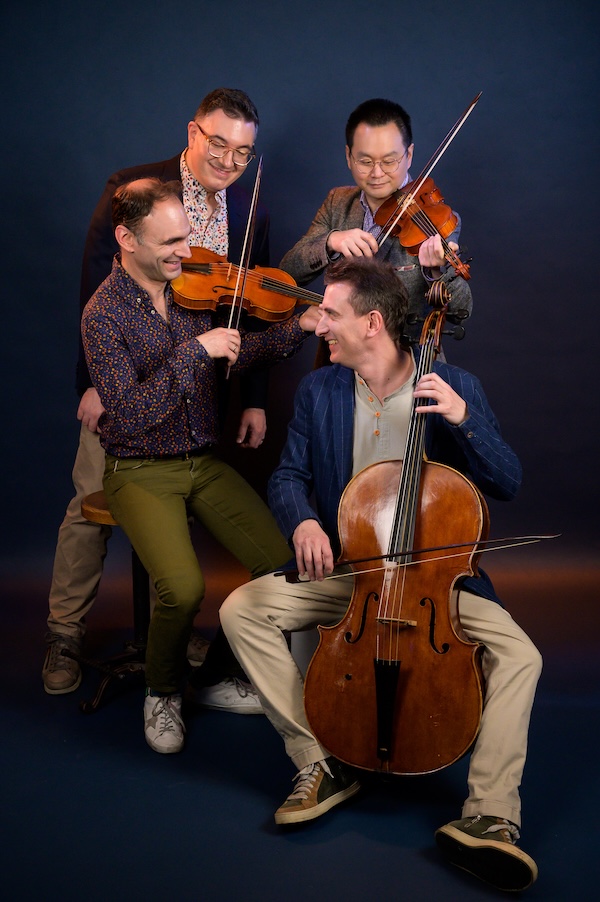
The Bible warns against putting new wine in old wineskins, but that didn’t prevent the early music ensemble The Sebastians from performing brand-new music—a world premiere, even–on their period instruments Saturday afternoon in the chapel of Brick Presbyterian Church on Park Avenue.
As music of Karl Hinze and Carson Cooman rubbed shoulders with that of J.S. Bach, Vivaldi and Corelli, the violins, violoncello, theorbo and harpsichord didn’t explode, but offered fresh perspectives on the sensibilities of three hundred years ago and today. The program was titled, of course, “Bach to the Future.”
In spoken comments, the group’s harpsichordist and artistic director Jeffrey Grossman characterized this program as the cap to a particularly Bach-oriented season that Included such landmark works as the six Brandenburg Concertos, the Mass in B minor and (in Princeton) the St. Matthew Passion.
It’s been argued that the reason the “historically informed performance” movement sprang up when it did after World War II was that modern tastes preferred a pared-down approach to the old masters contra the previous upholstered Romantic style. In program notes for Saturday’s concert, composers Hinze and Cooman each described how Baroque music as performed by The Sebastians fired their 2020s imaginations.
Cannily, the players framed the entire program with excerpts from the Goldberg Variations, a work that encourages reflection not only on what was “archaic” and “modern” in Bach’s own time, but on how music echoes across centuries to become classical standards today.
Harpsichordist Grossman led off with the tender and ornate Aria on which the Goldbergs are based, with his colleagues—Daniel Lee and Nicholas DiEugenio, violins; Ezra Seltzer, violoncello; and Adam Cockerham, theorbo—joining in on the repeats.
Having cited an iconic moment in Baroque music and introduced the band, the ensemble turned to Vivaldi to complete the picture of “expressive freedom, clarity of sound, and joyous, crackling energy” that composer Hinze described in their playing.
Vivaldi’s Trio Sonata in E minor, RV 67 opened with an aria-like Grave that demonstrated how much expressive tone shaping, pitch bending and rubato can exist within an orderly Baroque framework. Three dance movements followed: a hopping Corrente, a fetchingly phrased Giga and a striding Gavotta, propelled by the percussive accents of Seltzer’s violoncello.
All of those elements inspired both the music and the title of Hinze’s playfully titled Punch/Line, composed in 2024 and revised for this performance. The “line” at first was long notes and languid phrases, with jittery interjections, but soon cellist Seltzer laid down a riff in jerky 7/8 meter that put a “punch” under the intertwining violin lines. After a jazzy harpsichord solo—a nod, the composer wrote, to a similar moment in the Brandenburg Concerto No. 5—a brief, skipping dance in triple meter brought this charming piece to a close.
Corelli, himself a legendary violinist, gave Lee and DiEugenio plenty to do in his Trio Sonata in A major, Op. 3, no. 12. Whole swaths of the piece consisted of the two violinists rapidly swapping phrases over a pedal note on the violoncello, a treat to experience visually as well as tonally. A flurry of somewhat bewildering tempo markings in the printed program took shape aurally as a theme and variations, featuring in turn a running violoncello, racing violins, incisive dialogue in a high-stepping tempo, and a graceful gigue to wrap it up.
Variety was also the spice of Carson Cooman’s Movements, Op. 1639, a suite of eight short pieces making its world bow Saturday. (The whimsical opus number seemed to refer to the roots years of the Baroque era.) The opening movement’s elements of ragtime and hoedown spotlighted the ensemble’s keyboard and string components respectively. The well-contrasted pieces combined sighing violins with a rippling harpsichord, had violins play a Bartókian folk dance, and put fast cello triplets under a sturdy march.
A variations movement showed up here as well—can one sense a motif in this program?—as violins first intertwined, then made strange harmonies in long notes. A Presto movement opened in a clattering whirl for harpsichord that put one in mind of Ravel’s “Pagodes,” but unfolded with Vivaldian energy for all. In contrast, the next-to-last movement was a Ninna nanna, an Italian lullaby, violins sighing over a pizzicato cello and a twinkling harpsichord. The suite closed Goldberg-fashion with a reprise of its opening movement, wrapping up a pretty package indeed.
Did someone say Goldberg? A garland of variations from that masterpiece appeared on the harpsichord to close the program, as Grossman gave lively, fluently ornamented performances of the stepping-out Variation 22, the flowing Variation 12, the sprightly gigue of Variation 24, the triplet whirl of Variation 26, and a freewheeling rendering of the genial Variation 30, the “Quodlibet.”
And of course the gentle Aria returned at the end to sound a retrospective note, this time not over a 30-variation masterpiece but over a concert season saturated in the music of this group’s namesake. The string instruments joined in for a time but eventually dropped out, leaving the harpsichord to play the last few phrases alone, a perfect touch.
Leave a Comment