Met wraps the season successfully with Frank’s impassioned “Frida y Diego”
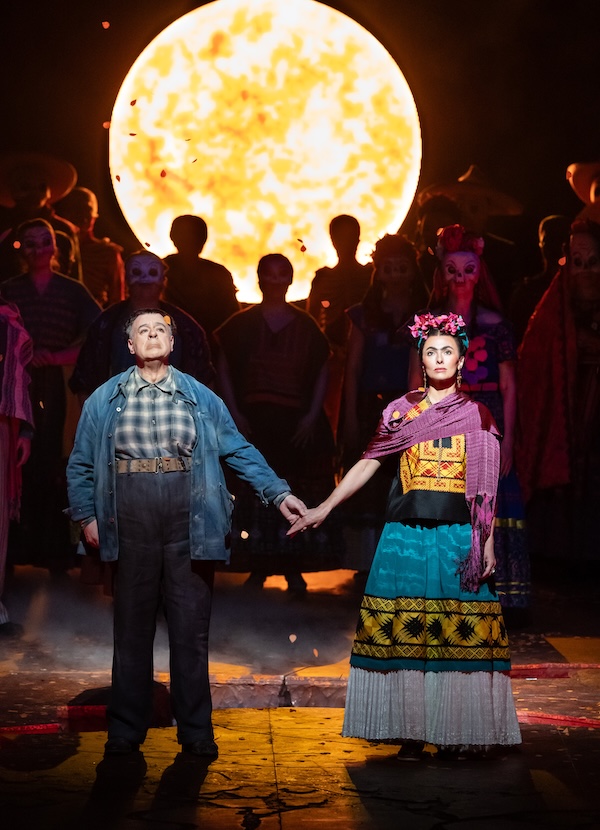
The final production of the Metropolitan Opera season opened Thursday night, and might be the most satisfying experience on the Met stage since it opened last fall.
The opera is Gabriela Lena Frank’s El Último Sueño de Frida y Diego. With a libretto by Nilo Cruz, the work had its world premiere at the San Diego Opera in 2022—later moving to San Francisco and Chicago’s Lyric Opera—but the Met offers an entirely new production by Deborah Colker for this New York debut.
The main characters are Frida Kahlo and Diego Rivera, two of the most famous artists of the 20th century and one of the most famous romantic couples in all of history. The story, in two acts, has Frida (mezzo-soprano Isabel Leonard), who is dead, returning as a corporeal spirit from the underworld through the magic of La Catrina, Keeper of the Dead (soprano Gabriella Reyes) along with a friend, Leonardo (countertenor Nils Wanderer in his Met debut) to see the lonely and bereft Diego (baritone Carlos Álvarez)—at least for one day.
This is something of a reverse Orpheus story, with a touch of the same tragedy but also an ultimate reuniting of Frida and Diego. Story-wise, that’s an uncanny resolution, a feeling of finality with a mix of pleasing and sad in a balance that shifts every time one thinks about it. This works in the current production because of the strong quality of the cast, and especially Frank’s score.
The composer, who just won the Pulitzer Prize for her symphonic work Picaflor: A Future Myth, has created a genuine opera with Frida y Diego. The 21st century has seen a flood of new operas from contemporary composers, very few of which have the essential quality of the music being a full part of the drama, something close to a character, rather than just accompaniment for the singers. The music tells the whole story while the singers tell theirs.
This is a colorful, romantically lyrical score, with details from Britten and John Adams. It is wonderfully fluid, spilling forth like a river, Frank’s syncopations and vocal tuplets creating a pulse with a creative instability against the cadences of her vocal lines and cadences.
The singers have plenty of music to open up, with the exception perhaps of Diego. On first hearing, the role seemed a bit under-characterized, although Álvarez was also underpowered and didn’t consistently project well with his voice. His sound was warm and natural, but didn’t always make an impact. This was in contrast with the other leads, who were excellent.
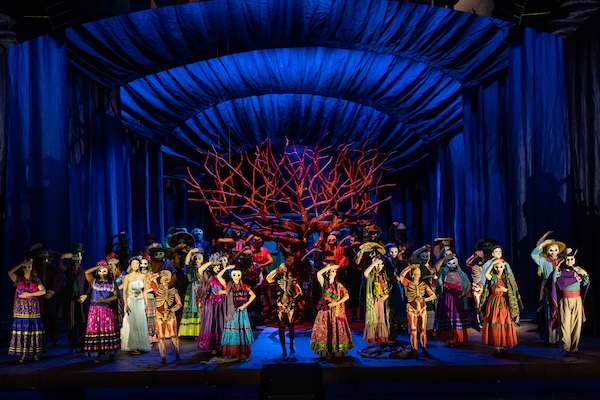
La Catrina appears first, she determines whom among the dead gets to visit the living, and Reyes’ singing was striking. She had a muscular, shining sound and sang with supple inflections, manipulating phrases to be both beguiling and insinuating. For the character, she was in remarkable skull makeup and skeleton fetish dress from costume designers Jon Bausor and Wilbert Gonzalez (a Met debut). The costume was so compelling that Reyes had to sing well not to be upstaged by it, which she did.
Leonard was also superb. The sheer sound of her voice was as beautiful as ever, a big, dark, glistening color that seemed rooted in her throat. That produced her typical expressive range and power, and a character that she made full of complexity. Frida is often reluctant to take each critical step along the way of her story, and Leonard brought out the emotional and moral dimensions of each decision.
Wanderer nearly stole the show. The character of Leonardo is a key to the complex fantasy in the opera—he doesn’t merely want to return to the living, but to do so in the guise of Greta Garbo to visit someone enamored of the movie star. Wanderer managed a believable and wonderful androgyny, like a reflection of the unsettled beauty in the opera, and showed a voice that has an incredible contralto quality. At one point, the line requires him to dip into regular tenor voice, then back to countertenor, and it was a stunning moment of both technique and compositional and musical imagination.
Met music director Yannick Nézet-Séguin led the orchestra. On this first hearing, the playing was colorful, balanced, and had the confidence of precision. But, uncharacteristically for the conductor, there seemed too little energy coming from the pit opening night. The pace felt just right, but was lacking a sense of focused intent and the expressive drive that comes out of that. The chorus, which sang with gentleness and fullness, almost seemed to be goosing the conductor along.
The rest, the singing and what’s onstage, is full of passion. The production has colors and costumes, and even effigies, for the Mexican locale—the libretto has Frida and Diego singing of their favorite hues for painting—a setting that moves from village market to Diego’s mural studio to the underworld, a mystical tree descending from the ceiling and skeletons rising from below to dance and move like Ray Harryhausen’s stop-motion creatures. The details are all a pleasure to see, ideal ornaments on top of this fine score and some wonderful singing.
El Último Sueño de Friday y Diego runs through May 30. metopera.org
4 Responses to “Met wraps the season successfully with Frank’s impassioned “Frida y Diego””
Leave a Comment







Posted May 16, 2026 at 8:30 am by Lewis Martin
Interesting. I understand all the world of chacun a son gout. But INNOCENCE is a modern masterpiece, in a stunning production by Simon Stone. Frida y Diego is by most critics’ consensus, and mine, a dreadful muddled production.
The opera has almost no plot or action. And the music is very professional, a nice first opera, but nothing to write home about. Mosty tonal, the orchestra seethes and roars and whimpers and a lot of tune-free singing goes on, but I kept thinking, ‘ in aid of what’?
Mr Gelb and the Met continue to foist upon us middling operas in mostly middling productions. Why? When some terrific operas are being written and performed around the world. Like INNOCENCE, which I assumed accidentally appeared at the Met. Which isn’t quite fair, as The Met has allowed operas by Thomas Ades to be produced.
Posted May 17, 2026 at 10:10 pm by Harold Emert
Not enough is said about virtuoso Brazilian choreographer Deborah Colker, best known for her choreography which opened the 2016 Olympics in her native Rio de Janeiro.Having witnessed in NYC in 2024 her debut at the Met in an ‘ Ainadamar’ based on the tragic death of Spanish poeta Garcia Lorca, i can only expect that her always stunning choreography deserves a more detailed description in this review.
Posted May 31, 2026 at 11:07 am by Chris Rutledge
Well, I am glad this review dwelt on the role of Leonardo, which apparently goes beyond injecting some gender fluidity into the historical aura of Kahlo. In a feast of dance, colour, costuming and dance staging, La Catrina steals the show – the one personality with a commanding drive and purpose.
Posted Jun 05, 2026 at 12:16 am by Wayne Saslow
I am not an opera-goer, but the thinness of the plot was so striking that I could not help but think that it should be reworked.
For each of the characters (Frida, Diego, La Caterina, Leonardo) the plot gives insufficient motivation for their actions. Frida wants more colors — there could have been dancing colored skeletons to show that — and when she becomes wracked with pain there could have been skeletons with sticks poking her.
Diego sits at his enormous easel but shows us nothing of what he paints — not a hint of what he paints. or of his great lost murals at the hands of the Rockefellers. La Caterina could have been made a character who once had been alive, and I would have been interested to learn of what she had lost in going to the Land of the Dead. Leonardo could have been been in a scene, or part of a scene, where we see him act out his love for his lover, and perhaps also seen the lover sleepwalk in response to Leonardo.
Things like what I mention above are only examples of what the playwright could do to fill out the characters. Lastly I note that in the theater version I saw this week, there were three Frida-like characters with blood or red roses over their hearts. Unless something was left out of what was shown in the theater, these characters had no role to play except to confuse the viewer.
I do hope the opera will undergo a revision, because the theatrical possibilities of the Day of the Dead conceit are extraordinary and will be stolen and improved by another playwright with the cunningness and nose of a Shakespeare for what spectacles people would delight in watching.