Viet Cuong premiere, Tsujii’s Beethoven highlight Orpheus program at Carnegie
The Orpheus Chamber Orchestra returned to Carnegie Hall on a particularly wet and nasty Saturday evening. If anything could shake off the weather, it was Viet Cuong’s bright new work, Time and Time Again, which received its world premiere at the concert.
The Vietnamese-American composer is known for his imagination and colorful voice, which he brought to bear in Time and Time Again. As the title suggests, repetition is at the core of the piece, with gestures or patterns that recur slightly altered, but instantly recognizable. What the title does not reveal is the open, optimistic mood that prevails throughout it and its instant appeal.
Time and Time Again unfolds in an almost cinematic fashion. Its main theme is just a few notes, but Cuong caresses each repetition with such imagination that it remains fresh. The sonorities he employs, including mellow brass, invigorating woodwinds, and string pizzicati, add luster to its glowing warmth. There is a brief, somewhat more somber section, and a few jarring dissonances in the brass, before the piece ends with a happy snap.
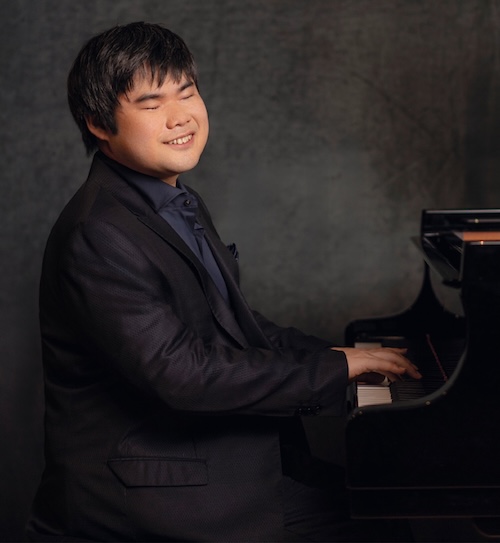
Pianist Nobuyuki Tsujii is one of Orpheus’s official honorary members, with the partnership dating to their 2014 tour of the United States and Japan. By that time, the Japanese pianist, who has been blind since birth, had won the Gold Medal at the 2009 Van Cliburn Competition and launched his international career. The chemistry that binds Tsujii and Orpheus resulted in an extraordinary performance of Beethoven’s Piano Concerto No. 2 in B-flat Major.
The concerto was actually Beethoven’s first work in the form, but the numbering reflects the order in which it was published. It is a product of his youth, composed when he was only 24, and served as his calling card at his first performance in Vienna. The warmth and sunshine of the Viet Cuong opener made an ideal prelude to this graceful, intimate, perfectly scaled reading of the piece.
Orpheus laid out the foundation with its light lyrical playing of the first movement’s theme. Tsujii entered in buoyant spirits, with the exuberance only heightened by his lighter-than-air roulades that followed. Intuition more than timing generated the spontaneity of the perfectly coordinated performance. Tsujii was at his most impressive in the fugal cadenza, with each entry clear and precise, where, for a time, lyricism yielded to power.
In the Adagio, Tsujii charmed with the elegance of his playing. For a moment, it appeared balance was an issue, but the piano’s spellbinding emergence from the thicker, louder orchestral textures dispelled that notion. The bell-like sounds he drew from the piano in the movement’s final measure were magical. High spirits prevailed in the Rondo, which ended with Tsujii blazing through its right-handed double trills.
Tsujii returned for two encores. The first was the final movement of Beethoven’s Moonlight Sonata, taken at breakneck speed. He was at his most impressive, ripping through its arpeggios with sparkling clarity. His lyrical reading of Chopin’s Nocturne in C-sharp Minor turned down the heat, but not the intensity. The emotion he brought to the piece was as impressive as the ease with which he dispatched its rapid runs and trills.
The concert ended with a fresh look at Brahms’ Piano Trio No. 1 in B major, recast as a Chamber Symphony by pianist-composer Michael Stephen Brown. With its combination of youthful zest and the structural mastery of the mature Brahms, the Trio is a masterwork.
Brown’s symphonic approach doesn’t quite scale the heights of the chamber original. Brown skillfully divides the sublime music to varying combinations of solo instruments or entire sections, but this failed to capture the precision, lightness, and lyricism Brahms instilled in the piano-led original. There were wonderful solos throughout, especially from the flute, oboe, and horn, and the strings played Brahms’ melodies with warmth and grandeur, but the trio’s simplicity and clarity were often lost.
Nonetheless, there were high points. Brown’s brilliant orchestration of the Scherzo conjured Mendelssohn at his lightest and brightest. His orchestration of the Largo retained its emotional impact, especially owing to solo work by oboist James Austin Smith and hornist Eric Read. In the end, however, the lasting impression was that there was more Brown than Brahms in this laudable but uneven effort.
Leave a Comment