Parlando wraps season with a laudable encore of cabaret music
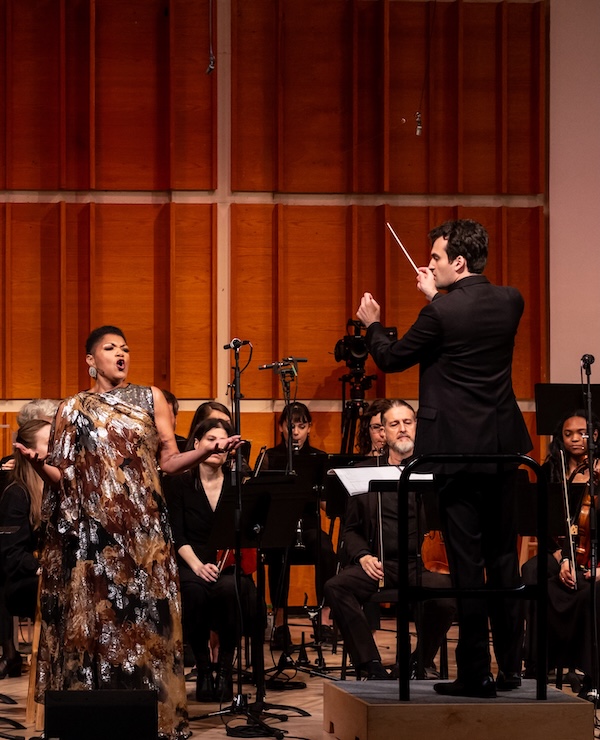
Parlando and conductor Ian Niederhoffer concluded their season Wednesday night with the second part of their series, “The Cabaret Project.” Spanning this season and last, the series has Parlando playing chamber orchestra arrangements of cabaret music, and cabaret-adjacent works in the classical repertoire.
This is a deeply fascinating question to explore, as Niederhofer hinted at in his introductions before each work, and presented in an enticing program: Emil Bauer’s arrangement of Ernst Krenek’s Fantasie Jonny spielt auf; Hanns Eisler’s Kleine Sinfonie; an orchestration of Abel Meeropol’s “Strange Fruit; and Aaron Davis’ song cycle on poems by Margaret Atwood, Zombie Blizzard. Davis played piano on “Strange Fruit,” and soprano Measha Brueggergosman-Lee joined Parlando on the Merkin Hall stage as vocal soloist in the last two works.
This music was full of style, expression and historical and social significance. Niederhoffer pinned modern cabaret music to the impact American military bands—notably James Reese Europe’s Harlem Hellfighters—had in Europe during WWI, explaining it as a mix of jazz and modern classical. The music those bands played wasn’t really jazz, which didn’t quite exist at the time. But it was important music that went into jazz, not just marches and W.C. Handy’s formal blues, but Tin Pan Alley tunes and dance music like cakewalks and foxtrots. This is a huge part of the story of how American popular culture came to dominate the world over the past 100-plus years, and the ramifications of that.
The Fantasie was an excellent selection, even if the performance took a few minutes to get over a slightly awkward embrace of Krenek’s now-stilted phrases and rhythms. His opera about a black musician in Europe, Jonny spielt auf, was an early target of the Nazis, who banned it as “degenerate” music. Musicologically, it is an essential part of the story of how American music, and even just the idea of it, especially black music, is at the core of not just cabaret but modernism.
Parlando set the mood with this, and also opened up the larger picture of how cabaret has been an important musical expression for socially and politically outcast and marginal groups. Eisler is one of the most significant examples. Exiled by the Nazis for being both a Jew and a communist, he ended up in Hollywood and became an important film composer—and also wrote the great cabaret work, Hollywooder Liederbuch, with Bertolt Brecht—before he was later deported to East Germany for being a communist.
Eisler’s Kleine Sinfonie is less straight cabaret than acerbic, spiky modernism—a quick, punchy symphony with cabaret attitude and characteristics. This again had a slightly undercooked start, the feeling that it took some time in the “Thema bit variationen” to get the right sharpness to the angles of the music, enough of a gimlet eye for Eisler’s faux irony. Cabaret has a façade of irony but underneath is full of sincere and almost naïve expression, and this work has a barely disguised hopeful yearning for innocence that Parlando dug into as it went along, with a bracing “Allegro assai” and haunting moments in the “Invention.”
“Strange Fruit” is one of the most famous and important songs in American history, a beautiful and harrowing anti-lynching ballad. Billie Holiday’s fervent commitment to it in her stint at Cafe Society in New York made her a star and gave the record companies enough courage to record and distribute it. Davis’ orchestration was excellent, with imaginative and effective expressive glissandos, while reinforcing the classic buildup of dramatic tension Meeropol crafted.
Brueggergosman-Lee was a welcome sight on stage to begin with, and she sang this with terrific musicality and pinpoint expression. Her sound had a rich throatiness, and she modulated it through each verse, pinching the last words into a kind of serrated blade. Moved out of the cabaret and into the concert hall, this was a superb set piece, a demonstration that art songs can and should be meant for the public.
Zombie Blizzard was a worthy companion to “Strange Fruit.” This 2023 work was hard in the world premiere of Aaron Davis’ orchestration. The text is seven poems by Margaret Atwood, from 2020, covering personal stories about sex, death, violence, loss, and the need for poetry. Each song spans a different style, with touches of jazz, rock, ballads, and dances, full of sassy brass and shifting downbeats and rhythms.
As songs, each had a fine, masterful shape that followed the direction of the text and found natural heights and endpoints. The larger-scale form was also excellent, the entire thing following a clear journey from self-possession to a moving expression of how life feels after those around us pass on.
Brueggergosman-Lee sang with a natural flow of classical tone and articulation, and an ease with the graceful, pop-style melodic phrases. Perhaps Niederhoffer and Parlando can grace us with an extension of this worthy project.
Leave a Comment