Lim’s mercurial imagination runs free in richly textured Carnegie recital
Mozart’s friend, the composer Dittersdorf, once noted the “astonishing wealth of ideas” in his colleague’s music, and then added, “I wish he were not so lavish with them. He leaves his hearer out of breath.”
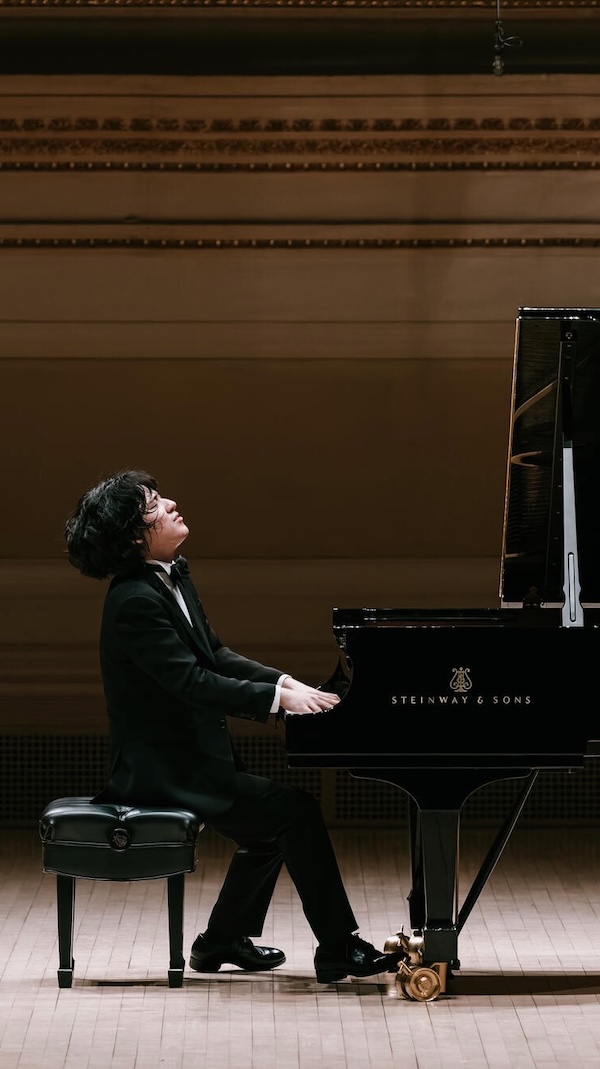
The audience at Friday’s recital by Yunchan Lim in Carnegie Hall seemed to be breathing sufficiently, but it was a challenge to keep up with the pianist’s fertile imagination as he spun out fresh takes on seemingly every bar of sonatas by Schubert and Scriabin, often at head-spinningly fast tempos.
But then, the South Korean has been a young man on the move ever since, at 18, he became the youngest gold medalist in the history of the Van Cliburn Competition. That was four years ago, and unlike many other Cliburn winners, Lim immediately shot to the top of the A list of international pianists.
The traits that have kept him there were on full display Friday, not only in dazzling digital prowess but in intensely communicative phrasing and a rich tonal palette.
Scriabin’s Sonata No. 2 was on the program, dubbed by the composer “Sonata-Fantasy.” In Lim’s hands, all the other pieces became sonata-fantasies as well, even Schubert’s Beethoven-inspired Sonata in D major, D. 850, as the inspiration of the moment tended to take precedence over the architecture of sonata forms.
The rush of triplets in Schubert’s first movement pauses briefly for a clanging, bell-like passage marked “a little slower.” Lim, who likes dramatic contrasts, took it a lot slower before resuming his dash through this kinetic Allegro vivace. Apparently judging a 40-minute performance to be more than long enough, he omitted the exposition repeat, bypassing the opportunity to reflect further on Schubert’s themes before plunging into the development section.
Youthful impatience may have also played a part in the rhythmic distortion of the Con moto slow movement, consistently shortening the long note in the theme’s short-short-short-long pattern. (Although this error is easily corrected by counting, many pianists—and conductors—make it anyway.) But Lim made one forget such cavils with a sensitivity to voicing and shifts of momentum that turned a long, repetitious movement into a garden of delights.
The tonal contrast between the Scherzo’s hard, stuttering chords and the flighty answer was so great they didn’t sound as if they were in the same piece. Again, small-scale effects obscured the long view. But what effects—an aggressive theme that suddenly turned flirtatious, a mellow trio in legato chords that swelled to immense resonance.
The little skipping theme of the finale, with its tick-tock accompaniment, is Schubert in his most “naive” mode. Lim didn’t entirely resist the temptation to dress it up in more adult expression, stealing some of the contrast from the legato lyrical episode that followed, but the elaborations of the rondo theme at each return were carried off with wit and charm, culminating in a quite astonishing spray of pianissimo scales at the end.
The three Scriabin sonatas that followed intermission took less time to play than Schubert’s one sonata. Lim programmed them in historical order, performed without interruption by applause: Nos. 2 and 3, both composed in 1897, and No. 4, of 1903. In this sequence, one could hear “middle Scriabin” outgrowing the early influence of Chopin and earning the admiration of his conservatory classmate Rachmaninoff with densely woven yet melodious piano textures that sounded like they required three or four hands to play.
With his vivid range of touch and ear for voicing, Lim seemed born to play this complex music. The slow opening of the Sonata No. 2 in G-sharp minor, Op. 19—inspired, the composer said, by the shifting colors and moods of the sea—seemed to glow under his hands like a phosphorescent tide. Distinctive voices, bold or wispy, gathered in an atmosphere ranging from limpid pianissimo to oceanic fortissimo. The closing Presto brought on the storm, with snatches of melody flying past amid rushing winds and thunderous bass octaves.
The Sonata No. 3 opened “Drammatico” with a feeling of a storm in abeyance, but barely so. In a much-inflected performance of the Allegretto, the pianist seemed to pause often to admire his handiwork, but faster sections had shape and thrust.
The impressionistic song of the Andante unfolded amid lush sonorities, with tenor and bass voices woven in, sounding near or distant. The Presto finale’s torrent of notes outlined a chromatically descending melody, a fatalistic metaphor borrowed from Chopin and Rachmaninoff. After a hushed moment with an enigmatic phrase glowing in the dark, the sonata concluded in an ecstatic explosion of chords and octaves.
The brief Sonata No. 4, just eight minutes from start to finish, began with another multi-hand effect, a birdy welter of calls, trills and peeps, through which a chordal theme wandered. The birds took wing in the weightless Prestissimo volando, the pianist flicking out chordal accents in the soft whir, until repeated chords brought on the massive final crescendo, and the piano’s roar was matched by the audience’s ovation.
Lim was old school when it came to encores, returning to the stage five times before granting a single extra piece: Rachmaninoff’s Vocalise, inflected Lim-style with plenty of rubato and swells, and finely layered with countermelodies.
Carnegie Hall presents violinist Lisa Batiashvili and pianist Giorgi Gigashvili performing works by Beethoven, Prokofiev, Bardanashvili and Franck, 7:30 p.m. Tuesday. carnegiehall.org
Leave a Comment