Feldman’s Piano and String Quartet finds its groove at Roulette
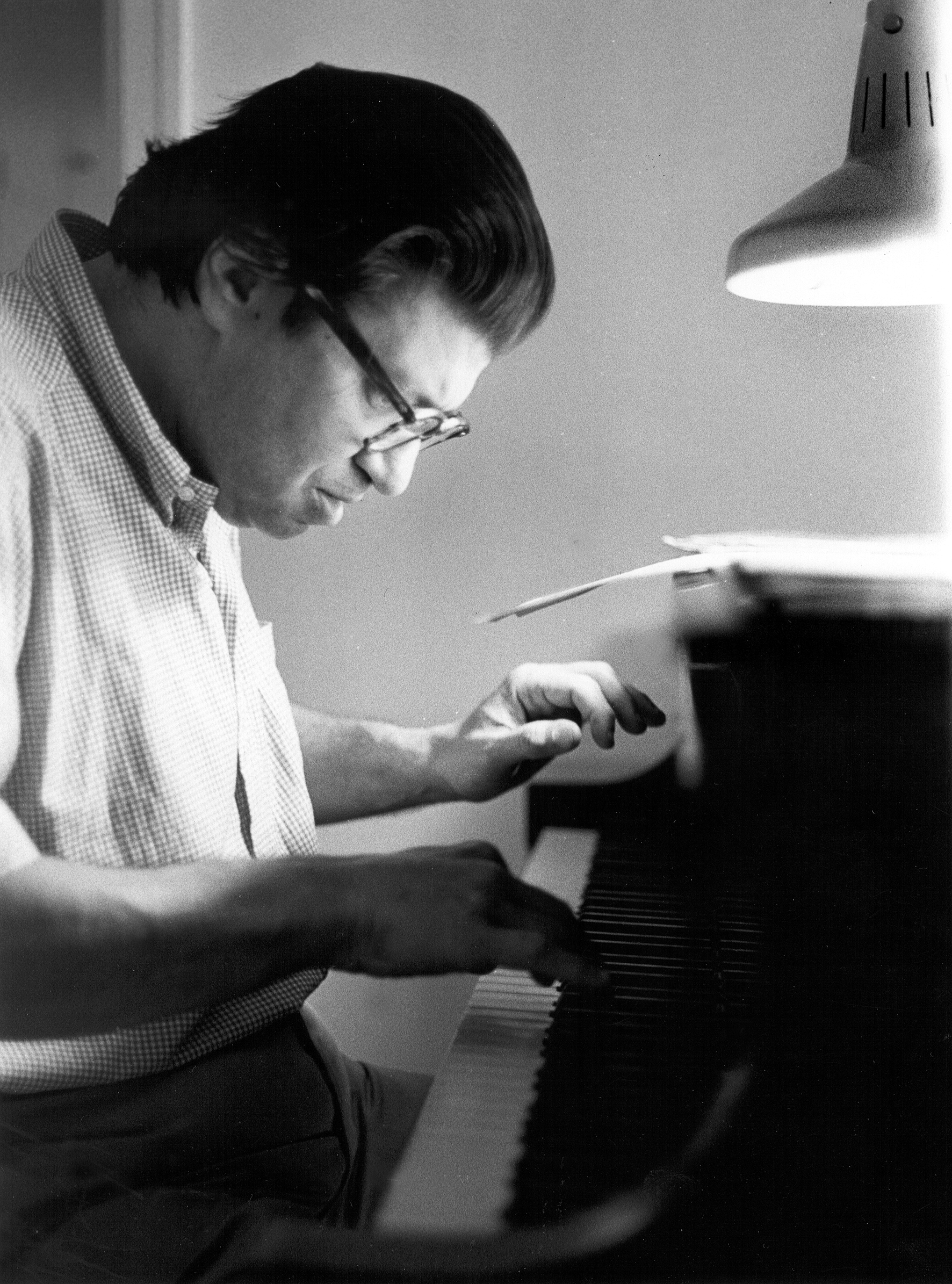
Perspective is another word for point of view, and changing that means shifting one’s position in space. With music, which only exists in the dimension of time, changing perspective means allowing time to pass, letting ideas accumulate and contexts change. With that, it can be easier to see where music sits and what it means in history.
Almost forty years after his death, and in his centennial year, history seems like it’s catching up with Morton Feldman, revealing his greatness in greater depth and detail. That was the feeling of the marvelous performance Wednesday night at Roulette of his Piano and String Quartet, played by pianist Vicky Chow and the Mivos Quartet. One of Feldman’s finest compositions sounded like one of the finest chamber music works—and it is.
Feldman wrote this in 1985, two years before his death, on a commission for pianist Aki Takahashi and the Kronos Quartet. At this point Feldman, an important pioneer of indeterminacy who thirty years prior had been using graph paper for his scores, was writing music with exacting, detailed notation in traditional language. There is an equally descriptive generic title that can be used for the piece, which is Piano Quintet, and as much as Feldman began as an experimentalist, by this time he was firmly in the classical tradition, albeit at the cutting edge. Rather than tunes, he was interested in timbres, he worked more with pulse than tempo, and most importantly he was making pieces with long duration.
Wednesday night’s performance was 77 minutes, which felt just right. There was a quiet, deeply musical beauty to this performance. The musicians didn’t play it with the objectivity that is usually applied to music considered a new part of the avant-garde, but with the subtle shaping to each phrase and internal communication of the 19th century repertoire. They played it like Schumann.
Though there is no melodic profile, there’s plenty of structure and form. The basic material is an arpeggiated piano chord that sounds like a question, the answer coming via sustained unisons and chords in the strings. Against the monochromatic piano, the four strings mix standard, harmonic, and sul tasto timbres, push pitches a quarter-tone this way and that, and vary dynamics within the quartet.
There are key formal details, like a solo statement in the cello that’s built out of some of the piano material, and chords in the strings that go through sequences of inversions, and even modulate at one point. This is in no key, nor is it tonal in the traditional sense, but there is plenty of consonance throughout, set against a near equal amount of dissonance and uncanny intervals that fall in the cracks. The back and forth between piano and strings is paralleled in the larger scope of the music rocking back and forth between still points and slightly unbalanced passages that, in this performance, landed gracefully on solid ground.
This adds up through time to music that is closer to Haydn and Schubert than Feldman’s New York School peers, and with the shaded but substantial expression of Feldman’s beloved Webern. Though not meant to get from one harmonic place to another, the performance instead accumulated experience, memory, and some wisdom through time, like life. Each repetition and phrase grew in meaning.
The ensemble was maybe a little too cautious through the first ten minutes, playing each phrase and call and response as if the music were delicate and easily damaged. But after that the playing grew more fluid, it felt like they came together on an understanding of the expressive purpose of the music, and it took over their playing.
Nearing the hour mark, the music making grew sunny, followed by a noticeably livelier pulse. At 70 minutes, the coda came clearly into view, then the last set of rocking string chords. The piano arpeggios at the end provided a final gesture that was yet another question mark.
The Bergamot Quartet and the Rhythm Method play Paul Pinto’s String Quartet No. 3 OCTET, 8 p.m. April 21, at Roulette. roulette.org
Leave a Comment