Buniatishvili’s recital offers more showmanship than insight
On February 4, 1987, Liberace died in Palm Springs, California. Just four months later, half a world away in the Georgian city of Batumi—known as “the Las Vegas of the Black Sea” for its casinos and nightlife—the pianist Khatia Buniatishvili was born.
Coincidence? Not on the evidence of the latter’s recital in Carnegie Hall Wednesday night, where the old ivory-tickler seemed to live on in an atmosphere of overheated fandom and showmanship.
Granted, the TV and Vegas star never addressed the greatest monuments of the piano repertoire, as Buniatishvili did by beginning her program with Schubert’s haunting, valedictory Sonata in B-flat major, D. 960. And his rippling arpeggios were no match for her jaw-dropping avalanches of octaves.
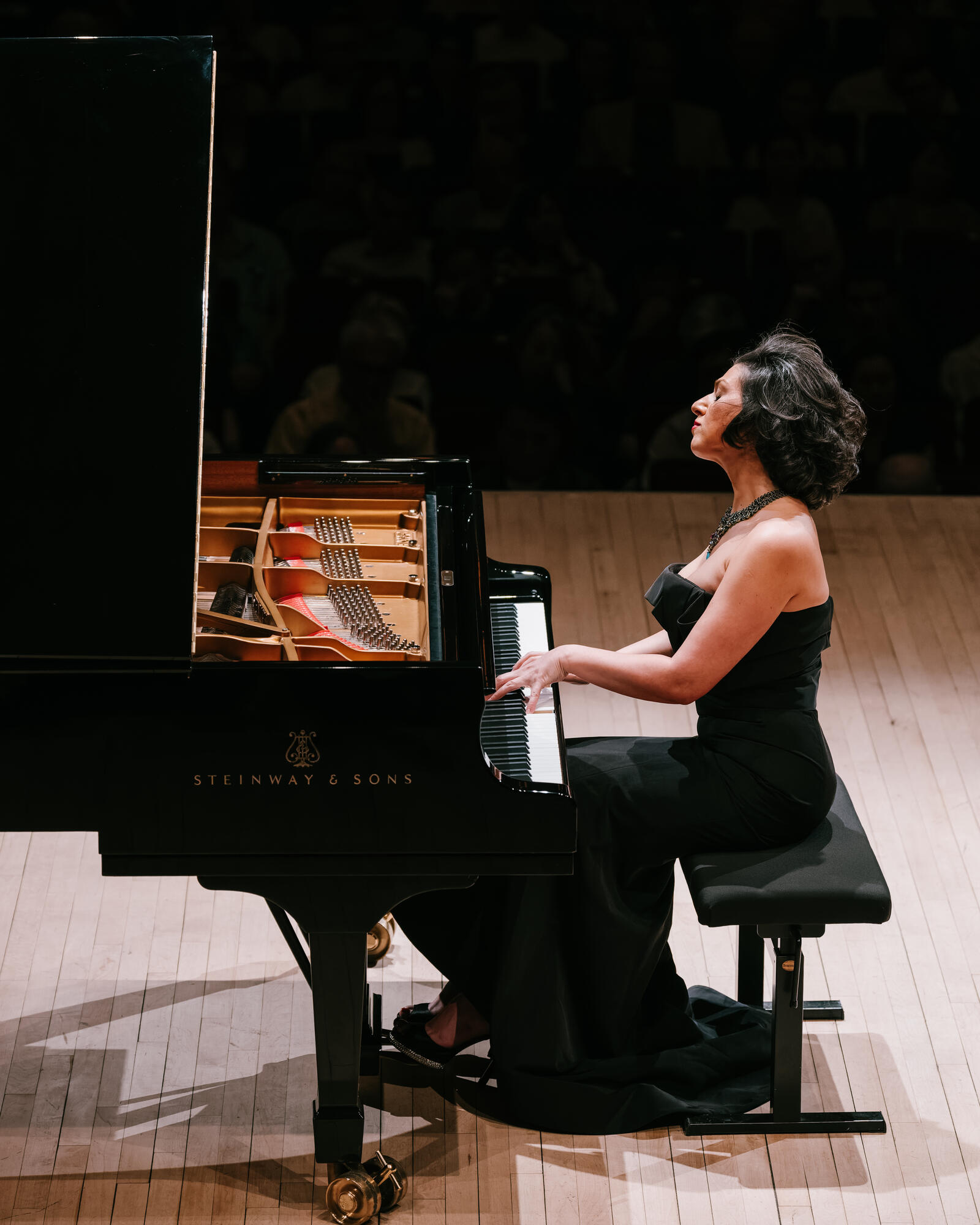
But one knew something was up when the Georgian pianist, tall and resplendent in a slinky black gown, made her way through the overflow seating onstage, blowing kisses in all directions, to an ovation. As she sat at the piano, the stage lighting dropped to a white pool surrounding the instrument. This was going to be a show.
What followed was a conscientious rendering of Schubert’s score, without conveying much of the “why” of it. The long first movement lacked that sense of humming past a graveyard, interrupted by a chilling low trill, that makes this indescribable music feel so tender and also so creepy. “Interpretation” consisted mainly of playing faster when the music was loud and slower when the music was soft. The performance became more convincing in the long decrescendo to the super-pianissimo close.
The Andante sostenuto did indeed “sustain” that hushed mood as the pianist explored shades of piano and pianissimo, with the left hand crossing discreetly back and forth over the right. Seemingly spellbound, the capacity audience hardly made a sound throughout.
But Buniatishvili’s uncanny technique is a fast car, and soon it was skidding around corners in the Scherzo, and blowing right past the speed-limit sign in the finale, Allegro ma non troppo. (This was not a night for “but not too much.”) So much fast playing robbed the sonata’s jubilant final pages of some of their impact.
At the bows, in another departure from custom, the artist was presented with flowers when she was far from done for the night. She returned after intermission sheathed in gold spangles to confront another moody masterpiece, Beethoven’s Sonata in D minor, Op. 31, no. 2, “The Tempest.”
The strangeness of Shakespeare’s play is reflected in Beethoven’s enigmatic utterances and withholding of momentum throughout this sonata, but Buniatishvili preferred to barrel through the opening Allegro as if anticipating the Liszt pieces later in the program.
The lack of dramatic tension overall affected the Adagio, which was not as arresting as the Schubert slow movement had been. The obsessive figurations of the finale, which should feel like driving a car with the brake on, became blithe swirls that tapered off at the end in a vanishing diminuendo, leaving the audience apparently mystified.
The pianist dispelled any awkwardness by swinging directly into Liszt’s Mephisto Waltz No. 1, fast and furious like the Five-Minute Shakespeare version of this party scene from Lenau’s Faust. Happily, some feathery leggiero episodes came along to relieve all the roaring and splattering, but at this point the evening had clearly turned the corner from musical communication to an exhibition of sheer speed and strength. The audience roared right back at the piece’s thunderous conclusion.
The pianist turned the temperature down a notch with Liszt’s transcription of Schubert’s song “Gretchen am Spinnrade,” passionate in the middle but mostly a hypnotic whirl of the maiden’s spinning wheel, smoothly evoked in Buniatishvili’s seamless legato.
For contrast, Liszt’s Hungarian Rhapsody No. 6 opened with a strutting, bombastic march followed by a trotting tune, played somewhat out of time. After a pause for an impassioned, Roma-style lament, things got going in earnest with a tune in rattling repeated octaves that just kept accelerating as it jumped from right hand to left amid storms of notes. At some point, it felt as though music was forgotten, replaced by the sheer fascination of watching hands in a blur as they raced to the fortissimo finish.
Responding to yet another ovation, the pianist played a settle-down encore, the gently florid Adagio from Bach’s Keyboard Concerto in D minor, BWV 974, before getting down to the real business, the closing pages of Liszt’s Hungarian Rhapsody No. 2, as “enhanced” by Vladimir Horowitz, louder and faster than one might have thought possible.
Carnegie Hall presents pianist Yunchan Lim performing works by Schubert and Scriabin, 8 p.m. April 24. carnegiehall.org
Leave a Comment