A trio of worthy debuts boosts Met’s “Onegin” revival
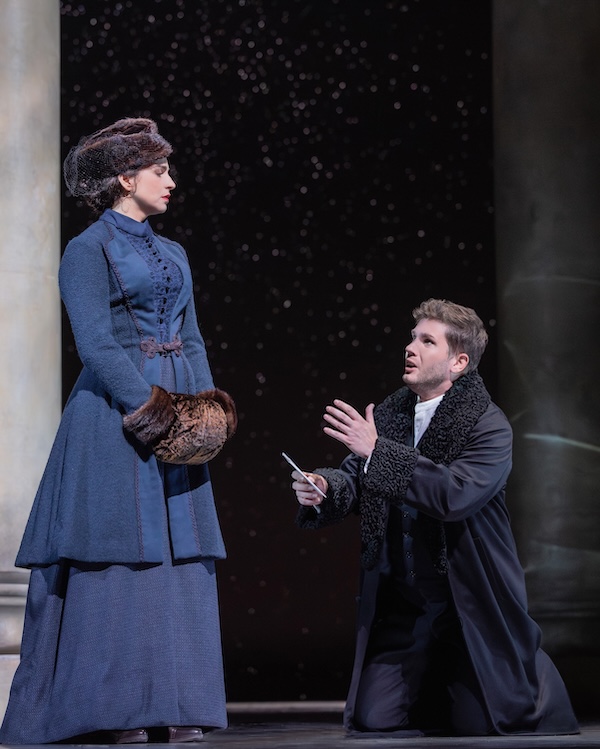
Tchaikovsky’s Eugene Onegin returned to the Metropolitan Opera on Monday evening. The chief attraction in this revival was Asmik Grigorian in her Met role debut as Tatiana. The Lithuanian soprano met all expectations in a riveting performance in which Grigorian’s vaunted dramatic skills were fully evident. Her Tatiana was carefully conceived and sculpted, yet always fresh and spontaneous vocally and dramatically.
Cascades of emotion coursed through Grigorian’s Tatiana as she penned her passionate declaration of love to Onegin in the Letter Scene. The voice, which could be timid, almost wan at times when expressing the confused feelings of a sometimes overbearing teenage girl, blazed with passion as she poured her feelings into the written word. In the final scene, Grigorian was equally fiery as she confessed her love for Onegin, but her words rang with richness and chilly authority as she chose duty over the vicissitudes of a life with him.
Iurii Samoilov, too, brought his Onegin to the Met for the first time, and also triumphed. His Onegin embodied smugness in the opening scenes, oozing masculinity and nonchalance. The veneer broke as he faced Lenski in the duel, when he grasped his friend in a bear hug, and then cradled his dead body. Desperation followed, as Tatiana dismissed him with a severity even harder than his heartless dashing of her girlish dreams of romance.
Samoilov’s baritone is smooth and enticing when Onegin balances between insouciance and callousness. In the final act, as Onegin’s composure unravels, so does Samoilov’s voice, with the suavity replaced by cragginess in a voice aching with desperation.
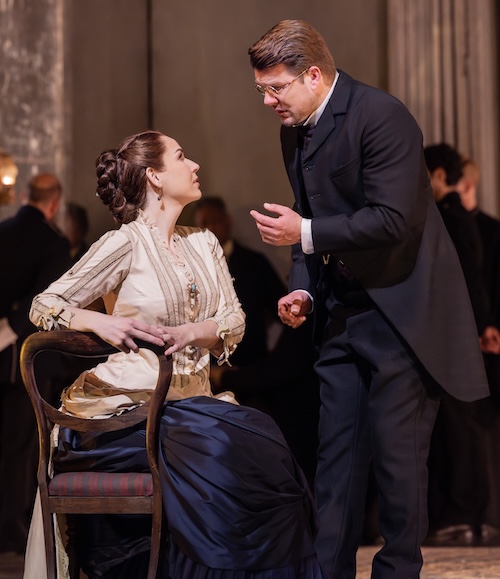
Stanislas de Barbeyrac also made his Met role debut as Lenski with this performance, with more mixed results. In the first scene, his voice was unsettled and his high notes effortful and fuzzy as he expressed his love for Olga. The tenor was in greater command of his voice when he later appeared at the party in honor of Tatiana, with his top secure and ringing free. His farewell to life captured Lenski’s desperation and confusion with poignancy and rich-voiced lyricism.
As Olga, Tatiana’s sister and Lenski’s intended, Maria Barakova’s voice was pure sunshine and vivacity. They true dynamics of the situation never registered with this Olga, as she flirted and danced with Onegin.
Alexander Tsymbalyuk was a potent, imposing Prince Gremin. Even though the lower notes of the aria are not his most congenial vocal turf, Tsymbalyuk expressed his love for Tatiana and his happiness in marriage to Onegin in a compelling bass-baritone.
The remainder of the cast were mostly veterans of the most recent 2022 revival. Elena Zaremba returned as a grand Madame Larina, who, despite her years, still possesses an imposing voice. Larissa Diadkova’s stern Filippyevna anchored every scene in which she appeared. Wearing a leg brace, Tony Stevenson proved to be dexterous vocally and physically as Monsieur Triquet, when singing the couplets in honor of Tatiana on her name day. As Zaretski, Richard Bernstein was as precise as the rules he enforced, for what Lenski’s best friend deemed the messy business of slaughter.
At 32, Russian conductor Timur Zangiev, in his Met debut, brought excitement and drama to the performance. Undoubtedly charged with adrenaline, Zangiev needed a few minutes to settle down, but then he took total command. His energy spilled over into the Met Chorus’ robust singing in the first scene, where the peasants celebrate the harvest. The Met Orchestra was attentive to Zangiev’s dramatic impulses. Particularly evocative were the horn solos that course through the Letter Scene and are again heard in the harrowing final act.
Deborah Warner’s production, an import from the English National Opera, was first staged at the Met during the 2013-1014 season. Tom Pye’s sets are showing their age and display an underlying lack of inspiration and imagination. They are still fit for purpose, however, and take advantage of the expanse of the Met’s stage. Before each scene, projections of seasonal landscapes spanning the entire stage proscenium establish place and mood, which the sets don’t always do.
The scenes at the Larin estate unfold in a fusty, disheveled conservatory-like room that opens onto a patch of birch trees. More effective is the bleak wintry terrain lit in soft orange light where the duel occurs. Eight massive gold columns dominate the stage for both the ball, where Onegin, the regal Princess Gremin, and later an outdoor colonnade, where, with snow gently falling, she declares her love, but renounces him forever.
Eugene Onegin runs through May 16. metopera.org
Leave a Comment