Freely individual playing colors outside the lines in Vienna Philharmonic’s Strauss, Sibelius
The first question many a concertgoer asks when encountering an unfamiliar piece is, “What’s it about?” Trying to answer that question has kept program annotators up late for generations.
Even the orchestral tone poems of Richard Strauss, their scores larded with tantalizing verbal hints such as “Of the Great Longing” or “Song of the Night Wanderer,” tend to slip off the analyst’s hook on closer inspection. In the end, reducing a musical inspiration to a character in a story does it no favors.
In a thought-provoking program essay on Strauss’s Also Sprach Zarathustra, which led off the Vienna Philharmonic’s richly inspired concert Sunday in Carnegie Hall, annotator Jack Sullivan duly cited Friedrich Nietzsche’s novel of that name, a reading of which had sent Strauss to his composing desk. But he declined to try to match Nietzschean philosophy to Strauss’s score note by note, instead penning a tribute to “the indefiniteness of music.”
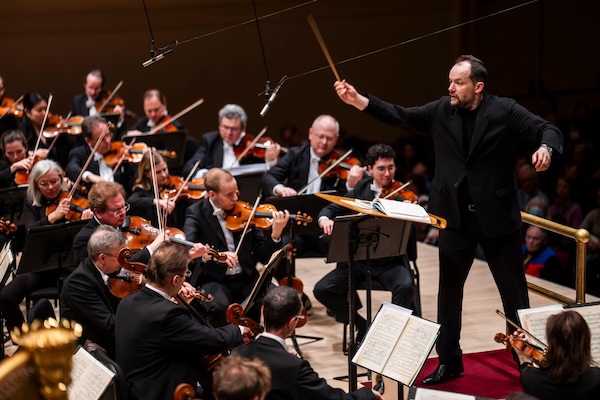
In a way, the entire evening, which also included Sibelius’s Symphony No. 2, was an affirmation of indefiniteness. Conductor Andris Nelsons shed some of the micromanaging tendencies of his earlier years, when he seemed to be cheerleading each section of the orchestra in turn, but there was nothing unclear about his intentions or his beat. And the players appeared to be mindful of him—in their own way.
There was nothing so gross as glaring errors of synchronization or intonation. But it wasn’t the watchmaker-like precision cultivated by some ensembles, either.
Make no mistake—when a superbly tuned and phrased unison line for violins was needed in the Sibelius’s first movement, it was there. But the prevailing aesthetic of the evening was a sense of collective inspiration that valued both feeling and accuracy, but feeling most of all.
The result was performances that sounded three-dimensional, the work of many hands. (I slipped and typed “peerformances” in that sentence, and I considered keeping it.) Standing up half the players for individual bows at the end, a relatively recent custom at orchestral concerts, never seemed more apt.
Of course, with Strauss’s score dividing pianissimo strings into as many as 17 parts in the early going, a certain looseness of texture might have been expected. But it seemed also that an individual freedom of attack among the players was enhancing the effect.
Later, the strings proved capable of pulling together for a superbly silky, melded sound. In fact, each section—round and gleaming brass, piquant or creamy woodwinds, vivid percussion—contributed to the sheer, unsurpassed sensuality of listening to this orchestra, whatever the details of interpretation.
Conductor Nelsons didn’t neglect those details, either. But he saw to it that the musical ideas moved along steadily, touching base with significant motives along the way, most notably the rising three notes that launched the work with its famous opening “sunrise.” The half-hour piece flowed past in what seemed like a fraction of that time.
But that flow abated long enough to savor concertmaster Rainer Honeck’s sweet confection of a violin solo in the “Dance Song.” However, the four trumpets sounded unexpectedly tentative intoning their three-note call at the beginning of the piece.
In contrast, a Baltic fog enveloped the opening pages of Sibelius’s symphony, its chugging theme a mere throb in the darkness, answered by faraway woodwind chirps. It was the sort of effect one is likely to hear only in the concert hall, as recordings and especially radio broadcasts tend to make this music sound much more “present.”
By the movement’s development section, however, that soft throb had become a pounding beat, as the orchestra’s sections eagerly interacted in a complex yet transparent texture. Elsewhere, rich double bass tone with woodwinds sparkling high above opened up wide Sibelian sonic space.
When this symphony premiered in 1903, it put some listeners in mind of the Finnish people’s struggle for independence, an impression reinforced by the melancholy, folkloric character of the slow movement, which eventually rises to a climax of almost panicky agitation. Nelsons and his players evoked these and other moods in this eventful music, amid a generally dark, sonorous atmosphere.
The scherzo was aggressively Beethovenian, as a nervous jitter of strings provoked a storm of timpani and brass. A soft, rustic trio for brass and winds gave tuneful relief before the driven scherzo returned, climbing in waves to the triumphant finale.
Thudding, tuba-reinforced chords punctuated this movement’s impassioned yet noble theme, pealed out by brass, then by ardent strings. Nelsons again dialed back to softest pianissimo, the better to build the Tchaikovsky-like stretto passages into brilliant climaxes and the symphony’s brass peroration.
The Viennese orchestra closed out this last concert in its current Carnegie Hall series the same way it did the previous two, with a fizzy waltz by Strauss—Johann Jr., that is. In their rendering of Freuet euch des Lebens, even the percussion was suave.
Carnegie Hall presents Academy of St Martin in the Fields, with music director and violinist Joshua Bell, performing works by Ives, Brahms and Robert Schumann, 8 p.m. Thursday. carnegiehall.org
Leave a Comment