Cleveland Orchestra brings daunting power, deep artistry to Mozart and Shostakovich
Some things require very little explanation or analysis, perhaps even none. A Rembrandt self-portrait, the film Casablanca, or the book The Little Prince—they are right out in the open, work perfectly, and the only secret to their extraordinary quality is the minds and skills able to make them.
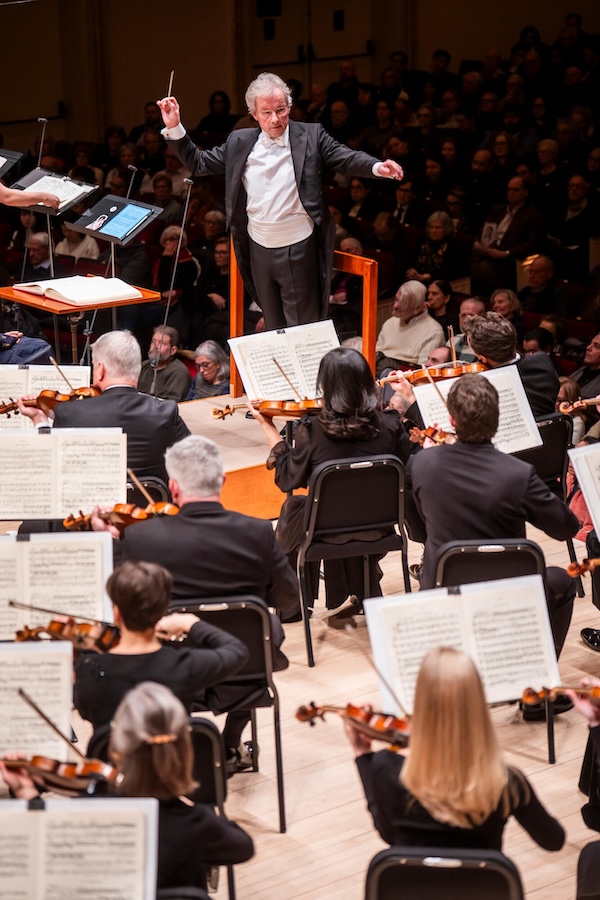
In a way, that’s all that needs to be said about Wednesday night’s concert in Carnegie Hall, where the Cleveland Orchestra under conductor Franz Welser-Möst played two of the greatest symphonies in the classical repertoire, Mozart’s “Jupiter” Symphony No. 41 and Shostakovich’s Symphony No. 11. It was an instance of a great orchestra playing great music; yet even more lies in the details—what this group did with the notes on the pages to make them sound so illuminated, meaningful, and spectacularly effective.
Cleveland is a great Mozart orchestra because they have been working on the details for decades. With a reduced chamber orchestra, this performance was packed with the most refined details. But it wasn’t precious in the least,; there was a lithe muscularity that is an often overlooked but essential part of Mozart’s music. Every bit was just a little better than the best one usually hears: violin intonation was scintillating, and the strings added tiny little expressive shapes at the end of each phrase. Welser-Mast’s tempos were so right as to be unobtrusive, and even his noticeable loping Andante felt just right for the music. The floating blend of the woodwinds and their relaxed pulse inside the rest of the ensemble were beautiful and marked Mozart’s marvelous imagination.
His final symphony is full of musical ideas that would not work in any other circumstances: phrases with odd shapes and rhythmic structure; idiosyncratic gestures like glissandos that turn out to be essential; harmonies that move in eccentric and brilliant directions. There was so much musical force behind all of this in the performance that is opened up the secrets of Mozart’s thinking, a piece that was transitional, full of new ideas like the slow quasi-ballet in the Andante cantabile and the way the themes chase and collide with each other in the vibrant finale.
Shostakovich’s Eleventh hasn’t had the reputation of other of his symphonies, like Nos. 5 and 10, but performances seem to be increasing, which is welcome because it’s probably his greatest symphony. With a lean amount of material, he spins out a powerful, wrenching musical narrative across nearly sixty minutes. Ostensibly, this tells the story of Russian soldiers massacring a crowd of peasants who came to petition the Tsar in the winter of 1905. It does this with tremendous psychological and expressive concentration, abrading tension, and wrenching drama.
This fantastic performance, attacca throughout, gave voice to Shostakovich’s unique quality, how he wrangles near-chaotic anguish and outrage through tremendous control of pace and dynamics. No one in the classical repertoire holds on to extreme quiet as well and as long as he does, and no one uses extreme contrasts in dynamics with such purpose and effect. The extended, delicate quiet of “The Public Square” had an abstract atmosphere, not landscape and snow but pure tension, while the marching fortissimos in “The 9th of January” were properly loud, setting off a smartwatch warning above 90 decibels.
Inside this was some of the finest orchestral playing one has heard, again in the details. The extended, repeated phrase in the low strings and timpani was at a slightly different pulse than the rest of the orchestra, a maniacal inevitability that underpinned even the calmest music above. In “Eternal Memory,” after the statement of the worker’s funeral march theme, the strings produced the eeriest vibrato one has ever heard, a sound that didn’t even seem acoustic.
Welser-Möst’s pace was here, also, a touch faster in general and particularly in that third movement, and it worked perfectly, even in music that is meant to sound like it’s sitting in place moving toward an unavoidable finale. He brought the antiphonal quality in the way different sections have different musical material.
One felt the profound humanity in Shostakovich, incredible tenderness in the strings, for example, after the eruption of violence in the second movement. This performance drove home the composer’s indomitable voice of outrage for people suffering from the violence and malevolence of tyranny.
The Met Orchestra, with conductor Yannick Nézet-Séguin and mezzo-soprano Isabel Leonard, perform music of Dawson, Barber, and Bernstein, 8 p.m. February 4. carnegiehall.org
3 Responses to “Cleveland Orchestra brings daunting power, deep artistry to Mozart and Shostakovich”
Leave a Comment





Posted Jan 23, 2026 at 8:18 pm by Mike Shadow
I was there and I’m maybe slightly more than a casual classical fan.
The 11th might have been the best thing I ever heard. Some parts, I was just awestruck. Maybe I should have but I really didn’t see it coming, it was so great. But that’s why we go, right?
Posted Jan 24, 2026 at 11:12 am by Gizell Larson
I was there as well and resonate entirely with Mr Grella’s commentary. I have several recordings of Shostakovich 11 and know it well . This performanc was thrilling.
Posted Jan 24, 2026 at 11:34 am by David Kozinski
The Orchestra is an absolute treasure for us back home in Cleveland! I have never been disappointed with a performance.