Russian rarities and early Schumann make lively bedfellows in Trifonov recital
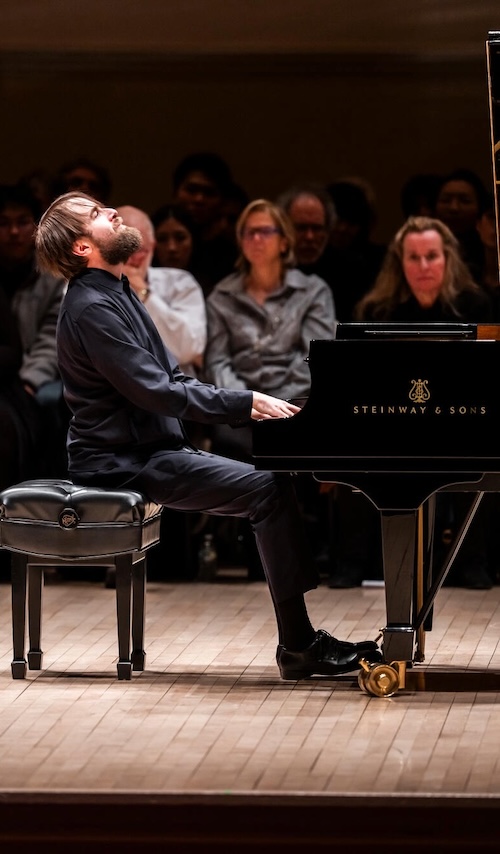
The long shadow of Beethoven may have loomed over 19th-century composers in many countries, but in Russia it was Robert Schumann, with his quirky humor and tender emotions, who became the north star. Bringing his strangely irresistible combination of volcanic energy and intimate expression back to Carnegie Hall Saturday night, Daniil Trifonov explored some lesser-known corners of the Russian piano repertoire before concluding with a volatile Schumann sonata.
Bach’s preludes and fugues have been the daily diet of musicians for generations, and inspired latter-day composers from Franck and Beach to Shostakovich and beyond to tackle the genre. Sergei Taneyev, student of Tchaikovsky and teacher of Scriabin and Rachmaninoff, was a virtuoso pianist who wrote symphonies and chamber music, but composed only one piano work that he thought highly enough of to give it an opus number: the Prelude and Fugue in G-sharp minor, Op. 29.
Trifonov led off Saturday’s program in a meditative mood with Taneyev’s prelude, sensitively phrased even as it grew to orchestral proportions. The composer was also the author of a treatise on counterpoint, and in his fugue he seemed determined to weave the strands as densely as possible, modernizing the harmonies with persistent chromaticism. The pianist exulted in this torrent of notes, culminating in the return of the prelude’s theme in triumphant chords.
Having presented this extroverted calling card, the pianist then retreated into one of Prokofiev’s most elusive works, the Visions fugitives, Op. 22. Listening to this sequence of 20 tiny pieces, averaging a minute each, was a little like hearing Chopin’s Op. 28 Preludes in one go, but without the latter’s strong contrasts of mood. Much of the music was made in the middle of the keyboard, avoiding extremes of high and low.
Bending low over the keys, Trifonov gave each piece its own microscopic character, from the poetic enigmas of the opening Lentamente to the comical toy march in No. 10, Ridicolosamente, and the terminally elusive closer, Lento irrealmente. It was a completely different calling card, from an artist exquisitely tuned to nuance.
After the Prokofiev’s pianissimo close, the pianist held the silence for a few seconds, then crashed into the grand opening chords of Nikolai Myaskovsky’s Sonata No. 2 in F-sharp minor, Op. 13. A conservatory classmate of Prokofiev and a student of Rimsky-Korsakov like Stravinsky, Myaskovsky became a prolific composer of symphonies and string quartets with a modern flavor, but not so much as to draw fire from Soviet authorities.
This 1912 piece inhabited a different sound world from Prokofiev’s Visions, and Trifonov made sure one knew that. As the bass sonorities of the Steinway concert grand built up, a listener as far back as Row T could feel the vibrations in his chest. Scales swirling like whitewater and rapid octave passages tumbled out of the pianist’s flexible hands and arms as finely phrased as if they had been written in single notes.
This sonata’s single span of 13 minutes even included references to the Dies irae chant famously used by Berlioz, Liszt and Rachmaninoff as a memento mori in their compositions, here elaborated into a climactic final fugue. And so the concert’s first half concluded with an ample demonstration of what the people in the full house and the onstage overflow seats had come to hear: jaw-dropping technical prowess placed at the service of musical communication.
After intermission, the technical thrills continued, as Schumann did not spare the horses when writing for the piano. But this composer’s inner world was just as important to him as digital dazzle, and his early Sonata No. 1 in F-sharp minor, Op. 11, opened Un poco adagio, the pianist building up layers of voices in a slightly agitated atmosphere, before the main Allegro vivace got under way.
At this point, one began to feel a disconnect between Schumann’s text and Trifonov’s approach to it. This composer’s character piece cycles like Carnaval have a subjective logic all their own, but when he updated an old form in a piece titled Sonata, he didn’t entirely abandon the idea of sonata form. The pianist’s freewheeling rubato with themes, the way he could make fast passages bubble like lava, though marvelous, eventually made one wish for something a little less molten, a sense of structure behind the inflections.
On the other hand, Trifonov’s introspective approach suited Schumann’s enigmatic tempo indication for the second movement, Senza passione, ma espressivo. His exquisite voicing of the winding melody and its gently rocking accompaniment seemed to be exactly what Schumann was talking about.
There was a sense of ironic humor to the pianist’s rendering of the robust Scherzo. After a strutting Intermezzo, Trifonov brought the scherzo section back lighter and more relaxed.
His subjective style better served the rondo finale, with its many contrasting episodes, than the first movement. His varied touch could be turbulent, heavy, sparkling, or all three at once, and his crescendos were like opening a floodgate. He toyed with the audience in the suspenseful coda before finishing hot and strong.
Acknowledging the audience’s long and loud applause, Trifonov consented to three tiny encores by Tchaikovsky: “Red Riding Hood and Wolf” from Suite from The Sleeping Beauty, and “Sweet Dreams” and “Lark Song” from Children’s Album, Op. 39. Although he kindly bowed to his admirers in the house and onstage, his impatience with this part of the evening was palpable.
Carnegie Hall presents violinists Maxim Vengerov and Vilde Frang, violist James Ehnes, cellist Daniel Müller-Schott, pianist Yefim Bronfman and clarinetist Anthony McGill in an all-Brahms program, 8 p.m. Tuesday. carnegiehall.org
Leave a Comment