Parlando explores jazz influences in classical music with mixed success
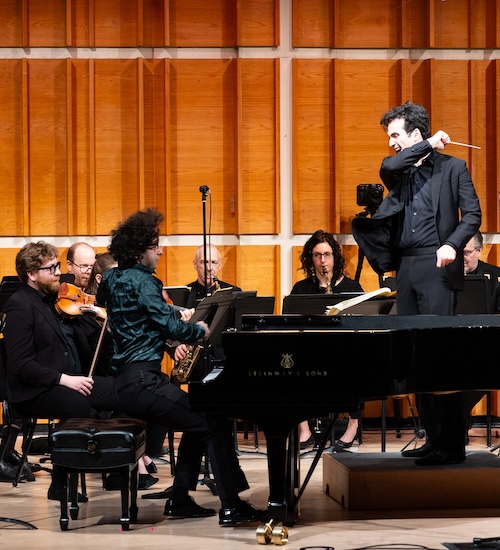
Ian Niederhoffer and his Parlando chamber orchestra are a didactic group, in the best sense. They put together concert programs to make aesthetic, historical, and philosophical points, which Niederhoffer further illuminates with remarks from the stage. That has set Parlando out from the crowd so far, and been a real success.
Saturday afternoon’s Merkin Hall concert showed the group has some limitations. The program, “Crossing Over,” was built on an awkward thematic construction that often had conductor and ensemble on shaky musical ground. To their credit, while this may not have been their most satisfying music making, it was still an enjoyable afternoon.
Much of that was due to the material: Suite for Jazz Orchestra No. 1 by Shostakovich; Nikolai Kapustin’s Piano Concerto No. 2, with soloist Maxim Lando; and the Duke Ellington/Billy Strayhorn jazz big-band arrangement of Tchaikovsky’s Nutcracker Suite.
The “Crossing Over” concept might have seemed to be about jazz qualities notated into classical music, and Parlando has already given audiences a welcome performance of Friedrich Gulda’s Concerto for Cello and Wind Orchestra. But the idea was more about how jazz flavors found their way into Soviet musical life. It’s a fascinating and complex subject, and there was no way to get at it in depth in just two pieces. Niederhoffer’s introductions gave a rough explanation, with further comments about Ellington and jazz in 1960—when the Nutcracker arrangement was made—that weren’t wrong in general terms but also weren’t quite right. And what that music had to do with the topic was Tchaikovsky’s nationality.
The playing was pretty much on the level of those explanations, sincere but cursory. The conductor did make the useful point that Shostakovich and Kapustin weren’t really composing jazz, and that music that American military bands—like the important one James Reese Europe led from the Harlem Hellfighters—who brought popular music across the Atlantic in World War I, weren’t quite playing jazz. It was more “hot” dance and rags and Tin Pan Alley tunes.
This quasi-jazz made its way by heresay to Shostakovich, who wrote three dance tunes—a Waltz, Polka, and Foxtrot—for a ensemble of brass, saxophones, a violin, a rhythm section that includes a banjo, and a slack-key guitarist. An angular, colorful two-dimensional version of jazz, this suite is more like Kurt Weill’s 1930s music than anything else, and needs that spirit and a light-footed, clearly articulated sardonic feel, like one gets from Max Raabe and the Palast Orchestra. This performance had a nice instrumental balance, but rhythms and phrases were a bit sluggish, with conductor and musicians just a bit too careful with their playing.
Kapustin was from the generation after Shostakovich. A huge jazz fan and a fine pianist, he was upfront about wanting to compose jazz flavored music but never claimed to be a jazz musician.
Kapustin’s Piano Concerto No. 2 is a zany hybrid of his typical style—technically demanding keyboard writing yet full of fun, showy flourishes. The music carries ideas about glamor and showmanship very much of the early ‘70s, but despite edging into Liberace territory at times it avoids kitsch. A central part of that is the other music Kapustin channels, like Gershwin and his beloved Oscar Peterson. One wonders why Lang Lang has not tackled this repertoire.
In his place, Lando showed terrific chops and massive enthusiasm. This was an excellent approach to Kapustin, often close to flying off the handle, though always in the direction of the music. There was the exciting feeling he was bursting through. The problem was a mismatch between him and the orchestra, especially a rhythm section that could not stay in sync with the soloist and a middle movement where no one seemed to grasp a samba feel.
Lando came back out to deliver an encore, his own transcription of the Waltz No. 2 from Shostakovich’s Second Jazz Suite.
The challenge of playing the Ellington/Strayhorn Nutcracker Suite is that it’s Ellington. He didn’t write and arrange music as an abstract thing, he used the musical personalities of his musicians as material. In 1960, that included figures like Ray Nance and Johnny Hodges, some of the most stylish instrumental voices ever. A group like the Jazz at Lincoln Center Orchestra can get close to this, but transformed into a jazz big band, Parlando wasn’t right.
There were capable solos, especially in the Entr’acte, and a nice brassy sound. But that was also monochromatic, and rhythms and phases were never properly on top of the beat, the guitar/piano/bass/drums often in a different place on the pulse then the rest of the band.
But there was a scene-stealing, game-saving bonus: for the finale, the reprise of the “Peanut Butter Brigade” section, the conductor’s dancer-choreographer sister, Gabrielle Niederhoffer, came out for a lively tap dance solo on the music, a classic happy feet ending.
Parlando plays Georg Friedrich Haas’ in vain, 3 p.m., Sunday, February 22, 2026. parlandonyc.org
Leave a Comment