Met’s holiday “Magic Flute” refreshes the seasonal spirit
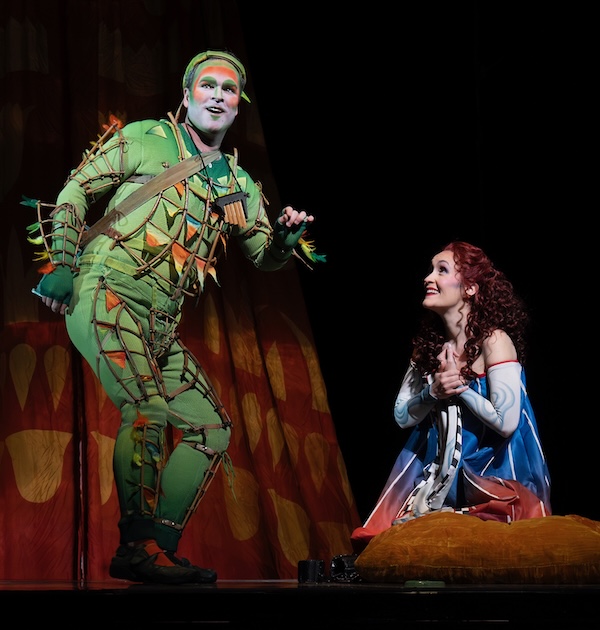
This is the time of the year for familiar comforts, and at the Metropolitan Opera that means the holiday version of Mozart’s Die Zauberflöte. This Magic Flute reduces the original and compresses the two Acts into one continuous ninety minute performance, with an English vernacular translation of the libretto by poet J.D. McClatchy.
An alternate version, but by no means an inferior one. The staging uses Julie Taymor’s production, which is superb and, in Thursday night’s opening, seemed refreshed. Perhaps consistent experience with this through the years has followed the transformation of initial surprise and delight to familiarity and back out again to find new pleasures in the details of the puppetry, the dancing bears and storks, the floating foodstuffs, the symbolic costumes.
On top of that was a predictably excellent cast (the first of two in this extensive run): tenor Joshua Blue as Tamino, baritone Joshua Hopkins as Papageno, soprano Erin Morley as Pamina, and soprano Aigul Khismatullina as the Queen of the Night.
Those are fine, experienced Mozart singers, with Khismatullina developing a career in the role. Despite the reductions of the score, Mozart’s marvelous music is still at the core. Cutting down means Papageno is perhaps the most prominent role, ideal for a version meant for families—and there were plenty of children in the attendance opening night, clearly wrapped up in the evening (a couple infants apart). Hopkins clearly enjoys himself in this situation, and his return in the role was welcome.
Morley had a lovely sound, delicate but full and shining. The aria “I feel it’s gone” (originally “Ach, ich fühl’s, es ist verschwunden”) is the strongest dramatic moment in this version, and her gorgeous, long phrases were captivating. Blue had equal clarity and a fine youthfulness as Tamino, his energy and the new proportions in this score had the interesting effect of placing him, not Morley, in the ingénue role.
Khismatullina wasn’t as consistent as the others opening night. She sang with easy power and fine diction, but her technique wasn’t completely secure in the most challenging parts of her two arias. In both, she pulled back on her tempo to carefully step through her articulation of the fast runs, setting a wobbly relationship with conductor Erina Yashima, who led the orchestra with verve in her Met debut. Khismatullina couldn’t manage the high F in “Oh, don’t tremble,” but did get there in “Hell’s vengeance,” if slightly out of tune.
Another character more prominent in this version is Sarastro, sung by bass Matthew Rose. He was fantastic, the night’s vocal star. There was a wonderful earthiness to his voice, not just the size and range required, but a feeling of mass without heaviness, a nice grain and a close-to-conversational ease. One eagerly awaited each vocal appearance.
There were no weak links in the rest of the cast. The three ladies featured the debut of mezzo-soprano Emily Treigle, along with mezzo Daryl Freedman and Kathleen O’Mara, and beyond the lovely singing their characterizations were vivid, making the most out of the parts.
Tenor Zhengyi Bai was terrific in his own debut as Monastatos, with a loose and comical manner and a strong, easy voice. Bass-baritone Le Bu’s precise phrasing as the Speaker was ideal, and the three Spirits (Nico Hwang, Deven Ange, and Ori Wosner) had a nice, piping blend. Soprano Maureen McKay was clearly enjoying herself as much as Hopkins as Papagena.
Many voices, lots happening on stage, beautiful music and sets. Welcome back, Magic Flute.
The Magic Flute runs through January 3, 2026. The opening night cast alternates with Paul Appleby, Michael Sumuel, Joélle Harvey, and Rainelle Krause, with conductor Steven White. metopera.org
Leave a Comment