Groissböck brings intimacy and intensity to lieder recital at Zankel Hall
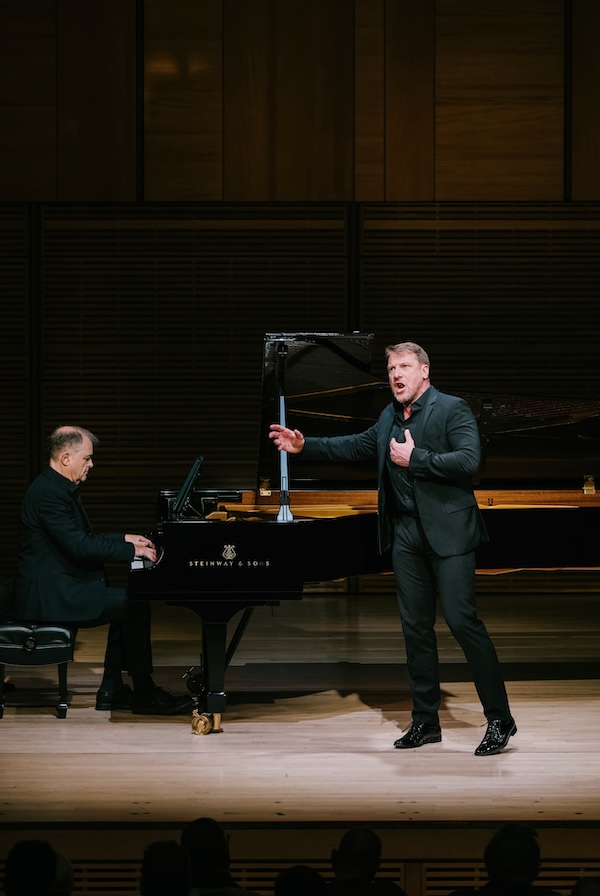
Günther Groissböck is known to New York audiences from his appearances at the Metropolitan Opera. Since his debut as Colline in La Bohème in 2010, the Austrian bass has appeared in Verdi, Wagner, and Strauss, practically owning the role of Baron Ochs in Der Rosenkavalier there and at opera houses around the world.
On Sunday afternoon at Zankel Hall, Groissböck revealed a more intimate, if no less dramatic, aspect of his artistry in a lieder recital with pianist Julius Drake.
Groissböck is cut from the old-school model of song recitalists. His facial expressions and body movements can be both galvanizing and disconcerting in their intensity. Foremost, however, is his immaculate diction and the ability to paint the emotions of his song through vocal color and dynamics.
Although it wasn’t announced, Groissböck was under the weather, clearly suffering from some respiratory distress. In the repertoire he programmed, it mattered little, given the narrative nature of many of the songs. Under different circumstances, there might have been a little less gravel in the lower ranges of his voice and top notes that rang more brilliantly.
Groissböck opened with four of Schumann’s evocative, narrative-driven ballades. The first was “Blondel’s Lied”, which tells of a minstrel searching for the imprisoned King Richard the Lionheart. It was a vehicle for Groissböck to display his talent for delineating character and mood, as well as his superb, elegant diction. The song gave Drake ample berth to do the same in the song’s interlude and postlude, with playing full of intensity and color.
In “Belsatzar,” Groissböck instilled terror into the story of the Old Testament king for whom retribution comes fast after he blasphemes against God. Singer and pianist slowly instilled tension in the narrative, which Groissböck released in a tremendous growl when the king gave voice to his scorn. Groissböck’s face reflected the terror of witnessing the mysterious fiery handwriting on the wall.
Even finer was Groissböck and Drake’s “Die beiden Grenadiere,” the final of the four Schumann songs. The singer vividly related the despair of two French soldiers returning from Russia, lamenting France’s defeat and Napoleon’s capture. The singer’s voice soared grandly while one soldier envisioned the Emperor passing over his grave, but collapsed in anguish at the reality of his fate. Drake propelled the story forward with his expert timing and rhythmic incisiveness, especially in the song’s march-like passages.
The Austrian singer championed songs by two compatriot composers seldom, if ever, encountered in live performance. The first was Hans Rott, whose musical genius attracted the attention of Bruckner and Mahler, but whose short life was plagued by mental illness. “Der Sänger” was in the narrative mold of the Schumann songs, but remarkable for the piano accompaniment, especially the swirling, kaleidoscopic interludes.
Despite its title, “Geistesgruß”, or “Ghost’s Greetings,” was the first change of mood in the recital. Groissböck’s voice warmed singing of a knight recalled his full life, but who was now content to rest for eternity in tranquillity. The song ends with a moving postlude, which under Drake’s touch resounded with profound richness and depth.
In the final Rott song, a setting of Goethe’s “Wanderers Nachtlied,” Groissböck’s bass opened un and became clearer. In contrast to Schubert’s setting of the poem, Rott painted the wanderer’s yearning for rest in long lines, which Groissböck spun in a seamless legato, exhaling the final words of comfort in one long sigh.
Bruckner’s province was monumental symphonies blending hhis deep Catholic faith with Wagnerian drama. In his short choral pieces, he achieved the same blend of rich Romantic harmony, strong polyphony, and deep spirituality. He didn’t strive for or reach such heights in the few solo songs he composed.
Groissböck obviously programmed three Bruckner songs as curiosities and for the suprising emotional contrast they gave to the prevailing somber mood of the earlier songs. “Im April” was light and lyrical, affording Groissböck the first opportunity to indulge in displaying the smooth resonance of his voice, while the final one, “Mein Herz und deine Stimme,” was bathed in its warmth and richness.
The first half concluded with Wolf’s Drei Gedichte von Michelangelo. Wolf’s life was cut short by physical and mental illnesses, but his songs are the perfect blend of music and text. In the three poems, Michelangelo conveyed his spiritual and emotional struggles, inspiring Wolf to create meaningful, deeply personal, and introspective songs. Groissböck immersed himself in those emotional waters but also discovered the triumph built into them.
The first song, “Wohl denk ich oft,” was one long crescendo, which began introspectively but culminated in exaltation for having risen from the masses of humanity to bearing a name known by all. “Alles endet, was entstehet” was etched with crystalline precision and depth of emotion. In the final song, “Fühlt meine Seele,” Groissböck’s voice rang out full-voiced when singing of the artist’s yearning to understand how he obtained his gifts. In the postlude, Drake summed up the entire emotional tumult of the three songs with sensitivity and depth.
Groissböck opened the second half of the recital with four of Strauss’s greatest and most popular songs. Unfortunately, these suffered form the most from Groissböck’s indisposition.
If “Heimliche Aufforderung”failed to take flight,“Zueignung” rang out with force, as did his rather stentorian “Breit’ über mein Haupt.” In “Allerseelen,” his voice relaxed and warmed, recalling the bittersweet memories of a past May when love bloomed.
The four songs from Mahler’s Des Knaben Wunderhorn proved far more congenial for Groissböck. They were also a return to the narrative style of the Schumann ballades, which serves him so well, as well as martial themes. Of the three, “Zu Strasburg auf der Schanz,” “Der Tambourgesell,” and “Revelge,” it was the final song, evocative of Schumann’s “Die beiden Grenadiere,” which found the artists at their best. Although Groissböck’s doomed drummer boy, standing stock still at the end of “Der Tambourgesell,” was an unforgettable image
As in the Schumann, Groissböck painted the cruel fortunes of a wounded soldier, who pleads with his comrades to rescue him, but is left to die with a detached incisiveness that heightened the horror. Drake underscored the emotional impact with playing that sounded like bullets firing and brittle marches, which seethed with irony. There was no triumph in “Revelge,” as in the rousing strains of “La Marseillaise “in the Schumann, only despair in the song’s final ghostly moments.
Melody supplanted declamation in the final song, “Urlicht.” Mahler’s sublime expression of faith that God will ease man’s suffering in eternal life. Groissböck expressed the song’s arc of emotion, which spans from despair to hope, with his singular blend of introspection and eloquence. Its final measures found him again standing erect with his eyes raised to heaven.
In announcing the sole encore, Drake said of the many recitals he had performed with Groissböck, this was the only one without Schubert songs. “An die Musik” rectified the omission nicely.
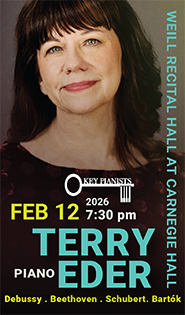
Soprano Axelle Fanyo and pianist Julius Drake perform Schoenberg, Cage, Messiaen, and Bolcom, January 28, 7:30 p.m. at Weill Recital Hall. carnegiehall.org
Leave a Comment