A fresh First Symphony highlights COE’s Brahms program with Nézet-Séguin
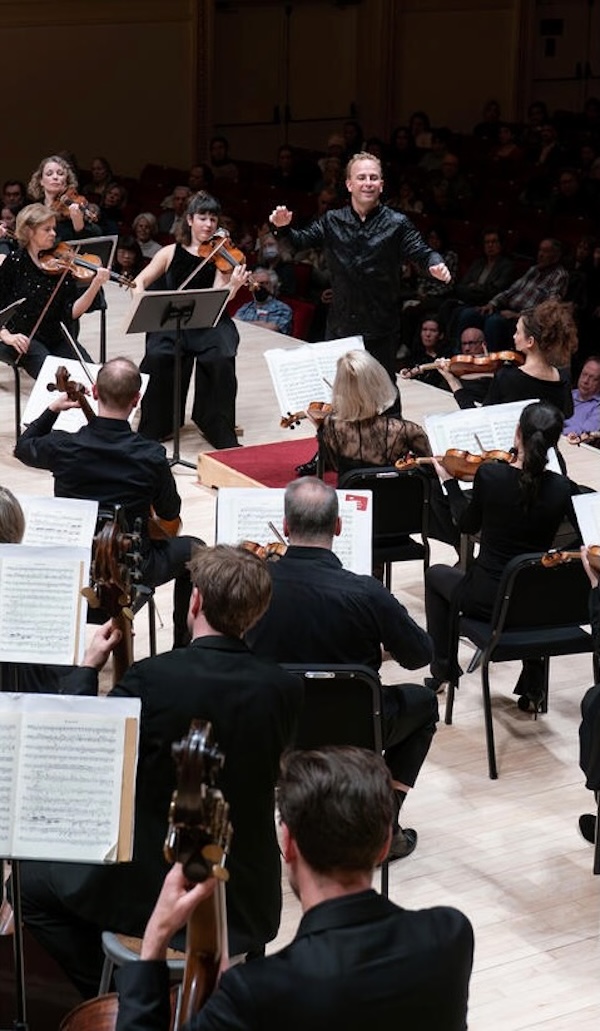
Tuesday night’s concert in Isaac Stern Auditorium in Carnegie Hall was a throwback affair. The Chamber Orchestra of Europe was on stage, led by conductor and honorary member Yannick Nézet-Séguin, and the program was not only all 19ᵗʰ century music but all Brahms: the Tragic Overture; the Double Concerto for Violin and Cello in A minor—with violinist Veronika Eberle and cellist Jean-Guihen Queyras—and after intermission, Symphony No. 1.
Leading musicians playing popular classics is the cliche of classical music in the general culture, and why some still see it as stodgy and uninteresting. Though there was a decent-sized crowd, there were more empty seats than usual. Those in attendance heard often skillful renditions of Brahms’ scores, but also had some bad old tendencies of too much deference to the past, and not just in the programming.
One of the best features of Tuesday’s music-making was the old-fashioned layout of the orchestra. With the violins divided and cellos, basses, and violas in the middle, they had an outsized weight and punch to their sound. With this, the opening two chords of the Tragic Overture were scintillating.
This quality meant the orchestra could produce expressive emphasis without leaning too heavily on accents, a key in the Overture and the whole concert. Nézet-Séguin can often press his ideas into mannerism, but with the internal fullness of the orchestra sound, the balance of this came off as taking care with phrases rhythms. Tempos were splendid throughout, and each modulation was in ideal proportion to the preceding and following ones.
In the Overture, that made for a deep feeling of drama, with an invigorating, dark ominousness that seemed more specific than the generic idea of tragedy. The tempos gave the music an effective shape.
The Double Concerto is one of those pieces accepted as canonic—because it is well-known Brahms—but isn’t one of the composer’s best pieces. The first movement in particular jumps back and forth between a logical, expressive long line and quilted pastiches of Brahms’ own common techniques and phases. It also suffers from some ordinary thematic material that Brahms forces through standard development that can’t quite redeem it.
The main result is an inconsistent tone between public expression in the orchestra and the sound of Brahms communicating only with himself through the soloists—even though there is plenty of material that passes between the two groups, the latter can seem to be playing only for each other.
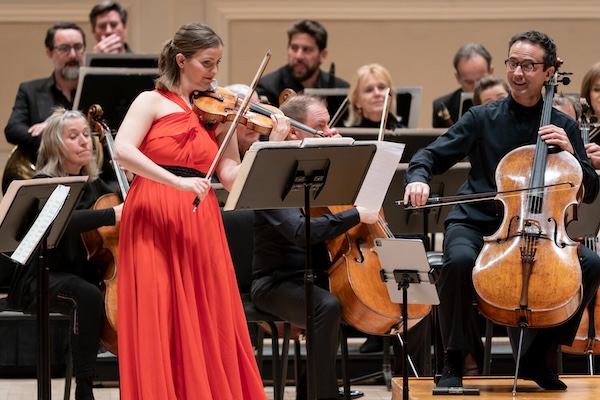
That’s what Eberle and Queyras did Tuesday night, too much so in the first movement. Their tones—Eberle slender and shining, Queyras sinewy and sweet—separated them from the ensemble, but so did their expressive purpose. It made for an argumentative flow.
The middle Andante is more coherent and polished compositionally, and so was the performance. This had a feeling of true ensemble, orchestra, conductor, and soloists making music together. It was full of Brahms’ unique mellow richness. The final movement had the best playing in the piece, lively and with a nice rhythmic touch from the orchestra. With the odd-man-out first movement, though, the whole experience felt unbalanced.
The First Symphony was the best event of the night, a truly superb performance that was an example of how clear thinking and high-level musicianship can refresh even the most familiar work. Nézet-Séguin’s pace was excellent from the very start, with a constant forward flow that carried great expression and never got too massive. The playing showed an organic view of the music that sidestepped the usual effortful feeling in the first and last movement and managed to produce an unexpected naturalness.
That fine pace in the first movement had one wishing for a slightly faster tempo than usual in the Andante—this was the one movement where the performance seems too conformist. It was satisfying but also felt like a missed opportunity.
The liquid flow returned in the third movement, and the finale, often portentous and overblown, was marvelous. This was the first time one has heard this piece without hearing the obvious derivation of the theme from Beethoven’s Ninth. That was how organic this performance was, everything seemed like Brahms, and if the music referred to something else, well, that was just the composer’s memory working within and produce something in his own voice.
If there’s one definition of what makes classical music relevant to contemporary life, it is that. But we need this all through a concert, and in all concerts.
The Cleveland Orchestra, with conductor Franz Welser-Möst, the Cleveland Orchestra Chorus and vocal soloists perform Verdi’s Requiem, 8 p.m., January 20, 2026. carnegiehall.org
Leave a Comment