The Sebastians conjure up a multimedia music world with “Handel’s London”
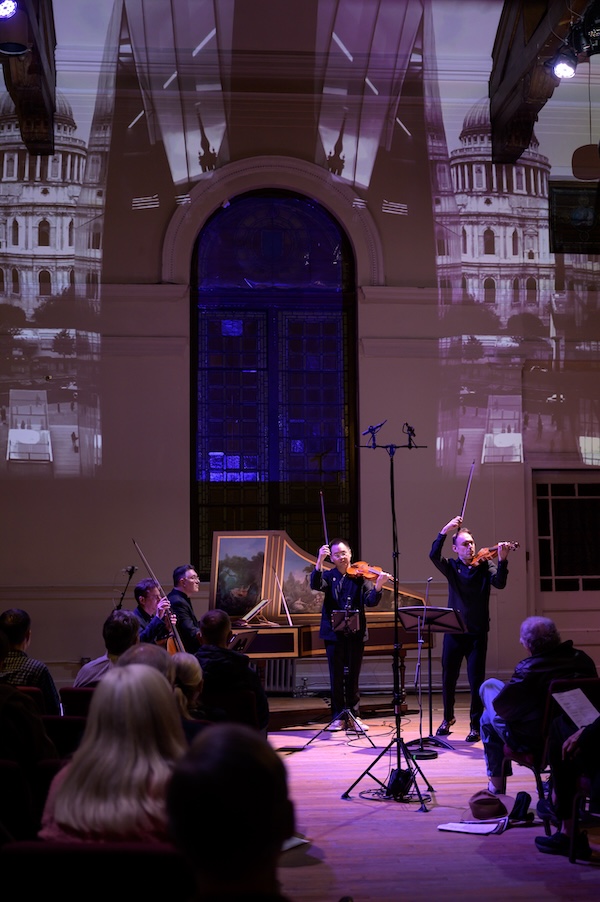
Handel’s London–the phrase conjures images of teeming streets, crowded theaters and concert rooms, vigorous debates over coffee, and, looming over it all, the spires and domes of the city’s great neoclassical buildings.
The Sebastians, a period-instruments foursome devoted to the rich literature of the Baroque trio sonata—yes, it takes four musicians to play a trio sonata, don’t ask—ventured far beyond their core repertoire Saturday afternoon at Good Shepherd-Faith Presbyterian Church, to sketch a musical portrait of the English capital in ten brief selections, lasting a little over an hour and titled, of course, “Handel’s London.”
Hannah Fox, a Brooklyn-based artist and VJ, worked with historic preservationist Emily Gee to produce the concert’s visual backdrop, projections of the city’s architectural treasures in old drawings and their present-day settings.
The dome of Saint Paul’s glimpsed down a modern glass-lined alley provided a subtle visual comment on the enterprise of trying to conjure an 18th-century sound world in the 21st.
Immediately adjacent to Lincoln Center, and lately hosting a variety of not-ready-for-prime-time musical events, the church’s well-worn interior was itself a time trip back more than a hundred years. However, the forest of microphones positioned (and re-positioned) to capture the event were of the latest vintage.
The lean, silvery sound of Baroque violins, in rapid-fire dialogue or swooping phrases, is unlike anything else in music. The Sebastians’ Nicholas DiEugenio and Daniel Lee combined expertly to highlight moods from aching pathos to sparking comedy.
A characterful basso continuo—the other “third” of the trio sonata—was ably supplied by violoncellist Ezra Seltzer and harpsichordist Jeffrey Grossman.
The concert’s parade of composers was led by its grand marshal, George Frideric Handel, with a typical musical product of the time, the Overture to his opera Rodelinda arranged for small home ensemble. This zesty little suite probably sold some tickets to the show, as original-cast albums do today.
The immigrant Handel, a Saxon trained in Italy, dominated the musical skyline as surely as St. Paul’s dome did the city’s. William Boyce adopted Handel’s style, with an overlay of British reticence, in his Trio Sonata No. 1 in A minor. Violinists DiEugenio and Lee excelled in the imitation and echo effects of the central fugue and closing allegro.
William Babell, a tireless inventor of virtuoso effects on the harpsichord, was to Handel’s operas what Franz Liszt was to Bellini’s and Donizetti’s—and just as controversial. On Saturday, as harpsichordist Grossman swung into the most extravagant passages of Babell’s improvisation on “Vo’ far guerra” from Handel’s Rinaldo, a police cruiser came down West 66th Street with lights and siren blaring—either a strangely appropriate collaborator or an officer dispatched to put a stop to this loud party. In any case, a hard-working Grossman triumphed in the end.
After this keyboard foofooraw, the humor of Johann Christoph Pepusch’s The Beggar’s Opera came across as mild. And yet this 1728 show, which satirized Italian opera and Handel by name, became a bigger hit than any of Handel’s operas. Saturday’s selection of excerpts, agreeably rendered by The Sebastians, consisted of a sort-of-French overture and four folksy airs.
For more echt Handel, there was the Passacaille from the Trio Sonata in G major, Op. 5, no. 4, its theme gently lifted by Seltzer’s light touch on the violoncello. Running and sighing variations showed Handel’s mastery at creating a mood in a few bars. The violinists phrased in near-perfect accord.
The pseudonymous composer “Mrs. Philharmonica” published a set of intriguing trio sonatas in 1715, then vanished from the scene. Even the U.K.-published, 27-volume New Grove has no entry on her/him. And yet a distinct, Jane Austen-like musical personality—a piquant wit, and a taste for harmonic clashes in closely-spaced string writing—emanated from her trio Sonata No. 1 in F major, as rendered by The Sebastians in appropriately shadowy tones, given her unparallelled obscurity.
If Handel was a hybrid Saxon-Italian-English presence, there was no such ambiguity about two Italian immigrants to London, Pietro Castrucci and Francesco Geminiani, whose passionate stylings were prized imported goods. The former’s Violin Sonata No. 5 in B-flat major featured violinist DiEugenio projecting a flowing Adagio, a fiery Allegro, and a “Venetian” Allegro with Vivaldi-like choppy phrases.
Geminiani’s Sonata in F major, Op. 5, No. 5 was billed as for Violoncello and Basso Continuo, but in fact sounded more like an unaccompanied piece, with Seltzer’s cello filling in most of the bass notes and harmonies with arpeggios and double stops while Grossman’s harpsichord played discreetly in the background. Amid it all, Seltzer artfully characterized the opening Adagio monologue, a vigorous Allegro, a florid Adagio aria, and a final Allegro in dancing 6/8 time. (During this piece, interestingly, trees and dappled shade in a London park were projected instead of monumental buildings.)
Handel’s friend and mentor in Italy, Arcangelo Corelli, was the epitome of refined Italian style in his Trio Sonata in G major, Op. 2, No. 12, a Ciacona with a bit of Handelian bounce to it. Then, just for maximum contrast, the concert closed with a trio-sonata arrangement of the biggest hit aria of them all, the robust “Rule, Britannia” from Thomas Arne’s Alfred.
The Sebastians will perform Bach’s Brandenburg Concertos, 5 p.m. March 22, 2026 at Good Shepherd-Faith Presbyterian Church. sebastians.org
Leave a Comment